



Lung Cancer
Latest News
Advertisement
Latest Videos
CME Content































Advertisement
More News

Perioperative nivolumab plus chemotherapy was approved by the European Commission for use in resectable PD-L1–positive non–small cell lung cancer.
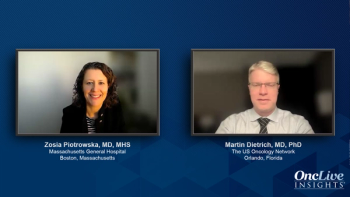
Panelists discuss how many patients never receive second-line therapy, emphasizing the critical importance of selecting the optimal first-line treatment and monitoring patients closely to identify progression early.
Panelists discuss how subsequent therapy after initial disease progression should consider patient symptomatology, biomarker testing through tissue or liquid biopsies, and potential treatment options including MET-targeted approaches or chemotherapy combinations.

First-Line Eftilagimod Alpha Plus Pembrolizumab/Chemo Yields Responses in Advanced Nonsquamous NSCLC
First-line eftilagimod alpha plus pembrolizumab and chemotherapy produced responses in advanced nonsquamous non–small cell lung cancer.

The FDA has approved the VENTANA MET (SP44) RxDx Assay as a companion diagnostic for telisotuzumab vedotin in non–small cell lung cancer.
Ahead of the 2025 ASCO Annual Meeting, lung cancer experts highlight the abstracts and related trials they’re looking forward to seeing at the meeting.
The FDA approved telisotuzumab vedotin for pretreated advanced NSCLC harboring high c-MET protein overexpression.

The novel injectable radiotherapy 186RNL showed safety and clinical activity as treatment for patients with leptomeningeal metastases.
Panelists discuss how medical professionals are integrating targeted therapies, such as those for EGFR, ALK, and other mutations like RET and ROS1, into the treatment of resectable early-stage non–small cell lung cancer (NSCLC), with a focus on incorporating the ADAURA and ALINA regimens into clinical practice.
Panelists discuss how medical professionals identify patients who should receive neoadjuvant immune checkpoint inhibitors (ICI) before surgery based on tumor characteristics, patient health, and treatment response, and how factors such as surgical outcomes, recurrence risk, and molecular markers guide decisions on the need for additional adjuvant therapy post surgery.
Alberto Chiappori, MD, discusses the inclusion of patients with CNS metastases in the eXALT3 trial of ensartinib in ALK-positive NSCLC.
Belrestotug plus dostarlimab did not improve PFS vs dostarlimab monotherapy in PD-L1–high NSCLC, supporting the termination of belrestotug development.
Joseph C. Murray, MD, PhD, discusses the safety profiles of encorafenib/binimetinib and dabrafenib/trametinib in patients with BRAF V600E–mutant NSCLC.

The top 5 OncLive videos of the week cover insights in myelodysplastic syndrome, lung cancer, hepatocellular carcinoma, colorectal cancer, and ovarian cancer.
A doublet is approved for KRAS-mutated ovarian cancer, T-DXd followed by THP improves pCR rates in HER2+ breast cancer, and more from OncLive.

Poll results highlighted key lung cancer abstracts of interest from the upcoming ASCO Annual Meeting on OncLive’s social media.
Panelists discuss how quality of life considerations, including prophylactic medications to prevent dermatologic toxicities and infusion-related reactions, are crucial when implementing EGFR-targeted therapies, especially the MARIPOSA regimen.

SOC Encorafenib/Binimetinib Sets a Precedent for Therapeutic Improvements in BRAF V600E–Mutant NSCLC
Joseph C. Murray, MD, highlights positive treatment shifts that have shaped the BRAF V600E–mutant non–small cell lung cancer treatment paradigm.
Panelists discuss how the overall survival benefit from the MARIPOSA regimen (amivantamab plus lazertinib) with a hazard ratio of 0.75 and projected survival improvement exceeding 1 year represents a significant advancement that must be weighed against toxicity concerns.
New lung cancer treatment options have emerged, and several groups are exploring treatment strategies that omit chemotherapy for locally advanced NSCLC.
In a 3-part series, Evan S. Wu, MD, PhD, will explore key issues surrounding the translatability of Chinese drug development data to a US population.
OncLive announces the inductees of the 13th annual Giants of Cancer Care recognition program.
Panelists discuss how the latest efficacy and safety data from AEGEAN, CheckMate 816, CheckMate 77T, and KEYNOTE-671, along with recent approvals in early-stage non–small cell lung cancer (NSCLC) treatment, are shaping optimized treatment approaches and influencing clinical practice.
Panelists discuss how a multidisciplinary team—including oncologists, thoracic surgeons, radiologists, and pathologists—collaborates to streamline the diagnostic process for patients with resectable non–small cell lung cancer (NSCLC), ensuring timely evaluation, accurate staging, and personalized treatment planning.
Advertisement
Advertisement
Trending on OncLive
1
Single-Center, Retrospective Data Show Low Rate of Lifileucel Infusion Following Referral in Advanced Melanoma
2
Long-Term Cilta-Cel Data Show Low Rates of PFS Events in Standard-Risk R/R Myeloma
3
Real-World Data Support Clinical Benefit With Lifileucel in Previously Treated Advanced Melanoma
4
Dr Riedell on the Long-Term Efficacy of Tisa-Cel in R/R Follicular Lymphoma
5