
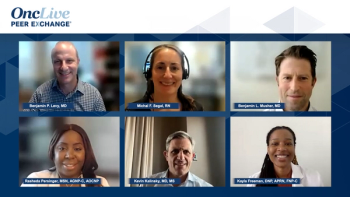
The expert panel discusses the history of antibody-drug conjugates and explores their mechanisms of action.

Your AI-Trained Oncology Knowledge Connection!
The expert panel discusses the history of antibody-drug conjugates and explores their mechanisms of action.
A panel of cancer-treating specialists introduce the discussion with a broad overview of antibody-drug conjugates (ADCs).

Saad Z. Usmani, MD, MBA, FACP, discusses key points from his presentation at the 2023 SOHO Annual Meeting on frontline treatment of patients with high-risk myeloma, including the characteristics of patients with disease at high risk of recurrence, current treatment approaches, and ongoing research aiming to address unmet needs for this subset of patients.

Ezra Rosen, MD, PhD, highlights the early-phase investigation of zotatifin in estrogen receptor-positive metastatic breast cancer, explains the agent’s unique mechanism of action as well as its efficacy and safety in a heavily pretreated population, and underscores the need for improved sequencing of the myriad of treatment options in the post–CDK4/6 inhibitor space.
Saad Z. Usmani, MD, MBA, FACP, discusses unmet needs in patients with high-risk multiple myeloma being treated in the frontline setting, highlighting areas of potential further exploration within this landscape.

Dazhi Liu, PharmD, MS, BCOP, discusses findings from a real-world analysis of the frequency of ERBB2 and ERBB3 alterations in patients with non–small cell lung cancer and the efficacy of liquid vs tissue biopsies for detecting these alterations.
Saad Z. Usmani, MD, MBA, FACP, discusses methods for identifying patients with high-risk multiple myeloma and notable disease characteristics in this population.

Patritumab deruxtecan displayed clinically meaningful and durable efficacy in patients with advanced EGFR-mutated non–small cell lung cancer who experienced progression following treatment with an EGFR-directed TKI and platinum-based chemotherapy.

A predictive system developed using data from United States and European stem cell transplant registries was prognostic of survival in patients with myelofibrosis undergoing allogeneic hematopoietic cell transplantation.
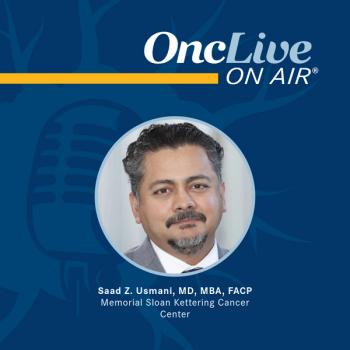
Dr Usmani discusses the integration of elranatamab, talquetamab, and telcistamab into the management of relapsed/refractory multiple myeloma, common adverse effects and recommended supportive care measures, and ongoing research that may help clarify their role in the paradigm.

Prioty Islam, MD, MSc, discusses the current status of the first-generation BTK inhibitor ibrutinib following the FDA approvals of next-generation BTK inhibitors in patients with chronic lymphocytic leukemia and expands on the few instances in the clinic where she may lean toward treatment with ibrutinib instead of the next-generation BTK inhibitors zanubrutinib or acalabrutinib.
Prioty Islam, MD, MSc, discusses the exploration of novel roles for BTK inhibitors in the treatment of patients with mantle cell lymphoma and chronic lymphocytic leukemia.
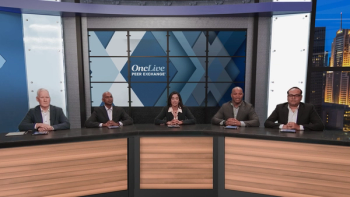
The expert panel discusses ongoing research and offers closing thoughts on the future of HR+/HER2- breast cancer treatment.
Panelists share clinical insight into how to approach treatment selection among ADCs in HR+/HER2- metastatic breast cancer both now and in the future, given the currently available options and additional ADCs in development.
Individualized myelofibrosis treatment begins with correctly identifying a patient’s disease subtype and considering their symptoms, from which accurate decisions regarding the use of JAK inhibitors vs radiation vs hypomethylating agents can lead to spleen and symptom burden reductions.
Prioty Islam, MD, MSc, discusses how the FDA approval of the noncovalent BTK inhibitor pirtobrutinib has transformed the treatment of patients with mantle cell lymphoma, and where this agent fits in to the current treatment armamentarium.

Deb Schrag, MD, MPH, discusses the rationale for exploring the use of selective preoperative chemoradiation in patients with locally advanced rectal cancer, the safety and efficacy findings from the PROSPECT trial, and the importance of reviewing patient-reported outcomes during clinical trials.
Dr Gadi discusses recent data updates on the TROP-2–directed antibody-drug conjugate (ADC) sacituzumab govitecan (SG), including analyses performed in patients with HER2-low disease.
Experts on HR+/HER2- breast cancer discuss biomarker testing approaches, including sampling considerations and timing of testing.

Helena A. Yu, MD, discusses the investigation of BL-B01D1 in patients with advanced solid tumors, the potential significance of this research for those with EGFR-mutant and wild-type disease, and the expanding body of evidence supporting continued antibody-drug conjugate development in non–small cell lung cancer.
Dr Vidal expands on use of PI3K/AKT/mTOR pathway inhibitors following frontline progression, focusing on the PI3K inhibitor alpelisib for patients with PIK3CA mutations, as well as capivasertib, an AKT inhibitor in development.
A focused discussion on trials that may address disease progression on first-line therapy, including those on ET and CDK4/6 inhibitor rechallenge and novel combination strategies.

Prioty Islam, MD, MSc, discusses the impact of the updated safety and efficacy data seen with FDA-approved BTK inhibitors in patients with chronic lymphocytic leukemia.

Prioty Islam, MD, MSc, reviews the benefits of using covalent BTK inhibitors in CLL and MCL; considerations for choosing first-generation vs next-generation covalent BTK inhibitors in patients with these B-cell malignancies; and the potential future role for ibrutinib in the CLL treatment paradigm.

Prioty Islam, MD, MSc, discusses findings from the BRUIN trial, highlights the potential benefits of using noncovalent BTK inhibitors instead of or before covalent BTK inhibitors in patients with MCL or CLL, and previewed ongoing clinical trials investigating this class of agents in earlier treatment lines in these populations.
Prioty Islam, MD, MSc, discusses the importance of shared decision making between patients and clinicians when selecting among available BTK inhibitors in the treatment of chronic lymphocytic leukemia or mantle cell lymphoma.
Experts share how they approach management of patients with disease progression on first-line endocrine therapy, with a focus on ESR1 mutation testing and identifying who might be suitable for treatment with the oral SERD elacestrant.
Timothy Pluard, MD, discusses recent data from an age-based subgroup analysis of RIGHT Choice, which compares the efficacy of combination ribociclib/ET versus chemotherapy in the first-line treatment of HR+/HER2- advanced breast cancer.
Jan Bewersdorf, MD, discusses the design of an ongoing phase 1 trial investigating ruxolitinib plus abemaciclib in patients with primary or secondary myelofibrosis.
Gregory Vidal, MD, PhD, presents ASCO 2023 data from the SONIA trial, which assessed the efficacy of CDK4/6 inhibitors when given as part of a combination with endocrine therapy (ET) in either the first- or second-line setting.