

Firmonertinib was active and safe at both the 160-mg and 240-mg dose levels across a broad range of patients with NSCLC harboring EGFR PACC mutations.
Firmonertinib was active and safe at both the 160-mg and 240-mg dose levels across a broad range of patients with NSCLC harboring EGFR PACC mutations.

Firmonertinib led to responses with a tolerable safety profile in frontline EGFR L858R–mutated NSCLC.
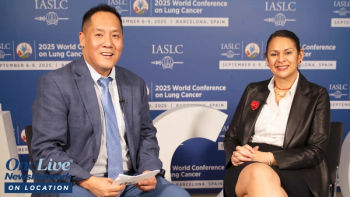
Narjust Florez, MD, and Joshua K. Sabari, MD, sit down with Chandler Park, MD, FACP, to discuss the latest abstracts in lung cancer presented during the International Association for the Study of Lung Cancer 2025 World Conference on Lung Cancer.

Tepotinib treatment was characterized by frequent but manageable TRAEs in MET exon 14–positive NSCLC, with peripheral edema as the most common toxicity.

The SKYSCRAPER-05 trial shed light on the use of perioperative tiragolumab plus atezolizumab with or without chemotherapy in NSCLC.

Sandip P. Patel, MD, discusses remaining gaps in biomarker testing and their implications for targeted therapies in early-stage NSCLC.

Eric K. Singhi, MD, expands on how oncologists can work with patient advocacy groups on social media to improve patient education and engagement.

Tepotinib showed superior outcomes in patients with adenocarcinoma MET exon 14 skipping NSCLC vs those with non-adenocarcinoma.

Perioperative tislelizumab plus chemotherapy showed sustained OS and EFS improvement vs chemotherapy in resectable NSCLC.

The SEZ6-targeting ADC ABBV-706 generated durable efficacy outcomes comparable with those of first-line SOC in patients with relapsed/refractory SCLC.
A correlation between ctDNA negativity in the post-surgical MRD window and improved RFS and OS was observed with the Signatera Genome assay in NSCLC.

Dato-DXd demonstrated CNS PFS and ORR benefits vs docetaxel in patients with NSCLC with brain metastases.
Durvalumab/chemoradiation followed by consolidation durvalumab did not improve OS vs chemoradiation followed by durvalumab in stage III NSCLC.

Luis E. Raez, MD, and Suresh S. Ramalingam, MD, FACP, FASCO, sit down with Chandler Park, MD, FACP, and Eric K. Singhi, MD, to discuss the latest abstracts in lung cancer presented during the International Association for the Study of Lung Cancer 2025 World Conference on Lung Cancer.
Taletrectinib delivered high response rates and durable benefit with manageable safety in ROS1-positive non–small cell lung cancer.

Perioperative pembrolizumab demonstrated improved mPR, pCR, EFS, and OS in patients with early-stage resectable NSCLC and any nodal status.

Adjuvant nivolumab plus chemotherapy led to a clinically meaningful reduction in relapse rates vs chemotherapy in resected NSCLC.
Ifinatamab deruxtecan was efficacious and had a manageable safety profile in patients with previously treated extensive-stage small cell lung cancer.
The brain-penetrant, TRK-sparing, ROS1-selective TKI zidesamtinib was active and safe in patients with advanced ROS1+ non–small cell lung cancer.
Ivonescimab plus chemotherapy showed significant and clinically meaningful PFS in EGFR-mutated NSCLC following progression on a third-generation TKI.

Geoffrey Liu, MSc, MD, discusses updated efficacy and safety results with taletrectinib in ROS1-positive non–small cell lung cancer.

Alexander Drilon, MD, compares response rates with zidesamtinib with that of prior ROS1 inhibitors in pretreated patients with ROS1-positive NSCLC.
Results from the ALCHEMIST trial show that adjuvant crizotinib did not improve DFS or OS vs observation in resected ALK-positive NSCLC.
Updated FLAURA2 OS data confirm osimertinib plus chemotherapy as a first-line SOC treatment in EGFR-mutated advanced NSCLC.
The addition of aumolertinib to chemotherapy improved PFS vs aumolertinib monotherapy for the treatment of patients with EGFR-mutated NSCLC.
Perioperative nivolumab maintained HRQOL and decreased the risk of deterioration vs placebo in patients with stage III N2 NSCLC.
COMPEL data support osimertinib plus chemotherapy in EGFR-mutated NSCLC after non-CNS progression on frontline osimertinib.
First-line iza-bren plus osimertinib demonstrated a manageable safety profile with preliminary antitumor activity in EGFR-mutant NSCLC.

A chemotherapy-free regimen of mosunetuzumab and polatuzumab vedotin improved PFS and response rates vs R-GemOx in relapsed/refractory LBCL.

Treatment with mosunetuzumab plus polatuzumab vedotin yielded high response rates and had a manageable safety profile in BTK inhibitor–exposed MCL.