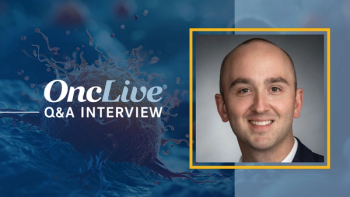
In a candid conversation on OncLive’s podcast How This Is Building Me, thoracic oncologist D. Ross Camidge, MD, PhD, reflected on the curiosity, failure, and unexpected tenderness that shaped a career and a patient journey unlike any other.
Camidge, director of the Lung Cancer Program and a professor of medicine-medical oncology at the University of Colorado School of Medicine in Aurora, has spent nearly 2 decades helping to reshape how the world understands and treats patients with lung cancer. He has stood on conference podiums before thousands of colleagues, helped shepherd a molecule called PF-02341066 from a phase 1 study into a licensed therapy now known as crizotinib (Xalkori), and coined terms—oligoprogression among them—that are now standard vocabulary in thoracic oncology. In June 2022, he became a patient in his own program, diagnosed with incurable lung cancer. In a recent episode of How This Is Building Me, the OncLive podcast he has hosted since 2023, Camidge went to the other side of the microphone and was interviewed by Erin Schenk, MD, PhD, another thoracic oncologist at the University of Colorado. What emerged was less a curriculum vitae than a meditation on curiosity, resilience, and the slow, hard work of learning to accept love.
How did Camidge’s curiosity lead him to medicine?
Camidge grew up in England, the son of a mother who was a dentist and a father who worked as a sales representative for an engineering company. The closest his family came to medicine was an aunt who was a pathologist and who had a habit, Camidge recalled, of explaining to everyone at the dinner table what everyone she knew had died from, which was “not terribly inspiring,” he said. But an interest in biology took hold early, along with a more fundamental trait: an unrelenting curiosity about everything and everyone around him.
“I always ask questions about everything,” Camidge told Schenk. “Even if something was presented to me as straightforward, you’d question everything about it.” He remembered subjecting neighbors at Christmas parties to such thorough interrogations that they eventually “look[ed] terrified and slunk away.” The curiosity, he acknowledged, was “probably just irritating” most of the time, but sometimes it allowed him to see things others had not.
In the United Kingdom, medicine is an undergraduate degree, which meant Camidge had committed to the path by the time he was a teenager. He applied to the University of Oxford, which required a separate entrance examination. He passed, but the timing of the offer left him with roughly 9 months before his studies began, a gap year that turned out to be formative in ways no curriculum could have been.
He took a job at McDonald’s, where his O levels, A levels, S levels, and Oxford acceptance earned him the assignment of cleaning the toilets. He wore, as he described it, “a lovely brown and blue nylon uniform [and] little hat” and came home each day smelling of burger grease. He then transitioned to volunteer work with Wandsworth Social Services, becoming a live-in “enabler” for a man named Steve, a lawyer with cerebral palsy. Every morning, Camidge woke Steve, bathed him, dressed him, drove him to his law office, and answered the phone for him. “He was the most amazing man,” Camidge said. “He was so kind, so patient. I think he was the first person outside of my family whom I genuinely valued.” The work, he added, gave him something he had not previously found: a purpose clear enough to quiet the internal questions about why he was there.
He rounded out the year in the Bahamas, running what he described, with characteristic self-deprecation, as a youth camp for “mostly underprivileged street kids, which sounds much better” than the reality of a naive 19-year-old in charge of 2 dormitories and a basketball court on an island with nothing else on it. “It’s the only time in my life I’ve ever had a suntan,” he noted.
What did failure at Cambridge teach Camidge about resilience?
Oxford suited Camidge. He found, for the first time, people with similar intellectual wiring, people who did not mind being questioned, and those who asked questions themselves. After 3 years of preclinical medicine, he made the choice, taken by perhaps 5% to 10% of his cohort, to pursue a PhD rather than go directly into clinical training. He landed at the Medical Research Council Laboratory of Molecular Biology in Cambridge, England, a place that had produced numerous Nobel laureates, a fact he said he may not have fully appreciated at the time.
What he found there was not triumph. He inherited a project built around adapter proteins involved in endocytosis, proteins that a previous student, a Marshall Scholar, had purified and characterized with apparent success. Camidge could not replicate the work. For 2 years, he worked 12-hour days, 6.5 days a week, and produced nothing. He was told, sometimes directly and sometimes indirectly, that he was stupid and lazy. “I think, in retrospect, I was probably clinically depressed at the time,” he said. “I don’t think I knew what was going on, but it was awful.”
D. Ross Camidge, MD, PhD: Thoracic Oncologist, Patient With Lung Cancer, and Lifelong Questioner
- Camidge’s lifelong habit of relentless questioning, which cleared Christmas parties of nervous neighbors and drove him into PhD research, became the engine behind landmark discoveries in ALK-positive lung cancer, including the concept of oligoprogression, which is now standard of care.
- Professional failure during his PhD candidacy at the Medical Research Council Laboratory of Molecular Biology in Cambridge, where 2 years of fruitless work left him with clinical depression, taught him to push off the bottom of the ocean rather than accept defeat, a mindset he has carried into research and patient care ever since.
- A diagnosis of incurable lung cancer in June 2022 in his own program set Camidge on an unexpected personal frontier: learning not just to endure others’ care and kindness but to absorb it, a practice he now brings explicitly into his talks with oncologists and patients about the human dimensions of cancer medicine.
The resolution came when he forced himself to change direction: to stop trying to make a failing project work and to design his own experiments. He described the moment with an image that has stayed with him: “You’re just in the ocean, and you’re sort of sinking, and you can sink for quite a long way. And then eventually you hit bottom, and you have 2 choices. You just lie there and get eaten by crabs and fishes, or you push off.” He pushed off. He cloned the proteins from different species, expressed them in Drosophila and other cell systems, and eventually, after a fourth year—an extension unusual in British PhD programs—produced enough to earn his postgraduate degree. His supervisor, he noted with some satisfaction, later attempted the original project herself and could not make it work either.
The PhD also gave him something else: a creative life. Camidge filled his hours outside the laboratory with reading, acting in plays, and eventually stand-up comedy. He performed in the Edinburgh Festival in Scotland in a production of Neil Simon’s Brighton Beach Memoirs, playing the teenage Eugene with dyed hair and knickerbockers, and once ad-libbed an entire sequence on stage when a fellow actor skipped 3 scenes. “I can do that,” he recalled thinking. The performance skills, he argued, translated directly to academic medicine: “When you become an academic, there is a lot of standing on stage and speaking in the microphones to large groups of people, which is not that different from stand-up comedy.”
How did crizotinib and ALK-positive lung cancer define Camidge’s career?
After returning to clinical training at the Oxford Clinical School and then rotating through hospitals in Newcastle, England, and in Edinburgh, Camidge recognized that the specialty that fused molecular biology most tightly with patient care was oncology. He trained briefly as a radiation oncologist, then pivoted to a newly created combined program in medical oncology and clinical pharmacology, the first of its kind in the UK, run by Duncan Jodrell, DM, MSc, FRCP(Edin.), whom Camidge said recognized in him a drive to push beyond standard approaches.
The training included an 18-month placement at AstraZeneca, where a physician named Andrew Hughes, MD, told him he would be treated not as a visitor but as a full pharmaceutical industry physician. Camidge sat on early drug development committees, helped design first-in-human trial parameters, and, characteristically, spent his coffee breaks interrogating colleagues across regulatory, clinical, and commercial teams. AstraZeneca offered him a permanent position. He declined, though he was immensely grateful for what the placement had given him.
In addition to exposure to the pharmaceutical industry, it had also given him exposure to the American oncology ecosystem. Attending conferences for the American Society of Clinical Oncology and the American Association for Cancer Research on a travel budget for the first time, Camidge met investigators who were enthusiastic about ideas rather than focused on why they would not work. “I sometimes explain that, at least to me, American is an attitude, not a nationality,” he said. “In Britain, they would tell you why something wouldn’t work…whereas when I spoke to people in America, they would tell you why it works and why it would be a great idea.”
He arrived at the University of Colorado in October 2005. Within 6 months, the director of the Lung Cancer Program had left and Camidge found himself running it. S. Gail Eckhardt, MD, offered him a slot on a new phase 1 study from Pfizer: a compound designated PF-02341066, pitched as a MET inhibitor. The same molecule also inhibited ALK, although at the time, this was only known about in rare lymphomas. In 2007, while the trial was already underway, a separate group announced that ALK rearrangements were also present in approximately 4% of non–small cell lung cancer cases. The University of Colorado and Massachusetts General Hospital in Boston were among the few sites capable of performing the fluorescence in situ hybridization test needed to identify these patients.
The first patient with ALK-positive disease at the University of Colorado started taking crizotinib and, within 24 hours, stopped coughing up blood. “It was like watching little miracles every time,” Camidge said. He recalled calling a patient named Andy on New Year’s Eve to tell him his test results had come back positive and that he was recommending crizotinib. After Andy had started treatment, Camidge’s phone rang during a family photo session. It was Andy, calling to report that he was hiking. Camidge and his colleagues called themselves, for a time, the “Miracle Factory.”
By 2009, data on the first 17 to 19 patients with ALK-positive disease showed response rates of 60% to 70%. Walking out of a Denver, Colorado, meeting where those early numbers were reviewed, Camidge turned to Australian colleague Ben Solomon, MBBS, PhD, FRACP, and said, “Ben, these guys have no idea what they’ve got.”
How did Camidge turn a single clinical trial into a lung cancer powerhouse?
The crizotinib experience crystallized a philosophy that came to define the University of Colorado Lung Cancer Program. Molecular profiling of tumors was not a peripheral activity but the organizing principle of care. Camidge worked with his pathologists and other colleagues to ensure that clinical notes documented not just histology but driver oncogene status. He developed what he called earned marketing, or getting a patient’s good-news story onto a local television station, which would generate waves of emails from patients around the US and the world asking for a review of their cases. Those inquiries became the foundation for the University of Colorado’s Remote Second Opinion Program, which has now helped patients in 44 states and 42 countries. Camidge is passionate about the program’s benefits of “taking expertise and getting it out of the ivory towers.”
He also articulated, in a 2012 article coauthored with Jack West, MD, the concept that phase 1 trials need not be last-resort options. The article, titled “Have Mutation, Will Travel,” argued that a patient with a specific molecular alteration and a trial testing the relevant inhibitor had a return on investment from traveling that was categorically different from anything that had existed in the era of unselected therapies.1 The first figure in the article was a map of the United States with a red dot over Denver and arrows radiating from the cities where the University of Colorado’s patients on crizotinib had traveled from. "Everything in the middle needs something too,” Camidge said. “And we have a great airport.”
Research discoveries continued to accumulate, including the exaggerated sensitivity of ALK- and ROS1-positive cancers to pemetrexed, the elevated thromboembolic risk in patients with ROS1- and ALK-positive disease, and the observation that progression on targeted therapies sometimes involved a single emerging clone rather than systemic failure. For that last phenomenon, Camidge’s team coined the term oligoprogression and proposed treating the isolated site with radiation, drawing on his radiation oncology training rather than abandoning an otherwise effective systemic therapy. All these observations, he noted, were “horribly controversial at the time” and are now standard of care.
What has it meant for Camidge to become a patient in his own lung cancer program?
In June 2022, Camidge was diagnosed with lung cancer. He kept the circle of people who knew relatively small for 3 and a half years before going public. When he did, the response was overwhelming—his voice in the interview carrying the texture of someone still working something out.
Two things, early in his illness, reliably undid his composure: thoughts about his 2 daughters and what their lives would look like without him as well as people being kind to him. The second, he said, was harder to explain but no less real. “When people are nice to me…it goes back to a sense of uncertainty, unworthiness, whatever was driving me to do something else.”
He described learning, in stages, how to receive the interest and concern of others. First was learning to say thank you and accept their interest, at least verbally. Then came the deeper work: “learning how to absorb it, to say, ‘This is somebody giving interest, love, support,’ and apart from just accepting the gift, opening the gift and appreciating it…to just absorb that into your cells.” That process, he said, has informed the talks he now gives to oncologists and patients, which he described as pushing medicine and communication “to a level that we haven’t done before.”
He was asked whether the comfort he had found in his own identity—the sense that he had value and that the voice asking, “Why am I here?” had been quieted—came before or after the diagnosis. “Before,” he said. The research had given him that. His most prized discoveries were not the ones announced from podiums to thousands of colleagues but the ones where the answer had been sitting in plain sight until someone thought to look. “My favorite discoveries are the ones that are under everybody’s nose, but nobody’s seen until you point it out.”
He opened the episode with a self-introduction that he had worked on. “I have been and still am the owner of a lovely life,” he said. “Professionally, I’ve spent my life as a doctor, specifically a cancer doctor. Personally, although it took a long time, I have learned to love so many people: my friends, my family, my daughters, my partner, even just random people whom you share your life experience with. And probably more importantly, and much harder, I’ve learned, and I continue to learn, how to accept others’ love in return. Like I said, a lovely life.”
The awkward teenager at those Christmas parties, interrogating the neighbors until they fled, might not have predicted that ending. But perhaps, Camidge suggested, the questions were always pointing there.
Reference
- West HJ, Camidge DR. Have mutation, will travel: utilizing online patient communities and new trial strategies to optimize clinical research in the era of molecularly diverse oncology. J Thorac Oncol. 2012;7(3):482-484. doi:10.1097/JTO.0b013e3182432646