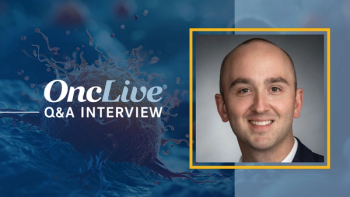
Brandon Huffman, MD, discusses INCB161734’s mechanism of action, phase 1 data, and the DAWN-303 trial design in KRAS G12D–mutated pancreatic cancer.
Supplements and Featured Publications

Paolo Tarantino, MD, PhD, discusses key data with ADCs in breast cancer that were presented at ASCO 2026.
New efficacy and safety analyses presented at the
“Now, we need to further raise the bar and develop novel ADCs with additional payloads and different treatment strategies to further improve outcomes for patients,” Tarantino said in an interview with OncLive®.
In the interview, Tarantino discussed key data with ADCs in breast cancer that were presented at ASCO 2026.
Tarantino is a breast medical oncologist and advanced fellow at Dana-Farber Cancer Institute and Harvard Medical School in Boston, Massachusetts.
Tarantino: It's been a revolution because for approximately 10 years, we've been doing the same first-line treatment for HER2-positive breast cancer: an induction taxane with trastuzumab [Herceptin]/pertuzumab [Perjeta] followed by trastuzumab/pertuzumab maintenance. Now, suddenly, that has been displaced by fam-trastuzumab deruxtecan-nxki [T-DXd; Enhertu]/pertuzumab, based on data from the phase 3 DESTINY-Breast09 trial [NCT04784715]. This was a trial that had 3 different arms, looking at either first-line T-DXd/pertuzumab, a taxane plus trastuzumab and pertuzumab [THP], or T-DXd plus placebo] for the first-line treatment of patients with HER2-positive breast cancer.
The trial was positive with a long median progression-free survival [PFS] for T-DXd/pertuzumab of 40.7 months [95% CI, 36.5-not estimable (NE)] compared with 26.9 months with THP [95% CI, 21.8-NE; HR, 0.56; 95% CI, 0.44-0.71; P <.0001]. We still don't know [the outcomes] with T-DXd alone. We're waiting for the results of that arm.
Overall, the strategy of giving T-DXd/pertuzumab allows us to go beyond the traditional 4 to 5 months of induction chemotherapy we did with taxanes, which is an opportunity because T-DXd is not associated with cumulative peripheral neuropathy. At the same time, [T-DXd] adds the burden of chemotherapy-related AEs for patients. Right now, we consider T-DXd/pertuzumab to be the preferred first-line treatment approach.
However, we are still trying to determine the adequate duration of T-DXd/pertuzumab. Many of us in the field believe that the ideal duration is not until progression for most patients. It may be for those at the highest risk of rapid progression, but not for all.
Right now, we are trying to understand if there is an ideal moment for each patient to switch to maintenance treatment. That moment is probably not the same for all patients. It will be determined based on clinical factors and the preferences of each patient.
There was an interesting sub-analysis at ASCO 2026 that looked at the rates of complete response [CR] and deep partial response [PR], which is a term we don't commonly use, but it makes a lot of sense because often we see responses that are almost complete, but patients have some minimal residual disease and you're not sure if it's residual disease or just a normal lymph node or a normal bone metastasis. Seeing patients have not only complete disappearance of disease, but also [those with] over 80% shrinkage, is helpful. With T-DXd/pertuzumab in DESTINY-Breast09, [52.8%] of the patients had either CRs or deep PRs, and for both these categories of patients, at 2 years, [approximately] 80% of patients were free from progression or death.2 Even a deep PR prognostically holds favorable meaning.
We also saw that the shrinkage of the disease was not something that only occurred initially, but deepened over time. The nadir—the median maximum shrinkage of disease—was approximately 1 year, but at 2 years, 80% of patients had a deep shrinkage of disease. We're realizing that giving T-DXd/pertuzumab for longer leads to more shrinkage of disease, and this could mean a more prolonged response. We need to balance this with tolerability. We don't want to expose patients to unnecessary prolonged chemotherapy-related AEs, so we need to balance this with their preferences and understand if we can stop at some point.
Right now, we don't have data telling us the right moment to stop this first-line T-DXd/pertuzumab regimen, which is why we need trials. There are at least a couple trials ongoing [and planned, such as the] phase 2 DEMETHER trial [NCT06172127] and hopefully soon, DESTINY-BreastGUIDE as well. However, we need to discuss with patients and agree, based on the clinical scenario, on the right moment to switch to a maintenance regimen.
The update of the phase 3 DESTINY-Breast05 trial [NCT04622319] at ASCO 2026 was reassuring, suggesting that we can effectively dissect, at least in the trial, the drug-related interstitial lung disease [ILD] from radiation pneumonitis. Both [toxicities] affect the lung but in different ways. It was nice to see that most of the cases of drug-related ILD with T-DXd are reversible, could be reverted with steroid treatment, and are manageable, although there were some grade 5 AEs as well. In contrast with that, radiation pneumonitis seems mostly non-reversible, because in most cases, there is scarring. I don't think that [the incidences of] these 2 phenomena overlap based on the data we have, which means also according to the trial data, that radiation can be safely given with adjuvant T-DXd or ado-trastuzumab emtansine [Kadcyla].
Two additional interesting pieces of information provided in the ASCO 2026 presentation were that patients with Japanese geographical origin, for some reason we are still not fully sure about, have a higher risk of ILD, and we should be aware of that. Secondly, and rapidly emerging, is that patients with renal impairment have a higher risk of ILD. That's another category of patients for which we should be cautious and do CT scans of the chest often, every 6 weeks, ideally. Overall, the striking benefits we've seen with T-DXd in DESTINY-Breast05 outweigh the risks, so we should be aware of the risks, ILD in particular, but also realize that this trial led to a major advancement in the field.
We have 2 distinct TROP2-directed ADCs that moved to the first-line setting [for triple-negative breast cancer (TNBC)]: datopotamab deruxtecan-dlnk [Dato-DXd; Datroway], based on data from the phase 3 TROPION-Breast02 trial [NCT05374512], and sacituzumab govitecan-hziy [Trodelvy], based on findings from the phase 3 ASCENT-03 [NCT05382299] and ASCENT-04 [NCT05382286] trials. For both trials, there were analyses presented at ASCO 2026 showing data beyond improved PFS, which was the primary end point [of each of these studies]. [These ADCs] also improved time to second progression [PFS2], which is reassuring, especially for the sacituzumab govitecan trials, for which no overall survival [OS] benefit has been demonstrated yet, whereas for Dato-DXd, we have already seen both a PFS and an OS benefit. PFS2 adds some interesting data. I think we have enough data to consider these to be the standard first-line treatments for patients.
The major question has now shifted to how to select patient for which TROP2-directed ADC. There are key differences in the administration schedules and toxicity profiles of these 2 TROP2-directed ADCs that [require] discussing with the patient and deciding with the patient which is most adequate. The second big question is what to do in the second-line setting after progression on a TROP2-directed ADC for metastatic TNBC. In this setting, my hypothesis, based on most of the retrospective data we have—we will also have upcoming prospective data—is that there is a lot of cross-resistance between topoisomerase-I ADCs, so I would recommend using traditional chemotherapy after an ADC, like a taxane, eribulin, or carboplatin.
We need to remember that these agents can still be effective, and at the same time, be open to considering additional ADCs in later lines because ADCs represent potential additional lines of treatment for these patients; these patients need more options, and [ADCs] need to be on the table. ADCs also tend to be effective in the brain, and one-third of patients with this disease develop brain metastases. Overall, we don't want to exclude patients from receiving more than 1 ADC, but immediately after progression on an ADC, I would not sequence another ADC. That said, the first-line data from TROPION-Breast02 showing incredibly high response rates [with Dato-DXd], a median PFS of 10.8 months [95% CI, 8.6-13.0], and improved OS [outcomes vs chemotherapy] bring hope in the field, as do the data with sacituzumab govitecan.3
about 2 months ago
Dr Tarantino on the Evolution of TROP2-Directed ADCs in First-Line TNBCabout 2 months ago
Dr Hurvitz on Updated PFS Data From the SERENA-6 Trial in Breast Cancer