Dr Vogel highlights the rationale and growing evidence for sequential FGFR inhibition in FGFR2 fusion–positive cholangiocarcinoma.

Arndt Vogel, MD, is a faculty member at the University of Toronto Institute of Medical Science, a scientist at the Toronto General Hospital Research Institute, and a medical oncologist at the UHN–Princess Margaret Cancer Centre
Dr Vogel highlights the rationale and growing evidence for sequential FGFR inhibition in FGFR2 fusion–positive cholangiocarcinoma.
Dr Vogel highlights the importance of the European Commission’s approval of zanidatamab for previously treated, metastatic HER2+ biliary tract cancer.

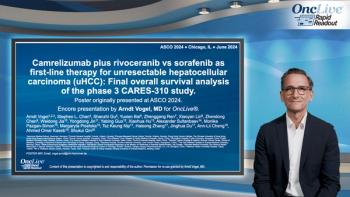
This is a final overall survival analysis on the phase 3 CARES-310 study (NCT03764293), a randomized, open-label, international phase 3 trial comparing camrelizumab plus rivoceranib vs sorafenib as first-line therapy for unresectable hepatocellular carcinoma (uHCC).
Arndt Vogel, MD, on the final overall survival data for camrelizumab plus rivoceranib in unresectable hepatocellular carcinoma.
Experts emphasize the importance of using multiple liver function assessments for more comprehensive patient evaluation in hepatocellular carcinoma treatment.
Rachna Shroff, MD, MS, FASCO, shares data from the CARES-310 study showing improved progression-free and overall survival in patients with hepatocellular carcinoma treated with camrelizumab and rivoceranib compared to sorafenib, regardless of liver function.
Amit Singal, MD, reviews analyses of the HIMALAYA and KEYNOTE-240 trials, focusing on the impact of liver function via ALBI grades on treatment outcomes and safety in patients with hepatocellular carcinoma.
Arndt Vogel, MD, discusses the post-hoc analyses of two key clinical trials focusing on the impact of liver function, measured by ALBI and Child-Pugh scores, on outcomes in hepatocellular carcinoma treatments.
Rachna Shroff, MD, MS, FASCO, and Amit Singal, MD, discuss the use of various liver function assessment scores—Child-Pugh, ALBI, and MELD—in the care of patients with hepatocellular carcinoma, emphasizing their pros, cons, and roles in treatment decision-making.
Arndt Vogel, MD, explains that the Child-Pugh score, although simpler to calculate than the ALBI score, sometimes lacks granularity in assessing liver function in hepatocellular carcinoma patients; however, both scoring systems are considered valuable tools in clinical settings and trials for evaluating liver function's prognostic impact on treatment outcomes.
The ALBI score, originally developed to stratify cirrhotic patients undergoing resection, has evolved into a vital tool for assessing prognosis and treatment efficacy in various stages of hepatocellular carcinoma and is now being explored for its utility in other liver-related diseases.
Drs Vogel and Singal discuss the critical importance of assessing liver function in hepatocellular carcinoma patients, as it impacts prognosis and treatment strategies; they mention the evolution from Child-Pugh scoring to the ALBI score, which uses albumin and bilirubin levels, for a more objective evaluation of liver health.
Rachna Shroff, MD, MS, FASCO, discusses hepatocellular carcinoma, noting its rising global incidence and identifying underlying liver cirrhosis as a key risk factor influenced by conditions like viral hepatitis and fatty liver disease; diagnosis often involves radiographic imaging and triple-phase CT and MRI scans, while treatment necessitates a multidisciplinary approach involving hepatologists, surgeons, and other specialists.
Closing out this discussion, experts share their final thoughts on advanced HCC treatments and key data presented at the 2023 ASCO Gastrointestinal Cancers Symposium.
Oncologists provide an overview of the treatment management of Child-Pugh B patients with advanced HCC.
In this discussion, panelists outline treatment considerations for patients with advanced HCC in the 2L setting and beyond.
In the context of frontline treatment strategies in advanced HCC, expert oncologists review clinical research in systemic immunotherapy approaches.
Expert panelists highlight anti-angiogenic systemic therapies under investigation for advanced HCC in second line and beyond.
Oncologists review a patient profile, evaluating treatment approaches for patients with advanced HCC that have progressed beyond 1L treatment.
Experts discuss treatment options for patients unsuitable for atezolizumab plus bevacizumab in advanced hepatocellular carcinoma.
Panelists share real-world evidence involving the use of lenvatinib in advanced HCC.
A panel of oncologists review a patient profile, evaluating a patient with advanced HCC treated with lenvatinib.
Expert oncologists analyze immunotherapy-based combinations in the frontline setting for patients with hepatocellular carcinoma.
Experts discuss the factors they take into consideration when selecting the appropriate treatment in advanced HCC.
Panelists review the HIMALAYA study, investigating durvalumab plus tremelimumab in patients with advanced HCC.
Expert oncologists discuss a patient profile in advanced HCC, evaluating a patient treated with durvalumab plus tremelimumab.
Experts review clinical studies evaluating TACE in patients with intermediate stage HCC.
Expert panelists discuss treatment strategies for patients with intermediate stage hepatocellular carcinoma (HCC) that are unsuitable for transarterial chemoembolization (TACE).
Expert insight to how the field of hepatocellular carcinoma management may evolve in coming years given therapeutic combinations and ongoing clinical trials.
October 7th 2022
August 10th 2022
October 14th 2022
August 10th 2022