Panelists discuss emerging research directions and novel therapeutic combinations poised to shape the next generation of renal cell carcinoma management.
Panelists discuss emerging research directions and novel therapeutic combinations poised to shape the next generation of renal cell carcinoma management.
Panelists explore histology-specific and molecularly guided approaches that are expanding treatment options across renal cell carcinoma subtypes.
Panelists discuss strategies for recognizing, preventing, and managing toxicities associated with frontline combination regimens in advanced renal cell carcinoma.
Panelists discuss evolving evidence supporting adjuvant therapy in renal cell carcinoma and how these findings inform clinical decision-making.
Panelists analyze landmark clinical trial data supporting current frontline RCC therapies, focusing on response rates, progression-free survival, and overall benefit across risk groups.
Panelists discuss the epidemiology, histologic diversity, and evolving biology of advanced renal cell carcinoma, setting the stage for modern treatment selection.
Panelists review current guideline-endorsed first-line treatment options for advanced renal cell carcinoma, emphasizing immunotherapy- and VEGF inhibitor–based combination regimens.

Robert Motzer, MD, and Elizabeth Plimack, MD, discuss clinical findings in the treatment of advanced RCC from the recent KCRS 2023 meeting, emphasizing the significance of circulating tumor cells, advances in imaging, and the potential of adjuvant therapies, particularly pembrolizumab.
Drs Elizabeth Plimack and Robert Motzer discuss the long-term toxicities of combination lenvatinib/pembrolizumab in patients with advanced RCC, highlighting fatigue, GI discomfort, hand-foot syndrome, liver toxicity, thyroid toxicity, and proteinuria.
Experts detail their approaches to dosing combination lenvatinib and pembrolizumab for patients with advanced RCC, emphasizing individualized treatment for balanced efficacy and toxicity.
Elizabeth Plimack, MD, and Robert Motzer, MD, explain their preferences between TKI-IO combination therapies for patients with advanced RCC considering efficacy, side effects, and specific patient factors.
Medical oncologists discuss a patient's surprising rapid decline after an initial diagnosis of clear cell RCC, emphasizing the efficacy of combination lenvatinib/pembrolizumab in similar patients.
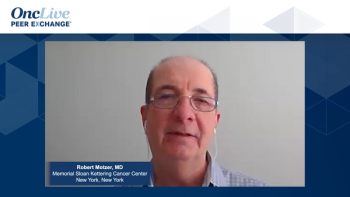
Robert Motzer, MD, presents the patient profile of a 65-year-old man diagnosed with clear cell RCC for discussion.

Elizabeth Plimack, MD, director of Genitourinary Clinical Research at Fox Chase Cancer Center, discusses the growth of immunotherapy for the treatment of patients with bladder cancer.

Elizabeth Plimack, MD, director of Genitourinary Clinical Research at Fox Chase Cancer Center, discusses immunotherapy combinations for patients with bladder cancer.

Elizabeth Plimack, MD, director of Genitourinary Clinical Research at Fox Chase Cancer Center, discusses recent trials in kidney cancer.

Elizabeth Plimack, MD, director of Genitourinary Clinical Research at Fox Chase Cancer Center, discusses 2 studies reported at the 2018 Genitourinary Cancers Symposium in patients with nonmetastatic M0 castration-resistant prostate cancer (CRPC).

Elizabeth Plimack, MD, director of Genitourinary Clinical Research at Fox Chase Cancer Center, discusses choosing a checkpoint inhibitor in bladder cancer.
Elizabeth Plimack, MD, director of Genitourinary Clinical Research at Fox Chase Cancer Center, discusses the approved checkpoint inhibitors for the second-line treatment of patients with bladder cancer.
Elizabeth Plimack, MD, director of Genitourinary Clinical Research at Fox Chase Cancer Center, discusses checkpoint inhibitors in the frontline setting of bladder cancer.

Elizabeth Plimack, MD, director of Genitourinary Clinical Research at Fox Chase Cancer Center, discusses strategies for developing cures for patients with locally advanced urothelial carcinoma.
Elizabeth Plimack, MD, director of Genitourinary Clinical Research at Fox Chase Cancer Center, shares the challenges with the FDA-approved immunotherapy agents for the treatment of patients with bladder cancer.
Elizabeth Plimack, MD, director of Genitourinary Clinical Research at Fox Chase Cancer Center, discusses the phase Ib trial of epacodostat and pembrolizumab (Keytruda) in patients with urothelial carcinoma.
Elizabeth Plimack, MD, director of Genitourinary Clinical Research at Fox Chase Cancer Center, discusses the KEYNOTE-052 trial investigating pembrolizumab (Keytruda) in the frontline setting for patients with urothelial carcinoma.

Elizabeth Plimack, MD, director of Genitourinary Clinical Research at Fox Chase Cancer Center, discusses the updated findings of the KEYNOTE-045 trial of pembrolizumab (Keytruda) in urothelial carcinoma.

Elizabeth Plimack, MD, director of Genitourinary Clinical Research at Fox Chase Cancer Center, discusses updated findings from the CheckMate-025 trial, which compared the efficacy of nivolumab (Opdivo) with everolimus (Afinitor) in patients with renal cell carcinoma.



Elizabeth Plimack, MD, MS, Associate Professor, Director of Genitourinary Clinical Research at Fox Chase Cancer Center, discusses immunotherapy in bladder cancer.

Elizabeth Plimack, MD, MS, attending physician, medical oncology, Fox Chase Cancer Center, discusses a phase I trial that looked at overcoming mTOR resistance with an HDAC inhibitor in renal cell carcinoma (RCC).

July 15th 2016