
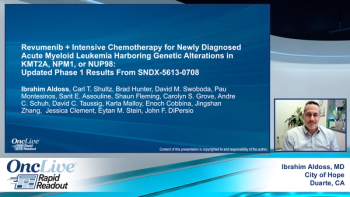
Ibrahim Aldoss, MD, discusses updated phase 1 results from the SNDX-5613-0708 study of revumenib plus intensive chemotherapy in patients with newly diagnosed AML harboring KMT2A, NPM1, or NUP98 alterations.

Ibrahim Aldoss, MD, is an associate professor in the Division of Leukemia in the Department of Hematology & Hematopoietic Cell Transplantation at City of Hope
Ibrahim Aldoss, MD, discusses updated phase 1 results from the SNDX-5613-0708 study of revumenib plus intensive chemotherapy in patients with newly diagnosed AML harboring KMT2A, NPM1, or NUP98 alterations.
Shira Dinner, MD, and Ibrahim Aldoss, MD, discuss key data in acute lymphoblastic leukemia presented at the 2025 EHA Congress.
Shira Dinner, MD, and Ibrahim Aldoss, MD, discuss data for subcutaneous in relapsed/refractory acute lymphoblastic leukemia.
Ibrahim T. Aldoss, MD, discusses MRD negativity outcomes with ponatinib vs imatinib in newly diagnosed Philadelphia chromosome–positive ALL.
Shira Dinner, MD, and Ibrahim Aldoss, MD, discuss the role of blinatumomab consolidation in BCR:ABL1–negative B-ALL.
Shira Dinner, MD, and Ibrahim Aldoss, MD, discuss the addition of blinatumomab to the CALGB 10403 regimen in MRD-negative acute lymphoblastic leukemia.
Shira Dinner, MD, and Ibrahim Aldoss, MD, discuss the role of blinatumomab in acute lymphoblastic leukemia management.
Shira Dinner, MD, and Ibrahim Aldoss, MD, discuss first-line treatment options for acute lymphoblastic leukemia.
Drs Aldoss and Jabbour discuss an analysis of PhALLCON that support the use of ponatinib monotherapy after TKI/chemotherapy treatment in Ph-positive ALL.
Ibrahim T. Aldoss, MD; and Elias Jabbour, MD, discuss ongoing research efforts in the treatment paradigm of Philadelphia chromosome–positive acute lymphoblastic leukemia.
Ibrahim T. Aldoss, MD; and Elias Jabbour, MD, discuss safety findings from the PHALLCON trial of ponatinib in Philadelphia chromosome–positive acute lymphoblastic leukemia.
Ibrahim T. Aldoss, MD; and Elias Jabbour, MD, discuss the efficacy with ponatinib observed in the PHALLCON trial of patients with Philadelphia chromosome–positive acute lymphoblastic leukemia.
Ibrahim T. Aldoss, MD; and Elias Jabbour, MD, discuss the impact of the FDA approval of ponatinib for the treatment of newly diagnosed patients with Philadelphia chromosome–positive acute lymphoblastic leukemia.
Ibrahim T. Aldoss, MD; and Elias Jabbour, MD, discuss current standards of care for the treatment of patients with Philadelphia chromosome–positive acute lymphoblastic leukemia.
Ibrahim T. Aldoss, MD; and Elias Jabbour, MD, discuss the prevalence and prognostic outcomes of patients with Philadelphia chromosome–positive acute lymphoblastic leukemia.
Ibrahim Aldoss, MD, discusses the impact of enhanced lymphodepletion on responses with WU-CART-007 in relapsed/refractory T-ALL/LBL.
Ibrahim Aldoss, MD, discusses the utility of ponatinib in the phase 3 PhALLCON trial for patients with newly diagnosed, Ph+ acute lymphoblastic leukemia.
Ibrahim Aldoss, MD, discusses the use of ponatinib as evaluated in the PhALLCON trial for patients with Ph+ ALL.
Ibrahim T. Aldoss, MD, discusses the use of revumenib monotherapy in patients with relapsed/refractory acute leukemia harboring KMT2A rearrangements.
With their final thoughts, medical experts share unmet needs in the treatment landscape of Ph+ acute lymphoblastic leukemia.
Key advances in ALL treatment from ASCO 2023 are discussed by Dr Przespolewski.
Dr Aldoss discusses the role ponatinib and blinatumomab in the management of Ph+ALL.
Medical experts highlight recent findings from the PhALLCON study.
Drs Aldoss and Przespolewski evaluate the changing treatment landscape for patients diagnosed with Ph+ ALL.
Amanda Przespolewski, DO, and Ibrahim Aldoss, MD define and discuss how to diagnose patients with Ph+ALL.
Ibrahim Aldoss, MD, and James K. McCloskey, MD, share thoughts on how to effectively sequence available treatment modalities for acute lymphocytic leukemia in various patient populations.
Drs Aldoss and McKloskey describe treatments that can be used in the salvage setting of acute lymphocytic leukemia, including CAR T-cell therapy.
Ibrahim Aldoss, MD and James K. McCloskey, MD describe treatment modalities that can be utilized in treating a pediatric or AYA patient with relapsed / refractory ALL.
Insights on how to approach an acute lymphocytic leukemia patient who is MRD positive after induction therapy.
An overview of the treatment implications of testing for minimal residual disease in pediatric and AYA patients with ALL.
August 10th 2021
August 3rd 2021
July 5th 2023
August 24th 2021