
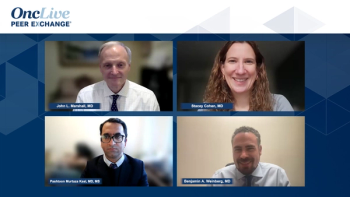
Experts on colorectal cancer discuss practical considerations related to MRD testing, highlighting strategies to navigate potential challenges.

John L. Marshall, MD, is chief of Hematology and Oncology, a professor of medicine and oncology, and director of the Otto J Ruesch Center for the Cure of Gastrointestinal Cancers at the Georgetown Lombardi Comprehensive Cancer Center
Experts on colorectal cancer discuss practical considerations related to MRD testing, highlighting strategies to navigate potential challenges.
Pashtoon Murtaza Kasi, MD, MS, discusses MRD testing practices in the community oncology setting and provides recommendations on the integration of MRD testing into clinical practice.
Focusing on the adjuvant setting, the expert panel discusses the timing and frequency of MRD testing in patients with colorectal cancer.
Colorectal cancer specialists discuss MRD testing platforms and how to choose among the available testing assays.
Experts on colorectal cancer discuss the timing of testing for minimal residual disease in the treatment journey.
A panel medical oncologists provide an overview of circulating tumor DNA and its role in MRD (minimal residual disease) testing in the treatment of patients with colorectal cancer.
John Lindsay Marshall, MD, discusses the significance of the FDA approval of fruquintinib (Fruzaqla) in patients with metastatic colorectal cancer.
John L. Marshall, MD, discusses the key takeaways from the 8th Annual School of Gastrointestinal Oncology® and remaining unmet needs for patients with metastatic colorectal cancer.
John L. Marshall, MD, discusses the evolution of genetic testing in gastrointestinal cancer.

John L. Marshall, MD, discusses potential next steps with research in bile duct cancer.

John L. Marshall, MD, discusses the results of the phase 2 DESTINY-Gastric02 trial in HER2-positive gastric and gastroesophageal junction cancers.

John L. Marshall, MD, discusses key findings from the phase 2 DESTINY-Gastric02 trial examining fam-trastuzumab deruxtecan-nxki in patients with HER2-positive gastric cancer.

John L. Marshall, MD, discusses the importance of molecular profiling when utilizing precision medicine.

John L. Marshall, MD, discusses factors to consider in the third-line treatment setting for patients with colorectal cancer.

John L. Marshall, MD, discusses the push toward precision medicine in colorectal cancer.
John L. Marshall, MD, discusses the challenges in the colorectal cancer field.
John L. Marshall, MD, discusses physician burnout in oncology.
John L. Marshall, MD, chief, Division of Hematology/Oncology, Medstar Georgetown University Hospital director, Otto J. Ruesch Center for the Cure of Gastrointestinal Cancer, Georgetown-Lombardi Comprehensive Cancer Center, discusses HER2 amplification in colorectal cancer (CRC).
John L. Marshall, MD, chief, Division of Hematology/Oncology, Medstar Georgetown University Hospital director, Otto J. Ruesch Center for the Cure of Gastrointestinal Cancer, Georgetown-Lombardi Comprehensive Cancer Center, discusses personalized chemotherapy in the treatment of patients with colorectal cancer.
John L. Marshall, MD, chief, Division of Hematology/Oncology, Medstar Georgetown University Hospital director, Otto J. Ruesch Center for the Cure of Gastrointestinal Cancer, Georgetown-Lombardi Comprehensive Cancer Center, discusses the progression of immunotherapy in colon cancer.
John L. Marshall, MD, chief, Division of Hematology/Oncology, Medstar Georgetown University Hospital director, Otto J. Ruesch Center for the Cure of Gastrointestinal Cancer, discusses the specificity now required in the treatment of patients with metastatic colorectal cancer (mCRC).
John L. Marshall, MD, chief, Division of Hematology/Oncology, Medstar Georgetown University Hospital director, Otto J. Ruesch Center for the Cure of Gastrointestinal Cancer, discusses frontline treatment options for patients with colorectal cancer (CRC).

John L. Marshall, MD, chief, Division of Hematology/Oncology, Medstar Georgetown University Hospital director, Otto J. Ruesch Center for the Cure of Gastrointestinal Cancer, discusses the current state of RAS-mutant gastrointestinal (GI) cancers during the 2017 Ruesch Center Symposium.
John L. Marshall, MD, chief, Division of Hematology/Oncology, Medstar Georgetown University Hospital director, Otto J. Ruesch Center for the Cure of Gastrointestinal Cancer, discusses the first annual Luminary Awards in GI Cancers, which is honoring five individuals who have devoted their time, talent and resources to improving the care for patients and families affected by GI cancers.
John L. Marshall, MD, chief, Division of Hematology/Oncology, Medstar Georgetown University Hospital, associate director, Clinical Research, Lombardi Comprehensive Cancer Center at Georgetown University Hospital, discusses molecular variances between right- and left-sided colon cancer.
John L. Marshall, MD, chief, Division of Hematology and Oncology, Medstar Georgetown University Hospital, discusses the mechanism of action of Yttrium-90 in the treatment of patients with liver-dominant, metastatic colorectal cancer.
John L. Marshall, MD, chief, Division of Hematology and Oncology, Medstar Georgetown University Hospital, and director, Otto J. Ruesch Center for the Cure of Gastrointestinal Cancers, discusses the next steps following the findings from the phase III SIRFLOX trial, which explored the addition of selective internal radiation therapy (SIRT), using Y-90 resin microspheres, to FOLFOX-based first-line chemotherapy in patients with liver-dominant metastatic colorectal cancer (mCRC).
John L. Marshall, MD, chief, Division of Hematology and Oncology, Medstar Georgetown University Hospital, and director, Otto J. Ruesch Center for the Cure of Gastrointestinal Cancers, discusses the safety profile of Yttrium-90, particularly when combined with capecitabine as a treatment for patients with liver-dominant metastatic colorectal cancer.
John L. Marshall, MD, chief, Division of Hematology and Oncology, Medstar Georgetown University Hospital, and director, Otto J. Ruesch Center for the Cure of Gastrointestinal Cancers, discusses Y-90 in metastatic castration resistant colorectal cancer (mCRC).
John L. Marshall, MD, chief, Division of Hematology/Oncology, Georgetown University Hospital, discusses potential obstacles ahead with the Cancer Moonshot Initiative following the results of the 2016 United States presidential election.