Articles by Jonathan Strosberg, MD
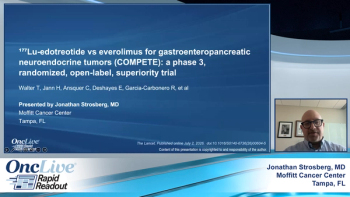
Jonathan Strosberg, MD, of Moffitt Cancer Center, discusses phase 3 COMPETE trial results showing ¹⁷⁷Lu-edotreotide improved progression-free survival, response rate, and safety compared with everolimus in patients with advanced gastroenteropancreatic neuroendocrine tumors.

Dr. Strosberg discusses tarlatamab, a bispecific T-cell engager targeting DLL3 on tumor cells and CD3 on T-cells, bringing cytotoxic T-lymphocytes into close proximity with cancer cells to induce targeted cell death. Although another DLL3-targeting antibody received approval for SCLC, tarlatamab has focused research efforts on both pulmonary and extrapulmonary NECs, making it particularly relevant for specialists managing rare extrapulmonary disease.
Following first-line progression, James's tumor board recommends comprehensive biomarker evaluation. Tissue from the initial biopsy undergoes DLL3 immunohistochemistry testing, returning positive results with H-score of 180 and 85% of tumor cells demonstrating staining intensity of 1+ or greater. Case presentation at multidisciplinary conference raises questions about whether this biomarker result can guide therapeutic decision-making for a patient lacking currently approved targeted options.
Following multidisciplinary tumor board discussion, James initiates first-line carboplatin-etoposide therapy, achieving partial response after 3 cycles with shrinkage of hepatic metastases and the primary colonic mass.
Dr. Strosberg discusses clinical practice approaches when encountering patients like James with colonic masses demonstrating very high Ki-67 indices and neuroendocrine immunohistochemical markers. When pathologists confirm poorly differentiated carcinoma with characteristic Ki-67 exceeding 55% to 70% and appropriate morphology, metastatic disease typically requires medical oncology management with cytotoxic chemotherapy as the primary intervention.
Dr. Strosberg introduces the case of James, a 64-year-old man with hypertension presenting with progressive abdominal pain, 12-pound unintentional weight loss, and fatigue over 6 weeks. Imaging reveals a 4.2-centimeter colonic mass with peritoneal lymph nodes and hepatic lesions. Colonoscopy-guided biopsy confirms poorly differentiated carcinoma of colonic origin, with positive chromogranin A and CK20 immunostaining, Ki-67 proliferation index of 82%, mitotic rate exceeding 20 per high-powered field, and confirmed metastatic disease. Somatostatin receptor expression is negative with mildly elevated chromogranin A levels.

Jonathan Strosberg, MD, associate professor, Moffitt Cancer Center, discusses updates from the NETTER-1 study in patients with neuroendocrine tumors (NETs).

Jonathan Strosberg, MD, associate professor, Moffitt Cancer Center, discusses the FDA approval of Lutathera (177Lutetium DOTA-octreotate) as a treatment for patients with gastroenteropancreatic neuroendocrine tumors (GEP-NETs).

Jonathan Strosberg, MD, medical oncologist, Department of Gastrointestinal Oncology, section head, Neuroendocrine Division, chair, Gastrointestinal Department Research Program, Moffitt Cancer Center, discusses quality of life in patients with midgut neuroendocrine tumors (NETs).

Jonathan Strosberg, MD, associate professor, Moffitt Cancer Center, discusses the results of the NETTER-1 trial.