Articles by Manali Bhave, MD
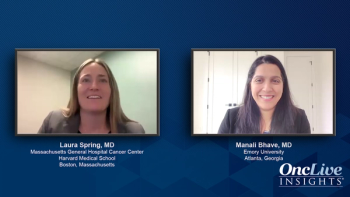
Laura Spring, MD, and Manali Bhave, MD, highlight promising new systemic treatment options on the horizon for patients with metastatic breast cancer, including T-DM1 for HER2-low disease, the AKT inhibitor capivasertib, and novel endocrine therapies.
Laura Spring, MD, and Manali Bhave, MD, discuss sequencing approved antibody-drug conjugates, T-DM1 and sacituzumab govitecan, for hormone receptor-positive, HER2-low metastatic breast cancer after progression on chemotherapy.
Oncologists discuss considerations for systemic therapy selection beyond first-line endocrine-based regimens in recurrent hormone receptor-positive, HER2-low metastatic breast cancer, including use of additional endocrine therapy combinations, chemotherapy, and supportive care approaches.
Laura Spring, MD, and Manali Bhave, MD, discuss considerations for systemic therapy selection in a patient with recurrent hormone receptor-positive, HER2-low breast cancer, including use of plasma and tissue genomic testing and endocrine therapy sequencing based on factors like prior response and ESR1 mutation status.
Oncologists present the clinical scenario of a 65-year-old woman with recurrent HR-positive, HER2-low breast cancer, and discuss optimal sequencing of systemic therapies in this setting.
Doctors Laura Spring and Manali Bhave discuss summarize their recommended sequence of systemic therapy options for HER2-positive metastatic breast cancer, from first-line taxane and dual HER2 blockade through later lines with T-DM1, tucatinib, and other regimens.
Laura Spring, MD, and Manali Bhave, MD, discuss findings from the DESTINY-Breast03 trial and how these results have led them to adopt T-DM1 as the new standard of care over lapatinib/capecitabine for second-line treatment of HER2-positive metastatic breast cancer after progression on first-line trastuzumab and a taxane.
Oncologists discuss key learnings from clinical trials investigating the first-line treatment of patients with HER2-positive metastatic breast cancer, and how these findings help inform their clinical practice regarding selection of optimal systemic therapy regimens.
Experts discuss considerations around first-line treatment selection for HER2-positive metastatic breast cancer, including when to diverge from the standard-of-care treatment, as well as the role of brain MRIs at diagnosis.
Two oncologists present the clinical scenario of a 57-year-old woman with metastatic HER2-positive breast cancer to discuss their approach for incorporating recent research into clinical decision making around systemic therapy.

Manali Bhave, MD, discusses the impact of new treatment strategies on the landscape of hormone receptor–positive/HER2-negative breast cancer.

Manali Bhave, MD, discusses promising combination strategies in triple-negative breast cancer.

Manali Bhave, MD, an assistant professor in the Department of Hematology and Medical Oncology at Winship Cancer Institute, Emory University School of Medicine, discusses promising anti-HER2 agents in metastatic HER2-positive breast cancer.

Manali Bhave, MD, an assistant professor in the Department of Hematology and Medical Oncology at Winship Cancer Institute, Emory University School of Medicine, discusses [fam-] trastuzumab deruxtecan in HER2-positive breast cancer.


![Dr. Bhave Discusses [Fam-] Trastuzumab Deruxtecan in HER2+ Breast Cancer](https://cdn.sanity.io/images/0vv8moc6/onclive/874f5ce9a832809bfa8a3fdcaa39f28f7227e536-275x209.jpg?w=300&fit=crop&auto=format)
