
An expert in hematologic malignancies, Catherine C. Coombs, MD, shares insights gleaned from the ALPINE clinical trial of zanubrutinib vs ibrutinib for relapsed/refractory CLL.
An expert in hematologic malignancies, Catherine C. Coombs, MD, shares insights gleaned from the ALPINE clinical trial of zanubrutinib vs ibrutinib for relapsed/refractory CLL.
Highlighting the ELEVATE TN and ASCEND clinical trials, panelists share expert insights into the next-generation BTK inhibitor acalabrutinib for CLL.
Catherine C. Coombs, MD, leads the faculty in a discussion of the current treatment landscape for CLL with a review of considerations for patients with high-risk or relapsed/refractory disease.
Thought leaders in hematologic malignancies reflect on studies of ROR1 and share perspectives on advancements on the horizon for mantle cell lymphoma.
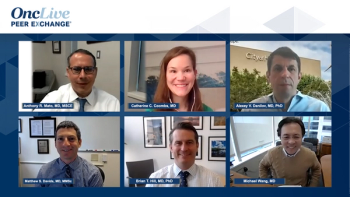
A panel of distinguished faculty builds a lively conversation on the emergence of pirtobrutinib and its effect on treatment sequencing strategies in MCL as well as the overall role of doublet and triplet regimens.
Michael Wang, MD, guides the panel in a discussion on CAR T-cell therapy for relapsed/refractory MCL including a summary of key takeaways from the ZUMA-2 trial and a conversation on real-world vs clinical trial data.
Panelists discuss treatment considerations in the use of BTK inhibitors for relapsed/refractory mantle cell lymphoma, with Matthew S. Davids, MD, MMSc, reviewing strategies for the management of AEs.
Key opinion leaders in mantle cell lymphoma discuss the emergence of more effective novel therapies such as BTK inhibitors and BCL-2 inhibitors and whether there is a continued role for lenalidomide-based regimens.
A panel of experts in hematologic malignancies discusses maintenance strategies for mantle cell lymphoma with particular emphasis on treatment considerations related to the COVID-19 pandemic and real-world data.
Focusing on the differences in treatment considerations between younger and older patients, Michael Wang, MD, discusses the current treatment landscape in mantle cell lymphoma.
Anthony R. Mato, MD, MSCE, introduces the panel, and Alexey V. Danilov, MD, PhD, provides an overview of the incidence, presentation, pathologic features, and treatment landscape for mantle cell lymphoma.
Matthew S. Davids, MD, MMSc, discusses the future of CAR T-cell therapy in chronic lymphocytic leukemia.

Matthew S. Davids, MD, MMSc, discusses investigational doublets and triplets in chronic lymphocytic leukemia.
Matthew S. Davids, MD, MMSc, discusses selecting between continuous and time-limited therapy in chronic lymphocytic leukemia.
Matthew S. Davids, MD, MMSc, discusses factors to consider when selecting treatment for patients with chronic lymphocytic leukemia.
Matthew S. Davids, MD, MMSc, discusses the use of chemoimmunotherapy in patients with chronic lymphocytic leukemia.
Matthew S. Davids, MD, MMSc, discusses remaining questions with umbralisib plus ibrutinib in chronic lymphocytic leukemia and mantle cell lymphoma.
Matthew S. Davids, MD, MMSc, discusses updated findings from a phase 1/1b study which examined the combination of ibrutinib (Imbruvica) and umbralisib in relapsed/refractory chronic lymphocytic leukemia and mantle cell lymphoma.

Matthew S. Davids, MD, MMSc, discusses the rationale for examining ibrutinib in combination with umbralisib in relapsed/refractory chronic lymphocytic leukemia or mantle cell lymphoma.
Matthew S. Davids, MD, MMSc, director, Center for Lymphocytic Leukemia, physician, Dana-Farber Cancer Institute, and assistant professor of medicine, Harvard Medical School, discusses exciting data with acalabrutinib (Calquence) in chronic lymphocytic leukemia (CLL).
Matthew S. Davids, MD, MMSc, associate director, Center for Lymphocytic Leukemia, physician, Dana-Farber Cancer Institute, and assistant professor of medicine, Harvard Medical School, discusses the potential cost effectiveness of a 12-month fixed duration of venetoclax (Venclexta) in combination with obinutuzumab (Gazyva) in first-line chronic lymphocytic leukemia (CLL).
Matthew S. Davids, MD, MMSc, associate director, Center for Lymphocytic Leukemia, physician, Dana-Farber Cancer Institute, and assistant professor of medicine, Harvard Medical School, discusses the use of the BCL‐2 inhibitor, venetoclax (Venclexta) with dose-adjusted infused etoposide, doxorubicin, and cyclophosphamide with vincristine, prednisone, and rituximab (R-EPOCH) to treat patients with Richter
Matthew S. Davids, MD, MMSc, associate director, Center for Lymphocytic Leukemia, physician, Dana-Farber Cancer Institute, and assistant professor of medicine, Harvard Medical School, discusses the use of CAR T-cell therapy for the treatment of patients with chronic lymphocytic leukemia (CLL).
Matthew S. Davids, MD, MMSc, associate director, Center for Chronic Lymphocytic Leukemia, Dana-Farber Cancer Institute, assistant professor of medicine, Harvard Medical School, discusses ongoing research with ibrutinib plus venetoclax in chronic lymphocytic leukemia.
Matthew S. Davids, MD, MMSc, associate director, CLL Center, Dana-Farber Cancer Institute, assistant professor of medicine, Harvard Medical School, discusses challenges in the frontline treatment of patients with chronic lymphocytic leukemia.
Matthew S. Davids, MD, MMSc, associate director, CLL Center, Dana-Farber Cancer Institute, assistant professor of medicine, Harvard Medical School, discusses frontline treatment approaches for patients with chronic lymphocytic leukemia.
Matthew S. Davids, MD, MMSc, associate director, Center for Chronic Lymphocytic Leukemia, Dana-Farber Cancer Institute, discusses updated findings from the DUO study in patients with chronic lymphocytic leukemia.
Matthew S. Davids, MD, MMSc, associate director, Center for Chronic Lymphocytic Leukemia, Dana-Farber Cancer Institute, discusses duvelisib in relapsed/refractory chronic lymphocytic leukemia.
Matthew S. Davids, MD, MMSc, associate director, Dana-Farber Cancer Institute, Center for Chronic Lymphocytic Leukemia, discusses results of a study combining ibrutinib (Imbruiva) plus fludarabine-cyclophosphamide-rituximab (FCR) in patients with chronic lymphoctic leukemia (CLL).
Matthew S. Davids, MD, MMSc, associate director, Dana-Farber Cancer Institute, Center for Chronic Lymphocytic Leukemia (CLL), discusses the initial results of a phase Ib study of ibrutinib (Imbruvica) in combination with obinutuzumab (Gazyva) in patients with relapsed or refractory CLL.