
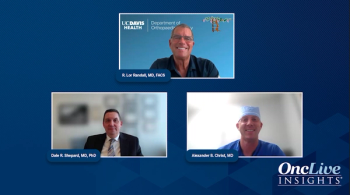
Dale R. Shepard, MD, PhD, of Cleveland Clinic, and Alexander B. Christ, MD, of UCLA Health, discuss practical management of tenosynovial giant cell tumor (TGCT) with R. Lor Randall, MD, FACS, of UC Davis Health.

R. Lor Randall, MD, FACS, is the David Linn Endowed Chair for Orthopedic Surgery and chair of the Department of Orthopedic Surgery as well as a professor at the University of California Davis.
Dale R. Shepard, MD, PhD, of Cleveland Clinic, and Alexander B. Christ, MD, of UCLA Health, discuss practical management of tenosynovial giant cell tumor (TGCT) with R. Lor Randall, MD, FACS, of UC Davis Health.
Dale R. Shepard, MD, PhD, of Cleveland Clinic, reviews the phase 3 MANEUVER trial of pimicotinib, an investigational once-daily colony-stimulating factor 1 receptor (CSF1R) inhibitor under US Food and Drug Administration review for tenosynovial giant cell tumor (TGCT), with R. Lor Randall, MD, FACS, of UC Davis Health, and Alexander B. Christ, MD, of UCLA Health.
Dale R. Shepard, MD, PhD, of Cleveland Clinic, compares the 2 approved colony-stimulating factor 1 receptor (CSF1R) inhibitors for tenosynovial giant cell tumor (TGCT), pexidartinib and vimseltinib, with R. Lor Randall, MD, FACS, of UC Davis Health, and Alexander B. Christ, MD, of UCLA Health.
Alexander B. Christ, MD, of UCLA Health, and Dale R. Shepard, MD, PhD, of Cleveland Clinic, explain how they choose between surgery and systemic therapy for diffuse tenosynovial giant cell tumor (TGCT) in a discussion moderated by R. Lor Randall, MD, FACS, of UC Davis Health.
R. Lor Randall, MD, FACS, of UC Davis Health, opens this OncLive Insights discussion on tenosynovial giant cell tumor (TGCT) with Dale R. Shepard, MD, PhD, of Cleveland Clinic, and Alexander B. Christ, MD, of UCLA Health.
R. Lor Randall, MD, FACS, reviews the prognostic potential and current clinical limitations of personalized ctDNA panels in osteosarcoma.
R. Lor Randall, MD, FACS, discusses how ctDNA could be used to identify microscopic residual disease in patients who appear radiographically disease-free.
R. Lor Randall, MD, FACS, discusses how tumor-informed ctDNA sequencing can identify osteosarcoma relapse months before radiographic detection.
R. Lor Randall, MD, FACS discusses safety and efficacy data from the MANEUVER trial, which evaluated pimicotinib in TGCT.
R. Lor Randall, MD, FACS discusses safety and efficacy data from the MANEUVER trial, which evaluated pimicotinib in TGCT.
R. Lor Randall, MD, FACS, discusses the rationale of a meta-analysis comparing IM nailing and EP reconstruction for patients with bone metastases.
R. Lor Randall, MD, FACS, discusses how the BOOM consensus provides a global standard for managing complex infections in orthopedic oncology.
R. Lor Randall, MD, FACS, discusses global consensus on managing periprosthetic joint infections in sarcoma and complex bone reconstructions.
R. Lor Randall, MD, FACS, discusses the clinical utility and global variability of DAIR procedures for periprosthetic joint infection in sarcoma.
R. Lor Randall, MD, FACS, discusses results from an analysis of factors associated with local recurrence risk in nonmetastatic Ewing sarcoma.

Joseph Dominic Femino, MD, discusses the lack of adjuvant options for chondrosarcoma and the promise of IDH inhibitors like ivosidenib.
R. Lor Randall, MD, FACS, discusses the multidisciplinary nature of research aiming to develop a predictive model of sarcoma survivorship.
R. Lor Randall, MD, FACS, discusses the potential implications of research into how socioeconomic disparities and cancer biology impact long-term outcomes in pediatric sarcoma.
R. Lor Randall, MD, FACS, outlines the aims and phases of a prospective study evaluating outcome disparities in pediatric sarcoma survivorship care.
R. Lor Randall, MD, discusses the need to move beyond modest survival improvements in pediatric bone sarcoma toward equitable, precision survivorship care.

R. Lor Randall, MD, FACS, discusses a new STS surveillance algorithm based on findings that show the comparable diagnostic utility of ultrasound and MRI.
R. Lor Randall, MD, FACS, summarizes the current status of and future directions for imaging protocols for post-surgical extremity STS surveillance.

R. Lor Randall, MD, FACS, compares the diagnostic accuracy, recurrence detection rates, and cost effectiveness of MRI vs ultrasound STS surveillance.
R. Lor Randall, MD, FACS, discusses the current paradigm and future trajectory of imaging modalities for the surveillance of soft tissue sarcoma.
R. Lor Randall, MD, FACS, discusses the challenges associated with incorporating surgical protocols into clinical trials evaluating sarcoma treatments.
R. Lor Randall, MD, FACS, discusses future research directions for advancing prosthetic embodiment for patients with sarcoma undergoing amputation.

R. Lor Randall, MD, FACS, discusses the management of non-ossifying fibromas, and how this differs from that of malignant tumors.

R. Lor Randall, MD, FACS, discusses the complexity of perivascular epithelioid cell tumors and the critical importance of multidisciplinary care.
R. Lor Randall, MD, FACS, discusses how suboptimal access to multidisciplinary, coordinated care remains a critical barrier to optimal outcomes in sarcoma.

R . Lor Randall, MD, FACS, discusses disparities in global access to care for patients with sarcoma.

November 16th 2020


