
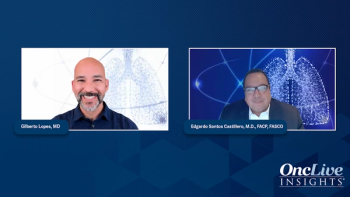
Dr. Edgardo Santos and Dr. Gilberto Lopes introduce the program and establish the clinical relevance of HER2-mutated NSCLC as an emerging target in thoracic oncology.

This expert-led oncology program features Dr. Edgardo Santos and Dr. Gilberto Lopes, who provide a clinicalvly focused discussion on therapeutic advances in HER2-mutated non–small cell lung cancer (NSCLC). Drawing from a recent workshop, the discussion synthesizes emerging clinical trial data, evolving treatment paradigms, and real-world decision-making considerations in this molecular subset of NSCLC. The faculty contextualize HER2 as a distinct actionable driver, emphasizing differences from HER2-positive breast cancer and outlining implications for biomarker testing, sequencing strategies, and patient selection. Key themes include the integration of HER2-targeted antibody-drug conjugates (ADCs), interpretation of efficacy and safety data, and challenges in optimizing first-line versus later-line therapy. Drs. Santos and Lopes also explore CNS activity, resistance mechanisms, and future directions in clinical research. The program is designed to support oncologists in translating rapidly evolving HER2 NSCLC data into evidence-based clinical practice.
Dr. Edgardo Santos and Dr. Gilberto Lopes introduce the program and establish the clinical relevance of HER2-mutated NSCLC as an emerging target in thoracic oncology.
In this section, the discussion shifts to therapeutic advances in HER2-mutated NSCLC, with a particular focus on antibody-drug conjugates (ADCs) as a transformative treatment modality.
This segment addresses the safety profile and toxicity management of HER2-targeted ADCs, a critical consideration for oncologists integrating these therapies into routine practice.
In this segment, Drs. Santos and Lopes explore treatment sequencing strategies for patients with HER2-mutated NSCLC, a rapidly evolving area of clinical decision-making. The discussion addresses the current positioning of HER2-targeted therapies relative to chemotherapy and immunotherapy, particularly in the first-line setting.
Dr. Santos and Dr. Lopes address the incidence of brain metastases and management of central nervous system (CNS) metastases in patients with HER2-mutated NSCLC, a clinically significant challenge in thoracic oncology.
The discussion turns to mechanisms of resistance to HER2-targeted therapies and the implications for future research and clinical practice. Drs. Santos and Lopes note that, as with other targeted therapies, resistance inevitably develops, necessitating ongoing innovation.
This section provides practical insights that help oncologists bridge the gap between evidence and practice, enhancing the applicability of HER2-targeted therapies in diverse patient populations.
Drs. Santos and Lopes provide a forward-looking perspective on the future of HER2-targeted therapy in NSCLC, emphasizing ongoing clinical trials and anticipated paradigm shifts. They discuss the potential for earlier-line use of ADCs, as well as combination strategies that may further improve outcomes.