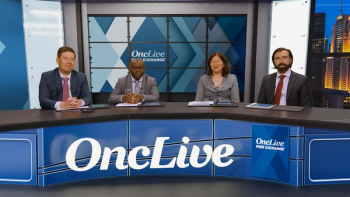
Evolving Treatment Strategies in Small Cell Lung Cancer
Centering discussion on several patient scenarios, expert panelists review recent clinical data and consider how it has impacted their management of patients with small cell lung cancer (SCLC).
Advertisement
Evolving Treatment Strategies in Small Cell Lung Cancer
Expert oncologists provide an overview of the landscape surrounding small-cell lung cancer and highlight the importance of early referral and diagnosis for overall patient outcomes.
Faculty discuss the evolving role of molecular markers in small-cell lung cancer and the need for future research to identify improved biomarkers for targeted treatment options.
A panel of expert oncologists present the case of a 68-year-old man with newly diagnosed, extensive stage small-cell lung cancer and brain metastases, who is treated with carboplatin, etoposide, and durvalumab, and provide their initial impressions.
Faculty discuss potential treatment approaches for limited stage small-cell lung cancer currently under investigation in the ADRIATIC and other ongoing trials.
Expert oncologists present the case of a 45-year-old woman with synaptophysin-positive, extensive-stage small-cell lung cancer with a Ki-67 score of 90%, who is treated with carboplatin, etoposide, and atezolizumab in the first-line setting, and provide their initial impressions.
Faculty discuss real world data for treatment approaches using chemotherapy in combination with immunotherapy in extensive-stage small-cell lung cancer.
A panel of expert oncologists present the case of a 78-year-old woman who is treated with lurbinectedin following disease progress on first-line carboplatin, etoposide, and atezolizumab.
Expert oncologists discuss important dosing considerations and treatment management strategies for lurbinectedin and other second-line therapy approaches in small-cell lung cancer.