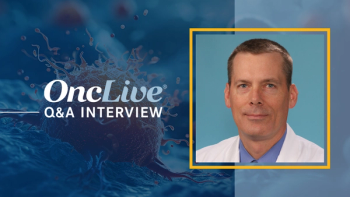
R. Lor Randall, MD, FACS, discusses AI in musculoskeletal tumor diagnosis, surgical planning and robotics, and validation of AI tools.

R. Lor Randall, MD, FACS, outlines how AI may affect oncology training, how to properly work alongside AI, and AI-patient conversations.
Artificial intelligence (AI) is poised to reshape both how oncologists are trained and how patients seek answers between visits, additionally, clinicians will need to engage with these tools deliberately, using them to sharpen rather than replace their own thinking, according to R. Lor Randall, MD, FACS.
"The next generation needs to understand that they will need to find a way to complete rather than compete with AI," Randall said in an exclusive interview with OncLive®. "Ultimately, no matter how empathetic and sympathetic an algorithm can become, and no matter how finessed the robot is, for the foreseeable future, [AI] will not have what the human experience is, which is in large part a fear of mortality or the spirituality of what it means to exist. There will always be an anchoring back to what the human experience is."
In the interview, Randall discussed how trainees can use AI to deepen rather than erode clinical understanding, why AI tools should be set to challenge rather than affirm users, and how clinicians should approach AI-driven patient interactions.
Randall is the David Linn Endowed Chair for Orthopedic Surgery, chair of the Department of Orthopedic Surgery, and a professor at the University of California Davis Comprehensive Cancer Center in Sacramento.
Want to learn more about navigating the implementation of AI in oncology? Be sure to check
Randall: That is the relevant question [about AI in oncology], and it hits me personally AI is going to have to be carefully brought into the educational arena. There's a lot of thought that goes into this, and [there are] a lot of people who are talking about it in medical school curricula, for example. We can't ignore [AI tools in education], but we also need to make sure that as Homo sapiens is learning the material, and that we don't let silico sapiens take away our ability to have a deep understanding of that material.
[Using AI in oncology education] needs some real discretion. We need to find ways by which we are monitoring the learning process of our next generation of colleagues to make sure that they are having a deep understanding.
One of the problems we have with AI right now, is [that] for all of the tools that we use, we need to make sure that the settings for affirmation of the driver of the chat are at their lowest setting, [so AI tools] are not trying to please us. Whenever I use AI to learn something, I ask it to be provocative of me and to confront me and challenge my thinking on things, [therefore] it makes me think deeper and harder about an issue.
If I'm thinking of a research project, I will have a conversation with [AI], and I will say, "I need you to push back on this hypothesis. I need you to critically evaluate how I am thinking." That gives me enhanced thinking. I want to be pushing myself.
Many of us turn to [AI] and have the setting on the high pleasure factor, so to speak, where [it affirms your input] when it wasn't [warranted], because that's how [AI companies] get more subscribers, due of the dopamine hit that we get with that pleasure principle. What we want is [to] have AI scrutinize and push back on our thinking so that we improve our own cognition by interfacing Homo sapiens with silico sapiens.
This is a real issue. There are peer-reviewed studies out there where there are blinded encounters for a patient. Where [patients] are interfacing with an algorithm or interfacing with a provider. As of a couple of years ago, the satisfaction rates were approximately around 50%, [meaning that] even a couple of years ago, the satisfaction of talking to an AI was as pleasurable as it was to a person, and that's telling.
We need to take this seriously, because a human being needs 8 hours of sleep and we have productivity benchmarks where we have to see a patient every 15 to 30 minutes. We are sleeping during a period of the day [whereas] AI doesn't need to sleep. It needs a lot of energy, but it doesn't need to sleep. [Using AI tools for patient interactions] becomes convenient if a patient in the middle of the night has a question to get that instantaneous appointment with an AI and get some answers to their questions. These are real issues.
We as a medical community in general need to understand that this is coming, whether we like it or not. The 2 most expensive industries are health care and education currently, because they're so human resource intense. We have to pay people to educate; we have to pay people to take care of people, and that is socioeconomically demanding. The economics are going to drive [AI interactions with patients], there's going to be less and less demand for terminal degree people to do these things.
[The oncology field] needs to be part of that equation and not ignore it. The next generation needs to understand that they will need to find a way to complete rather than compete with AI. Ultimately, no matter how empathetic and sympathetic an algorithm can become, and no matter how finessed the robot is, for the foreseeable future, [AI] will not have what the human experience is, which is in large part a fear of mortality or the spirituality of what it means to exist. There will always be an anchoring back to what the human experience is.
Socioeconomically, [there is] going to be less and less demand for human workers in the equation, but we will still be in demand because we're taking care of our brothers and sisters.
Generative AI, speaking as a non- expert, is getting smarter. It's understanding more and more about the human experience. If [AI has] learned what the anxieties of a patient are, it probably already will dial back its provocations, and will be superseded by the empathy and the fact that they don't want to say something that is going to irritate the patient. I've been impressed with the social adaptability of the technology that I've interfaced with in this arena.
We in health care need to have a confident but also humble perspective on AI. We will be in demand, but in a different way. [AI] is something that can augment the experience, and it is not going away. It's only going to become more relevant and prevalent. We need to rediscover our humanity and to make sure that that nugget of being alive and carbon-based as opposed to silicon-based keeps us all working together.
Editor's Note: This transcript has been edited for grammar and clarity using artificial intelligence tools.