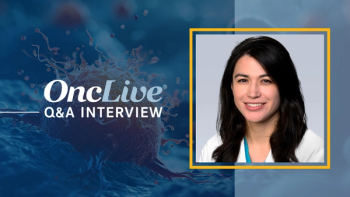
As longer-term follow-up data emerge from clinical trials evaluating fixed-duration BTK inhibitor–based regimens, the findings could help clarify the role of BTK inhibitor rechallenge after relapse in patients with mantle cell lymphoma (MCL), according to Tycel Phillips, MD.
Phillips highlighted certain key trials evaluating BTK inhibitor–based regimens in MCL, including the phase 2 TrAVeRse study (NCT05951959), the phase 3 TRIANGLE study (NCT02858258), and the phase 2 BOVen study (NCT03824483). TrAVeRse is evaluating acalabrutinib (Calquence) plus venetoclax (Venclexta) and rituximab (Rituxan; AVR) in patients with treatment-naive MCL.1 TRIANGLE evaluated ibrutinib (Imbruvica) plus R-CHOP (rituximab, cyclophosphamide, doxorubicin hydrochloride, vincristine sulfate [Oncovin], and prednisone) in the frontline setting, followed by 2 years of ibrutinib maintenance.2 Finally, BOVen examined zanubrutinib (Brukinsa), obinutuzumab (Gazyva), and venetoclax in patients with MCL harboring TP53 mutations.3
In an interview with OncLive®, Phillips explained why data from longer follow-ups in these trials and others evaluating BTK inhibitor-based regimens in MCL will be pivotal for answering crucial questions. He also underscored other areas of need that future MCL trials could aim to address.
Phillips is an associate professor in the Department of Hematology and Hematopoietic Cell Transplantation in the Division of Lymphoma at City of Hope in Duarte, California.
OncLive: What developments are you watching in the MCL space right now?
Phillips: [What’s] important is that we have a plethora of frontline studies that have incorporated BTK inhibitors with or without chemotherapy. Part of the appeal, at least with some of these regimens, is that use of a time-limited approach [with BTK inhibitors] may allow retreatment of patients at the time of relapse. As we get more long-term follow-up [data] from these studies, [determining] whether [BTK inhibitor rechallenge] is feasible or just something that we hoped [for but] never came to reality will be quite important, considering what we have historically known about [limited] treatment options after failure of a BTK inhibitor.
Which longer-term BTK inhibitor data could help inform practice strategies?
If we look at studies that are still generating more new data, the TrAVeRse study, which…looked at the AVR combination in the frontline space, [is interesting]. [TrAVeRse] is a global study that enrolled [108] patients and completed enrollment fairly quickly. Once they completed induction therapy, [patients were] randomly assigned to maintenance or to stop treatment if they were minimal residual disease [MRD] negative. Seeing what maintenance adds in this patient population and if it’s needed [will be crucial]. In the initial readout at the 2025 American Society of Hematology Annual Meeting and Exposition, MRD-negativity rates were reported at a 10–5 [sensitivity]. A lot of these data sets that we have, at least in the MCL space, have leaned on the fact that 10–6 is probably the most appropriate cutoff for durable responses. As we get that sort of information about how many of those patients reached [the 10–6 threshold], [seeing] what happened to the patients who were randomly assigned to stop treatment vs those in maintenance will be an important component.
Moving forward, we hope that we get more long-term follow-up [data] from TRIANGLE, the study that treated patients with ibrutinib plus R-CHOP, followed by 2 years of ibrutinib maintenance. [As] this study was one of the first [phase 3 trials] to read out with a time-limited BTK inhibitor approach, it will be important to know whether those patients, when they do start to relapse, can be re-treated with a BTK inhibitor.
Persisting Questions in MCL
- Whether patients can be re-treated with BTK inhibitor–based regimens following fixed-duration treatment with this class of agents remains a large question in MCL.
- Long-term follow-up data from the TrAVaRse, TRIANGLE, and BOVen studies may help address outstanding questions about BTK inhibitors.
- Other ongoing research could address unmet needs for patients with highly proliferative, blastoid, or pleomorphic disease.
The same goes for the BOVen study, which came out of Memorial Sloan Kettering Cancer Center and evaluated zanubrutinib [plus] obinutuzumab and venetoclax. [This study had a] more niche patient population [than other studies], as BOVen only looked at patients with TP53 mutations. Again, [BOVen] utilized a time-limited treatment approach including a BTK inhibitor, and the question remains: At relapse, will these patients be able to be rechallenged with a BTK inhibitor, or will we need to consider other treatment options…?
I am eager to see what happens with these patients in long-term follow-up. If we don’t get that information from these studies, as we start developing more studies using BTK inhibitors, the second progression-free survival [PFS2] or the second remission duration [for patients becomes important]. Does PFS2 equate what we have historically had when we sequentially separated BTK inhibitors from frontline therapy, or is it longer or shorter? These are the questions that we need to really get a grasp on before we fully indoctrinate these [inhibitors] into our untreated patients.
How are you currently approaching frontline treatment decisions for newly diagnosed patients with MCL?
[Answering this question] has become more complicated, and I don’t say that in a negative way. We have more options for patients, which is a good thing and allows a more nuanced approach to picking which options are better for the patient. [Increased treatment options mean] not necessarily just saying older patients go to chemotherapy and maintenance rituximab, or younger patients go to chemotherapy and consolidation with transplant.
Given that we have all these chemotherapy-free or novel therapeutic regimen options, we can pick and choose how and which patients are better suited [for given treatments]. It’s an easier discussion for the typical patient with MCL who is in their 60s, where the aim is still to keep the cancer in remission as long as possible. However, [remission duration] is much shorter, in theory,with a patient who is 60 or 50 years old vs patients who are diagnosed in their 30s and 40s.
When you’re trying to get the deepest remission but also try to plan ahead for a patient [whom], without the disease, you expect…to live another 40 to 50 years, it’s a different discussion compared with a patient who, on average, may only live another 20 years. Beyond those 20 years is a stretch, even with some of these long-term follow-up data we have, a lot of which are still within a 20 to 30–year range.
Tying in the discussion we have with some of these novel treatments, we must be cognizant of the point that with some of these younger patients, the [later-line] treatments we are going to provide them with are important, especially knowing that the cancer will come back, unless we’re providing remissions of a couple of decades, at which point we would hope to have newer and better treatments at the time the relapse for those patients.
What other major unmet needs remain in the MCL space and treatment paradigm?
[One good thing] is that we have had several studies that suggest that we’ve done a much better job at treating patients with TP53 mutations. [Thus, TP53 mutations] may not be the boogeyman anymore [in MCL]. We still struggle with certain patients with other features, [such as patients who are] highly proliferative, blastoid, or pleomorphic, in addition to other mutations that are noted to negatively affect patient outcomes. [Patients with] NOTCH and KMT2A mutations look like those who are the most in need right now.
As we look at the studies that have presented some outcomes for these patients and circling back to these BTK inhibitor–based studies, there are the patients who probably are not benefiting as much as some of these other groups with the addition of a BTK inhibitor. They may need more in addition to those drugs or completely different treatments altogether as [the MCL space] moves forward.
References
- A study of acalabrutinib plus venetoclax and rituximab in participants with treatment naïve mantle cell lymphoma (TrAVeRse). ClinicalTrials.gov. Updated October 21, 2025. Accessed March 2, 2026. https://clinicaltrials.gov/study/NCT05951959
- ASCT after a rituximab/ibrutinib/ara-c containing induction in generalized mantle cell lymphoma. ClinicalTrials.gov. Updated December 19, 2017. Accessed March 2, 2026. https://clinicaltrials.gov/study/NCT02858258
- Study of zanubrutinib, obinutuzumab, and venetoclax in patients with chronic lymphocytic leukemia (CLL) or small lymphocytic leukemia (SLL). ClinicalTrials.gov. Updated September 23, 2025. Accessed March 2, 2026. https://clinicaltrials.gov/study/NCT03824483