John L. Marshall, MD, Georgetown University
Articles by John L. Marshall, MD, Georgetown University
Advanced Cholangiocarcinoma: Molecular Testing
ByJohn L. Marshall, MD, Georgetown University,R. Kate Kelley, MD, UCSF Helen Diller Family Comprehensive Cancer Center,Sameek Roychowdhury, MD, PhD, James Cancer Hospital & Solove Research Institute,Milind Javle, MD, The University of Texas MD Anderson Cancer Center Experts who treat patients with GI cancers, such as cholangiocarcinoma, emphasize the need for more standardized approaches to molecular testing.
Advanced Cholangiocarcinoma: Transition to Precision Medicine
ByJohn L. Marshall, MD, Georgetown University,R. Kate Kelley, MD, UCSF Helen Diller Family Comprehensive Cancer Center,Sameek Roychowdhury, MD, PhD, James Cancer Hospital & Solove Research Institute,Milind Javle, MD, The University of Texas MD Anderson Cancer Center A panel of GI oncologists comment on the transition to targeted therapy and immunotherapy as treatments for advanced cholangiocarcinoma, as well as highlight predictive and prognostic markers that can help guide treatment decisions with novel therapies.
Treating Unresectable, Advanced Cholangiocarcinoma
ByJohn L. Marshall, MD, Georgetown University,R. Kate Kelley, MD, UCSF Helen Diller Family Comprehensive Cancer Center,Sameek Roychowdhury, MD, PhD, James Cancer Hospital & Solove Research Institute,Milind Javle, MD, The University of Texas MD Anderson Cancer Center Treatment recommendations, including supportive care options and the role of liver-directed therapy for patients with an unresectable, advanced bile duct cancer.
Neoadjuvant Therapy for Advanced Cholangiocarcinoma
ByJohn L. Marshall, MD, Georgetown University,R. Kate Kelley, MD, UCSF Helen Diller Family Comprehensive Cancer Center,Sameek Roychowdhury, MD, PhD, James Cancer Hospital & Solove Research Institute,Milind Javle, MD, The University of Texas MD Anderson Cancer Center An overview of potential options, as well as trials, further exploring neoadjuvant approaches for the management of patients with advanced cholangiocarcinoma.
Optimizing Adjuvant Therapy for Advanced Cholangiocarcinoma
ByJohn L. Marshall, MD, Georgetown University,R. Kate Kelley, MD, UCSF Helen Diller Family Comprehensive Cancer Center,Sameek Roychowdhury, MD, PhD, James Cancer Hospital & Solove Research Institute,Milind Javle, MD, The University of Texas MD Anderson Cancer Center Insight regarding best timing to initiate an appropriate adjuvant therapy in patients with advanced cholangiocarcinoma, and the role of ctDNA analysis in the postsurgical setting.
Adjuvant Therapy for Advanced Cholangiocarcinoma
ByJohn L. Marshall, MD, Georgetown University,R. Kate Kelley, MD, UCSF Helen Diller Family Comprehensive Cancer Center,Sameek Roychowdhury, MD, PhD, James Cancer Hospital & Solove Research Institute,Milind Javle, MD, The University of Texas MD Anderson Cancer Center Current treatment approaches for advanced cholangiocarcinoma, despite current gaps that can be considered in the adjuvant setting, as highlighted by GI oncologists.
Liver Transplantation for Advanced Cholangiocarcinoma
ByJohn L. Marshall, MD, Georgetown University,R. Kate Kelley, MD, UCSF Helen Diller Family Comprehensive Cancer Center,Sameek Roychowdhury, MD, PhD, James Cancer Hospital & Solove Research Institute,Milind Javle, MD, The University of Texas MD Anderson Cancer Center Scenarios for which liver transplantation may be appropriate in advanced cholangiocarcinoma.
Advanced Cholangiocarcinoma: Criteria for Resection
ByJohn L. Marshall, MD, Georgetown University,R. Kate Kelley, MD, UCSF Helen Diller Family Comprehensive Cancer Center,Sameek Roychowdhury, MD, PhD, James Cancer Hospital & Solove Research Institute,Milind Javle, MD, The University of Texas MD Anderson Cancer Center Panelists discuss types of scans and other testing results that can be used to help identify patients with an advanced bile duct cancer who are eligible for surgical resection.
Advanced Cholangiocarcinoma: Current Patient Prognosis
ByJohn L. Marshall, MD, Georgetown University,R. Kate Kelley, MD, UCSF Helen Diller Family Comprehensive Cancer Center,Sameek Roychowdhury, MD, PhD, James Cancer Hospital & Solove Research Institute,Milind Javle, MD, The University of Texas MD Anderson Cancer Center GI oncologists react to a prognosis for patients with newly diagnosed advanced cholangiocarcinoma and discuss how they counsel patients on goals of care and treatment expectations.
Cholangiocarcinoma: Importance of Adequate Tissue Collection
ByJohn L. Marshall, MD, Georgetown University,R. Kate Kelley, MD, UCSF Helen Diller Family Comprehensive Cancer Center,Sameek Roychowdhury, MD, PhD, James Cancer Hospital & Solove Research Institute,Milind Javle, MD, The University of Texas MD Anderson Cancer Center Best practices for working with other colleagues to ensure adequate tissue collection occurs when conducting a biopsy on a patient suspected of having cholangiocarcinoma, as well as considerations for next-generation sequencing.
Cholangiocarcinoma: Appropriate Diagnostic Work-Up
ByJohn L. Marshall, MD, Georgetown University,R. Kate Kelley, MD, UCSF Helen Diller Family Comprehensive Cancer Center,Sameek Roychowdhury, MD, PhD, James Cancer Hospital & Solove Research Institute,Milind Javle, MD, The University of Texas MD Anderson Cancer Center Types of assessments that are used to help appropriately work up a patient suspected of having a bile duct cancer.
Rising Incidence of Cholangiocarcinoma
ByJohn L. Marshall, MD, Georgetown University,R. Kate Kelley, MD, UCSF Helen Diller Family Comprehensive Cancer Center,Sameek Roychowdhury, MD, PhD, James Cancer Hospital & Solove Research Institute,Milind Javle, MD, The University of Texas MD Anderson Cancer Center Factors that may contribute to the rise in the number of cholangiocarcinoma cases being reported, as suggested by GI oncologists.
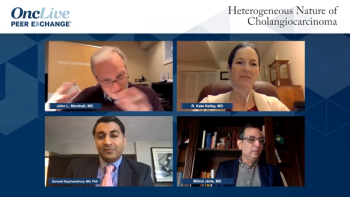
Heterogeneous Nature of Cholangiocarcinoma
ByJohn L. Marshall, MD, Georgetown University,R. Kate Kelley, MD, UCSF Helen Diller Family Comprehensive Cancer Center,Sameek Roychowdhury, MD, PhD, James Cancer Hospital & Solove Research Institute,Milind Javle, MD, The University of Texas MD Anderson Cancer Center GI oncologists explain the complicated nature of cholangiocarcinoma as it relates to the disease’s underlying pathogenesis.
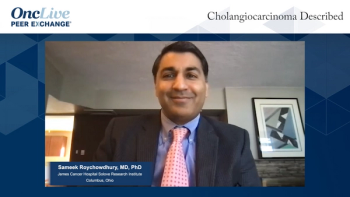
Cholangiocarcinoma Described
ByJohn L. Marshall, MD, Georgetown University,R. Kate Kelley, MD, UCSF Helen Diller Family Comprehensive Cancer Center,Sameek Roychowdhury, MD, PhD, James Cancer Hospital & Solove Research Institute,Milind Javle, MD, The University of Texas MD Anderson Cancer Center Dr Sameek Roychowdhury, of the James Cancer Hospital Solove Research Institute, describes what cholangiocarcinoma is, specifically highlighting how the disease often presents in patients.


