

A brief overview of oral SERDs currently being investigated in the setting of relapsed/refractory HR+/HER2- breast cancer.
A brief overview of oral SERDs currently being investigated in the setting of relapsed/refractory HR+/HER2- breast cancer.

Panelists briefly consider the ongoing role of everolimus in relapsed/refractory HR+/HER2- breast cancer given recent shifts in the treatment paradigm.

Comprehensive insight on novel treatment approaches in the setting of relapsed/refractory HR+/HER2- breast cancer, including oral SERDs, SERMs, and ER PROTAC degraders.

Shifting their focus to the HR+/HER2+ setting of breast cancer, expert panelists consider the potential of CDK4/6 inhibition in light of clinical trial data.
A brief review of frontline combination strategies in the context of multiple driver pathways in HR+/HER2- breast cancer.
Experts home in on real-world data and resistance mechanisms to discuss practical use of CDK4/6 inhibition in HR+/HER2- breast cancer.v
Comprehensive insight on the barriers to CDK4/6 inhibition in HR+/HER2- breast cancer, from both medical and accessibility perspectives.
Taking into account all 3 available CDK4/6 inhibitors in HR+/HER2- breast cancer, experts consider how they’d select frontline therapy in this setting.
Panelists share insight on clinical trial data behind use of palbociclib in the frontline setting of HR+/HER2- breast cancer.
Focusing on the frontline setting of HR+/HER2- breast cancer, panelists discuss clinical trial data with abemaciclib and ribociclib, respectively.
Expert perspectives on the evolving treatment paradigm for patients receiving frontline therapy for HR+/HER2- breast cancer.
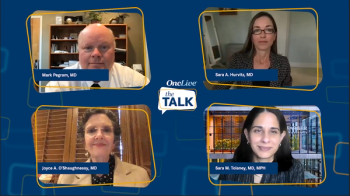
Drs Joyce O’Shaughnessy, Sara Tolaney, Sara Hurvitz, and Mark Pegram examine recent trial data from ESMO 2021 on triple-negative breast cancer.
Breast oncologists explain results from the phase III MONALEESA-2 trial presented at ESMO 2021, and its clinical implications.
Key opinion leaders review data from the phase III TULIP trial in patients with pre-treated HER2-positive locally advanced or metastatic breast cancer and the ExteNET study on extended adjuvant treatment with neratinib.
Experts highlight key messages regarding optimal identification and management of interstitial lung disease.
Drs. Sara Tolaney and Mark Pegram discuss promising therapies and upcoming mechanisms of actions to treat HER2+ metastatic breast cancer.
Breast cancer experts, Drs. Sara Tolaney and Mark Pegram discuss ongoing and noteworthy trials with trastuzumab deruxtecan in mBC.
Sara Tolaney, MD, and Mark Pegram, MD, discuss their rationale for sequencing of most effective therapy in treatment of patients with metastatic breast cancer.
Expert oncologists discuss data from several phase 2 and phase 3 trials presented at ESMO 2021 on the use of trastuzumab deruxtecan for HER2-positive breast cancer and how it impacts their practices.
Shared insight on the benefit of multidisciplinary care and the pulmonologist’s role in identifying and managing interstitial lung disease.
Key opinion leaders share risk-benefit considerations when utilizing therapies that may increase a patient’s risk of developing ILD.
Breast cancer experts, Sara Tolaney, MD, and Mark Pegram, MD, discuss current standard of care in sequencing of therapies in mBC and the effect of DESTINY-Breast03 data on sequencing going forward.
Mark Pegram, MD, and Sara Tolaney, MD, review the DESTINY-Breast03 study design, clinical efficacy, and safety data.
Sara Tolaney, MD, describes trastuzumab deruxtecan and the data that led to its accelerated approval in HER2+ breast cancer.
Mark Pegram, MD, provides a historical perspective on recent advancements made in the treatment landscape for patients with HER2-positive breast cancer.
Charles A. Powell, MD, MBA, leads a discussion on bronchoscopy’s role in identifying interstitial lung disease.
A broad review of strategies to manage interstitial lung disease, including steroid use, therapy cessation/rechallenging, and dose reduction.
Brief considerations for the impact an agent’s therapeutic class can have on how interstitial lung disease should be approached.
Experts consider the mainstays in ILD management and factors that may dictate one treatment strategy over another.
Mark D. Pegram, MD, discusses unmet clinical needs in HER2-positive metastatic breast cancer.