In this final segment, our panel looks ahead at where the field is going and what the next wave of advances could mean for patients who do not yet have good options.

Richard D. Carvajal, MD, is physician-in-chief and director of medical oncology at the Northwell Health Cancer Institute, and leads all hematology and medical oncology programs across Northwell’s cancer network.
In this final segment, our panel looks ahead at where the field is going and what the next wave of advances could mean for patients who do not yet have good options.
In this segment, our panel makes the case for universal HLA-A*02:01 testing in every uveal melanoma patient and gives you the practical tools to make it happen in your practice today.
In this segment, our panel gets into the specifics of how academic and community oncologists can work together to ensure patients on tebentafusp stay on therapy and receive the right guidance throughout their treatment.
In this segment, our panel addresses one of the most important and underappreciated problems in uveal melanoma care: the gap between patients who are eligible for effective therapy and patients who actually receive it.
In this segment, our panel addresses the practical realities of administering tebentafusp week after week, including how leading centers have built workflows that allow patients to transition from academic induction to community-based ongoing dosing without interrupting treatment continuity.
In this segment, our panel takes a closer look at the Phase 3 trial data supporting tebentafusp, exploring what the overall survival benefit means in the context of modest response rates and limited progression-free survival, and why this trial changed how the field thinks about measuring success in uveal melanoma.
In this segment, our panel prepares you for what to expect when you start a patient on tebentafusp, covering the toxicity profile in practical detail and explaining why the first few doses look very different from what comes later.
In this segment, our panel explains the mechanism of bispecific T-cell engager therapy and why it works differently from every other approach that has been tried in uveal melanoma.
In this segment, our panel puts the current treatment landscape for metastatic uveal melanoma into historical context, walking through the long series of agents that failed to move the needle before the recent shift in what is achievable for these patients.
In this segment, our panel goes deeper into the molecular workup for uveal melanoma, covering the prognostic significance of BAP1, SF3B1, and EIF1AX mutations alongside gene expression profiling, and explaining how PRAME is emerging as both a prognostic marker and a potential therapeutic target.
In this segment, our panel walks through the initial workup for a patient newly diagnosed with uveal melanoma, with a focus on how gene expression profiling and PRAME status are used to stratify patients by metastatic risk.
In this segment, our panel establishes why uveal melanoma is a fundamentally different disease from cutaneous melanoma and why that distinction matters for every treatment decision that follows.
In this last episode, experts underscore the importance of incorporating the patient voice into clinical trial processes.
In this episode, experts discuss the growth and strategic development of Northwell's cancer clinical trial programs.
In this episode, experts discuss how artificial intelligence tools can enhance clinical trial recruitment, improve workforce efficiency, and more.
In this episode, experts highlight the increasing push to simplify cancer trial eligibility criteria and improve diversity in participant enrollment.
In this episode, experts discuss progress in cancer clinical trials and the challenges posed by the increasing complexity of therapies and protocols.
In this episode, experts emphasize the importance of providing flexible clinical trial options, such as satellite sites and remote follow-ups.
In this episode, experts discuss the challenges of increasing awareness and participation in clinical trials.
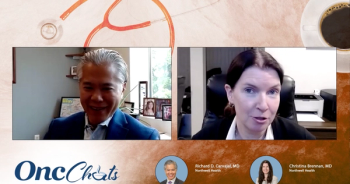
In this episode, experts discuss the importance of integrating clinical trials as a standard of care, particularly in the realm of oncology.
Richard D. Carvajal, MD, discusses the prognostic factors of uveal melanoma that differentiate it from other subsets of melanoma.
Richard Carvajal, MD, Director of Experimental Therapeutics and Director of the Melanoma Service at Columbia University Medical Center, discusses the phase III SUMIT trial, a randomized, placebo-controlled, double-blind trial of selumetinib in combination with dacarbazine in patients with metastatic uveal melanoma.
Richard D. Carvajal, MD discusses the significance of researching, understanding, and improving outcomes for patients with rare cancers.
Richard D. Carvajal, MD, Director, Experimental Therapeutics and Melanoma Service New York-Presbyterian Hospital/ Columbia University Medical Center, discusses the challenge of using vaccines for cancer therapy.
Richard D. Carvajal, MD, medical oncologist, Memorial Sloan-Kettering Cancer Center, describes the design of a phase II study of selumetinib versus temozolomide in uveal melanoma with GNAQ/GNA11 mutations.
Richard D. Carvajal, MD, medical oncologist, Memorial Sloan-Kettering Cancer Center, discusses the background of the investigation of selumetinib for advanced uveal melanoma.
Richard D. Carvajal, MD, a medical oncologist at Memorial Sloan-Kettering Cancer Center, describes the success of MEK inhibition in patients with advanced uveal melanoma using the agent selumetinib.
September 25th 2013
April 6th 2015