
Dr Orloff discusses the distinct biology of uveal melanoma and why it has historically resisted systemic treatment.

Marlana M. Orloff, MD, is an associate professor at Jefferson University and physician in the Department of Medical Oncology at Sidney Kimmel Cancer Center.
Dr Orloff discusses the distinct biology of uveal melanoma and why it has historically resisted systemic treatment.

In this final segment, our panel looks ahead at where the field is going and what the next wave of advances could mean for patients who do not yet have good options.
In this segment, our panel makes the case for universal HLA-A*02:01 testing in every uveal melanoma patient and gives you the practical tools to make it happen in your practice today.
In this segment, our panel gets into the specifics of how academic and community oncologists can work together to ensure patients on tebentafusp stay on therapy and receive the right guidance throughout their treatment.
In this segment, our panel addresses one of the most important and underappreciated problems in uveal melanoma care: the gap between patients who are eligible for effective therapy and patients who actually receive it.
In this segment, our panel addresses the practical realities of administering tebentafusp week after week, including how leading centers have built workflows that allow patients to transition from academic induction to community-based ongoing dosing without interrupting treatment continuity.
In this segment, our panel takes a closer look at the Phase 3 trial data supporting tebentafusp, exploring what the overall survival benefit means in the context of modest response rates and limited progression-free survival, and why this trial changed how the field thinks about measuring success in uveal melanoma.
In this segment, our panel prepares you for what to expect when you start a patient on tebentafusp, covering the toxicity profile in practical detail and explaining why the first few doses look very different from what comes later.
In this segment, our panel explains the mechanism of bispecific T-cell engager therapy and why it works differently from every other approach that has been tried in uveal melanoma.
In this segment, our panel puts the current treatment landscape for metastatic uveal melanoma into historical context, walking through the long series of agents that failed to move the needle before the recent shift in what is achievable for these patients.
In this segment, our panel goes deeper into the molecular workup for uveal melanoma, covering the prognostic significance of BAP1, SF3B1, and EIF1AX mutations alongside gene expression profiling, and explaining how PRAME is emerging as both a prognostic marker and a potential therapeutic target.
Marlana M. Orloff, MD, discusses efficacy and safety findings from the phase 2/3 OptimUM-02 trial in uveal melanoma.
In this segment, our panel walks through the initial workup for a patient newly diagnosed with uveal melanoma, with a focus on how gene expression profiling and PRAME status are used to stratify patients by metastatic risk.
In this segment, our panel establishes why uveal melanoma is a fundamentally different disease from cutaneous melanoma and why that distinction matters for every treatment decision that follows.
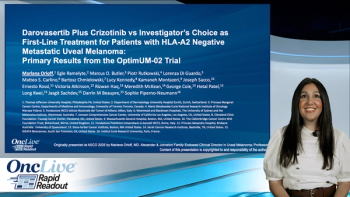
Marlana Orloff, MD, reviews primary OptimUM-02 data showing darovasertib plus crizotinib significantly improved progression-free survival and response rates versus investigator’s choice in first-line HLA-A2–negative metastatic uveal melanoma, with overall survival data not yet mature.
Marlana Orloff, MD, discusses efficacy findings with darovasertib plus crizotinib in metastatic uveal melanoma that were seen in the OptimUM-01 trial.
Marlana M. Orloff, MD, discusses optimal therapeutic approaches for patients with uveal melanoma that is rapidly progressing.
The next steps in research investigating best practices using novel therapies such as tebentafusp as treatment for uveal melanoma.

Drs Richard D. Carvajal and Marlana M. Orloff highlight variables that should be considered when assessing the appropriateness for treating patients with uveal melanoma with tebentafusp.
Advice to help educate patients about symptoms and management of cytokine release syndrome following treatment with tebentafusp for uveal melanoma.
What to know about treatment response and treatment-related adverse events with tebentafusp for uveal melanoma.
Potential sequencing strategies with novel therapies such as tebentafusp for uveal melanoma.
Considerations for accurately predicting and identifying response to tebentafusp in uveal melanoma, and insight regarding the appropriate length of treatment for patients with disease progression.

Implications for treating uveal melanoma with tebentafusp based on responses demonstrated by the IMCgp100-102 and IMCgp100-202 clinical studies.
Drs Richard D. Carvajal and Marlana M. Orloff comment on tebentafusp’s mechanism of action (MOA) and explain what makes the therapy attractive for uveal melanoma.

A brief explanation regarding the difference between uveal melanoma and skin melanoma and an overview of standard treatment approaches used to treat patients with uveal melanoma.
July 23rd 2021
July 23rd 2021
