This presentation reviews final overall survival and long-term outcomes from the phase 3 EMBARK trial evaluating enzalutamide-based treatment strategies in patients with high-risk biochemically recurrent prostate cancer.
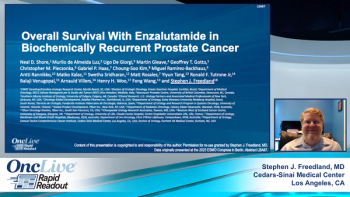
This presentation reviews final overall survival and long-term outcomes from the phase 3 EMBARK trial evaluating enzalutamide-based treatment strategies in patients with high-risk biochemically recurrent prostate cancer.
Stephen J. Freedland, MD, discusses future avenues for research with enzalutamide in biochemically recurrent prostate cancer.
Stephen Freedland, MD, discusses how findings from the phase 3 EMBARK trial suggest a new standard of care in prostate cancer.
Stephen Freedland, MD, discusses how the efficacy findings of each arm of the phase 3 EMBARK trial in prostate cancer stacked up with one another.
Stephen Freedland, MD, discusses the rationale for conducting the phase 3 EMBARK trial evaluating enzalutamide plus leuprolide in high-risk prostate cancer.
Experts offer concluding remarks on castration-sensitive prostate cancer, sharing their perspectives on the evolving field and expressing their aspirations for future advancements in disease treatment.
Key opinion leaders outline a case study of a patient with metastatic castration-sensitive prostate cancer, detailing the chosen treatment approaches and the overall outcome of the case.
Experts present a case study of a patient with non-metastatic castration-sensitive prostate cancer exhibiting rapid PSA doubling, highlighting the clinical implications and potential treatment considerations.
Specialists examine non-metastatic castration-sensitive prostate cancer cases, evaluating the significance of PSA doubling time and the reliability of biomarkers in risk assessment for these patients.
Prostate cancer experts analyze the EMBARK trial, emphasizing the potential impact of an androgen receptor inhibitor in the treatment of non-metastatic castration-sensitive prostate cancer.
Key opinion leaders examine the treatment landscape for castration-sensitive prostate cancer, highlighting prevalent first-line approaches and discussing the role of androgen deprivation therapy in the treatment paradigm.
The panel of prostate cancer experts explores risk stratification methodologies and prognostic markers for castration-sensitive prostate cancer, emphasizing crucial factors that influence patient categorization and treatment decisions.
Key opinion leaders examine the principles and advantages of early intervention strategies for patients with castration-sensitive prostate cancer.

Stephen J. Freedland, MD, discusses the effects of treatment suspension on HRQOL in nonmetastatic hormone-sensitive prostate cancer in the EMBARK trial.
Stephen J. Freedland, MD, discusses the correlation between treatment suspension and HRQoL in patients with nmHSPC who were enrolled on the phase 3 EMBARK trial.

Stephen J. Freedland, MD, discusses the significance of the FDA approval of enzalutamide in nonmetastatic castration-sensitive prostate cancer.
Stephen J. Freedland, MD, discusses remaining questions with the real-world utility of enzalutamide in prostate cancer.
Stephen J. Freedland, MD, discusses remaining questions with the real-world utility of enzalutamide in prostate cancer.
Stephen J. Freedland, MD, discusses how real-world evidence with the use of enzalutamide in patients with metastatic castration-resistant prostate cancer (mCRPC) compares with data from the phase III PREVAIL trial.
Stephen J. Freedland, MD, discusses the importance of conducting real-world analyses in prostate cancer.
Stephen J. Freedland, MD, discusses the importance of standardizing prostate-specific antigen testing in prostate cancer.
Stephen J. Freedland, MD, discusses a real-world analysis of enzalutamide in metastatic castration-resistant prostate cancer.
Stephen J. Freedland, MD, director, Center for Integrated Research in Cancer and Lifestyle, co-director, Cancer Genetics and Prevention Program, associate director, Faculty Development Samuel Oschin Comprehensive Cancer Institute, professor of surgery, Cedars-Sinai Medical Center, discusses nuanced diet and lifestyle interventions in patients with prostate cancer.
Stephen J. Freedland, MD, associate professor, Duke University, discusses an analysis presented at the 2014 AUA Annual Meeting that looked at carbohydrate intake, glycemic index, and prostate cancer risk.
Stephen J. Freedland, MD, from Duke University School of Medicine, discusses the complications faced when treating men with early-stage prostate cancer.
July 10th 2024
February 18th 2020