





Mantle Cell Lymphoma
Latest News
Advertisement
Latest Videos



































































Advertisement
More News

The FDA has lifted a partial clinical hold on a phase 1 trial evaluating NX-2127 in relapsed/refractory B-cell malignancies

Tycel Phillips, MD, discusses efforts to clarify and refine the treatment paradigm of patients with mantle cell lymphoma.
Tycel Phillips, MD, discusses unmet needs for patients with relapsed/refractory mantle cell lymphoma.

Andre H. Goy, MD, discusses how the ZUMA-18 trial data support the benefit of earlier-line use of brexucabtagene autoleucel in mantle cell lymphoma.

In case you missed it, read a recap of every episode of OncLive On Air recorded in January 2024.

Muhamad Alhaj Moustafa, MD, MS, discusses standard treatments for transplant-eligible and transplant-ineligible patients with mantle cell lymphoma.

Liso-cel may be an effective treatment option for patients with relapsed/refractory mantle cell lymphoma and high-risk features.
Jonathon B. Cohen, MD, MS, discusses treatment considerations for mantle cell lymphoma and the role of pirtobrutinib in the management of this disease.
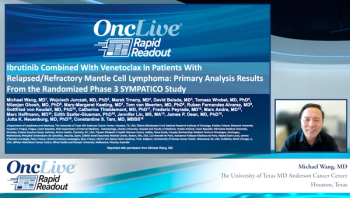
Michael Wang, MD, presents the primary analysis results from the multinational, randomized, double-blind, phase 3 SYMPATICO study comparing ibrutinib plus venetoclax vs ibrutinib plus placebo in patients with relapsed/refractory mantle cell lymphoma (R/R MCL).

A panel of experts discuss future directions and remaining unmet needs for patients with relapsed/refractory MCL.

Catherine C. Coombs, MD, spotlights the use of bispecific antibodies in diffuse large B-cell lymphoma and pirtobrutinib in mantle cell lymphoma.

Jonathon B. Cohen, MD, MS, expands on updated data from the BRUIN trial of pirtobrutinib in patients with relapsed BTK-exposed mantle cell lymphoma.

Liso-cel sBLAs for indications in relapsed/refractory FL and MCL after exposure to a BTK inhibitor have received priority review from the FDA.

CD19 CAR T cell therapy plus acalabrutinib demonstrated early efficacy in patients with relapsed/refractory mantle cell lymphoma.

William B. Pearse, MD, discusses the current and future roles of BTK inhibitors in patients with relapsed/refractory mantle cell lymphoma.

William Pearse, MD, discusses how the FDA approval of pirtobrutinib for relapsed/refractory mantle cell lymphoma has advanced BTK inhibitor treatment.
William Pearse, MD, discusses the roles of acalabrutinib and zanubrutinib in mantle cell lymphoma, as well as the adverse effect profiles of each agent.

Tycel Phillips, MD, discusses the potential advantages of treating patients with relapsed/refractory mantle cell lymphoma in the phase 3 GLOBRYTE trial.
Tycel Phillips, MD, discusses the rationale for the phase 3 GLOBRYTE trial examining glofitamab in patients with relapsed/refractory mantle cell lymphoma.

Alexey Danilov, MD, PhD, discusses how further research may address unmet needs in chronic lymphocytic leukemia or mantle cell lymphoma.

The combination regimen comprised of acalabrutinib, venetoclax, and obinutuzumab proved to be safe and feasible and to elicit responses in patients with high-risk, relapsed or refractory mantle cell lymphoma.
Relmacabtagene autoleucel continued to induce responses with acceptable tolerability in Chinese patients with relapsed or refractory mantle cell lymphoma.

Jonathon B. Cohen, MD, MS, discusses safety and efficacy outcomes with pirtobrutinib in previously treated patients with relapsed/refractory mantle cell lymphoma, as observed in the phase 1/2 BRUIN study.

Treatment with the oral BTK inhibitor ibrutinib in combination with venetoclax led to a statistically significant improvement in progression-free survival vs ibrutinib plus placebo in patients with relapsed/refractory MCL.

The combination comprised of zanubrutinib, obinutuzumab, and venetoclax elicited high response rates and 2-year progression-free survival rates that compared favorably with historical outcomes achieved with chemoimmunotherapy in high-risk patients with previously untreated mantle cell lymphoma harboring TP53 mutations.
Advertisement
Advertisement
Trending on OncLive
1
NAPISTAR-1-01 Data Support Rapid TUB-040 Development in Biomarker-Unrestricted Ovarian Cancer
2
FDA Grants Fast Track Designation to LYT-200 in R/R High-Risk MDS
3
Japan Approves Subcutaneous Pembrolizumab for All Approved Pembrolizumab Indications
4
Updated NCCN Guidelines Recommend Rusfertide Across Polycythemia Vera
5