
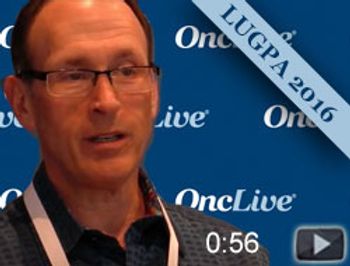
Dr. Geoffrey Sklar, Chief Medical Officer, Chesapeake Urology Associates, spoke with OncLive about some of the exciting advancements in bladder cancer during the LUGPA Annual Meeting.
Dr. Geoffrey Sklar, Chief Medical Officer, Chesapeake Urology Associates, spoke with OncLive about some of the exciting advancements in bladder cancer during the LUGPA Annual Meeting.
Neoadjuvant therapy is evolving as a treatment approach for patients with advanced renal cell carcinoma.
Toni K. Choueiri, MD, dives into the ongoing research with volitinib, the competing yet complementary roles of targeted agents and immunotherapy, and the most important steps to take with biomarker research in the field of renal cell carcinoma.

Nicholas G. Cost, MD, assistant professor, Surgery-Urology, Department of Pediatric Urology/ Urologic Oncology, University of Colorado Denver, discusses a clinical trial exploring pembrolizumab (Keytruda) plus axitinib (Inlyta) in patients with renal cell carcinoma (RCC).
The life expectancy of patients with metastatic castrate-resistant prostate cancer has doubled in recent years thanks to a multitude of new therapies, and there are still many more advancements to come.
Richard Harris, MD, of UroPartners, says there are many exciting advancements currently happening in the field of prostate cancer. Harris shared his insights during an interview with OncLive at the 2016 LUGPA Annual Meeting.
Gary Kirsh, MD, President of The Urology Group and the Large Urology Group Practice Association (LUGPA), discusses this exciting phase in prostate cancer care. Kirsh shared his insights during an interview with OncLive at the 2016 LUGPA Annual Meeting.

Richard S. Finn, MD, associate professor of Medicine at the UCLA David Geffen School of Medicine, discusses the phase III PALOMA-2 trial during an interview at the 2016 ESMO Congress.

Giorgio Scagliotti, MD, PhD, professor of Medical Oncology, University of Torino, discusses the design and the results of the phase III ASCEND-5 study during an interview at the 2016 ESMO Congress.
First-line treatment with fulvestrant led to significantly better progression-free survival compared with anastrozole for patients with HR-positive advanced breast cancer.
Cabozantinib (Cabometyx) reduced the risk of progression or death by 31% compared with sunitinib (Sutent) in the frontline setting for patients with metastatic renal cell carcinoma.
Adjuvant sunitinib prolonged disease-free survival by 1.2 years compared with placebo following nephrectomy for patients with high-risk clear cell renal cell carcinoma.
Atezolizumab (Tecentriq) reduced the risk of death by 27% compared with docetaxel in patients with advanced non–small cell lung cancer following the failure of platinum-based chemotherapy.
Progression-free survival was more than 3 times longer with ceritinib (Zykadia) than with chemotherapy, the current second-line standard, in patients with advanced ALK-positive non–small cell lung cancer who progressed after first-line crizotinib.
Safety, efficacy, and biomarker results from the phase II CheckMate-275 trial of the PD-1 inhibitor nivolumab (Opdivo) that support FDA and European Medicines Agency applications were reported at the 2016 ESMO Congress.
Mansoor Raza Mirza, MD, chief oncologist, Rigshospitalet, Copenhagen University Hospital, discusses the results of the phase III NOVA trial during an interview at the 2016 ESMO Congress.
Maria Ignez Braghiroli, MD, medical oncologist, Instituto do Câncer do Estado de São Paulo, discusses clinical characteristics and outcomes of patients with NRAS-mutant metastatic colorectal cancer (mCRC) during an interview at the 2016 ESMO Congress.

Single-agent pembrolizumab improved overall and progression-free survival compared with doublet chemotherapy for untreated patients with advanced non–small cell lung cancer who expressed PD-L1 on ≥50% of cells.
A fourth of patients with heavily pretreated advanced ovarian cancer achieved objective responses with novel antibody-drug conjugate targeting protein tyrosine kinase 7.

Caroline Robert, MD, PhD, Head of Dermatology, Institute Gustave-Roussy, discusses the results of the phase III COMBI-v study in BRAF-mutant melanoma during an interview at the ESMO 2016 Congress.

Jordi Bruix, MD, head of the Barcelona Clinic Liver Cancer at University of Barcelona, discusses the results of the phase III RESORCE trial in hepatocellular carcinoma (HCC) during an interview at the 2016 ESMO Congress.
The oral multikinase inhibitor regorafenib (Stivarga) has the potential to become the standard of care as second-line treatment in patients with previously treated hepatocellular carcinoma who are unsuitable for loco-regional therapy and have progressed on sorafenib.
Postmenopausal women with hormone receptor-positive metastatic breast cancer had significant slowing of disease progression with the addition of the investigational cyclin-dependent kinase 4/6 inhibitor ribociclib to endocrine therapy.
Maintenance therapy with niraparib reduced the risk of progression or death by 73% compared with placebo for patients with germline BRCA-positive platinum-sensitive, recurrent ovarian cancer.
Treatment with ipilimumab reduced the risk of death by 28% versus placebo in patients with high-risk stage III melanoma.

Antonio Llombart-Cussac, MD, PhD, medical oncologist, chairman, Medical Oncology Service, University Hospital Arnau de Vilanova in Valencia, Spain, discusses the CASCADE study, which assessed declines in treatment efficacy over time in patients with metastatic breast cancer, during an interview at the 2016 ESMO Congress.

Lars Bastholt, MD, clinical oncologist, Odense University Hospital, discusses the use of lenvatinib to treat patients with non-small cell lung cancer at the 2016 ESMO Congress.

The majority of heavily pretreated patients with high-grade ovarian cancer and germline or somatic BRCA mutations showed a durable response to rucaparib.
Almost 40% of patients with resected early-stage non–small cell lung cancer had evidence of tumor regression following neoadjuvant treatment with nivolumab (Opdivo) in a preliminary clinical trial.
Over one-fourth of patients with metastatic melanoma in Europe do not have access to groundbreaking therapies that could extend their lives.