Evolving Management Landscape for Advanced Prostate Cancer

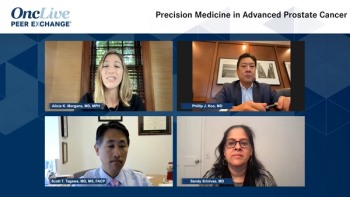
EP. 1: Precision Medicine in Advanced Prostate Cancer
ByAlicia K. Morgans, MD, MPH, Robert H. Lurie Comprehensive Cancer Center of Northwestern University,Phillip Koo, MD, MD Anderson Cancer Center,Scott T. Tagawa, MD, MS, FACP, Weill Cornell Medicine,Sandy Srinivas, MBBS, Stanford Cancer Center A panel of physicians who work in the field of genitourinary oncology comment on the evolving role of precision medicine in advanced prostate cancer.

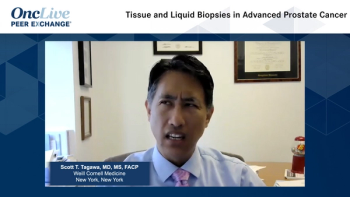
EP. 2: Tissue and Liquid Biopsies in Advanced Prostate Cancer
ByAlicia K. Morgans, MD, MPH, Robert H. Lurie Comprehensive Cancer Center of Northwestern University,Phillip Koo, MD, MD Anderson Cancer Center,Scott T. Tagawa, MD, MS, FACP, Weill Cornell Medicine,Sandy Srinivas, MBBS, Stanford Cancer Center Dr Scott T. Tagawa comments on the pros and cons of liquid and tissue biopsies used to assess patients with advanced prostate cancer.

A discussion regarding the use of PSMA PET imaging to detect phenotypic biomarkers that may simplify approaches to precision medicine in advanced prostate cancer.

EP. 4: PSMA-Targeted 18F-DCFPyL PET/CT in High-Risk Prostate Cancer
ByAlicia K. Morgans, MD, MPH, Robert H. Lurie Comprehensive Cancer Center of Northwestern University,Scott T. Tagawa, MD, MS, FACP, Weill Cornell Medicine,Phillip J. Koo, MD An interpretation of the OSPREY study of 18F-DCFPyL injection in patients with high-risk prostate cancer and implications of its use.

A discussion regarding use of the PSMA-targeted 18F-DCFPyL PET/CT to assess patients with suspected recurrence of prostate cancer based on data revealed by the CONDOR trial.

EP. 6: Treatment Advances in mCSPC
ByAlicia K. Morgans, MD, MPH, Robert H. Lurie Comprehensive Cancer Center of Northwestern University,Scott T. Tagawa, MD, MS, FACP, Weill Cornell Medicine,Sandy Srinivas, MD, Stanford University Medical Center Treatment Advances in mCSPC

EP. 7: ADT Monotherapy in mCSPC
ByAlicia K. Morgans, MD, MPH, Robert H. Lurie Comprehensive Cancer Center of Northwestern University,Phillip Koo, MD, MD Anderson Cancer Center,Scott T. Tagawa, MD, MS, FACP, Weill Cornell Medicine,Sandy Srinivas, MBBS, Stanford Cancer Center The rationale for treating metastatic castration-sensitive prostate cancer with androgen deprivation therapy as monotherapy as the field advances with newer combination approaches.

EP. 8: Triple Therapy Approaches for mCSPC
ByAlicia K. Morgans, MD, MPH, Robert H. Lurie Comprehensive Cancer Center of Northwestern University,Phillip Koo, MD, MD Anderson Cancer Center,Scott T. Tagawa, MD, MS, FACP, Weill Cornell Medicine,Sandy Srinivas, MBBS, Stanford Cancer Center Potential implications for treating metastatic castration-sensitive prostate cancer with triple therapy based on recently reported data.

EP. 9: mCSPC: Applying New Data into Clinical Practice
ByAlicia K. Morgans, MD, MPH, Robert H. Lurie Comprehensive Cancer Center of Northwestern University,Phillip Koo, MD, MD Anderson Cancer Center,Scott T. Tagawa, MD, MS, FACP, Weill Cornell Medicine,Sandy Srinivas, MBBS, Stanford Cancer Center Recommendations for integrating treatment advances in metastatic castration-sensitive prostate cancer into everyday practice.

EP. 10: Oral GnRH Antagonist Therapy for mCSPC
ByAlicia K. Morgans, MD, MPH, Robert H. Lurie Comprehensive Cancer Center of Northwestern University,Phillip Koo, MD, MD Anderson Cancer Center,Scott T. Tagawa, MD, MS, FACP, Weill Cornell Medicine,Sandy Srinivas, MBBS, Stanford Cancer Center Implications of treating patients with metastatic castration-sensitive prostate cancer with relugolix, an oral GnRH antagonist.

EP. 11: Advances in Nonmetastatic CRPC
ByAlicia K. Morgans, MD, MPH, Robert H. Lurie Comprehensive Cancer Center of Northwestern University,Phillip Koo, MD, MD Anderson Cancer Center,Scott T. Tagawa, MD, MS, FACP, Weill Cornell Medicine,Sandy Srinivas, MBBS, Stanford Cancer Center An overview of drug approvals for nonmetastatic castration-resistant prostate cancer (CRPC), and discussion regarding the potential utility of prostate-specific membrane antigen (PSMA) positron emission tomography (PET) to guide treatment decisions.

EP. 12: Nonmetastatic CRPC: Treatment Selection
ByAlicia K. Morgans, MD, MPH, Robert H. Lurie Comprehensive Cancer Center of Northwestern University,Phillip Koo, MD, MD Anderson Cancer Center,Scott T. Tagawa, MD, MS, FACP, Weill Cornell Medicine,Sandy Srinivas, MBBS, Stanford Cancer Center An in-depth discussion regarding experience treating nonmetastatic castration-resistant prostate cancer (CRPC) with apalutamide, enzalutamide, and darolutamide, and factors that impact treatment selection.