
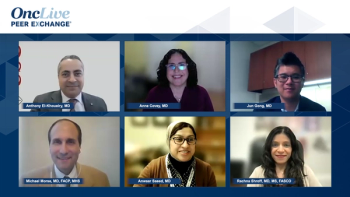
Anthony El-Khoueiry, MD, opens the discussion by defining the current prevalence of hepatocellular carcinoma (HCC).

A panel of medical experts discuss key highlights from ASCO GI 2024 surrounding the hepatocellular carcinoma (HCC) treatment landscape.
Anthony El-Khoueiry, MD, opens the discussion by defining the current prevalence of hepatocellular carcinoma (HCC).
Mechanism of action for liver-directed therapies in HCC are illustrated by Anne Covey, MD, an interventional radiologist.
Michael Morse, MD, establishes his criteria for implementing TACE versus systemic therapy in HCC treatment.
Rachna Shroff, MD, MS, FASCO, highlights the prominence of the EMERALD-1 study for patients with HCC.
Drs Gong and Covey emphasize the impact of TACE + durvalumab ± bevacizumab combination therapy surrounding HCC treatment strategy.
Dr Shroff breaks down the combination of atezolizumab and bevacizumab as outlined by the IMBrave-050 study.
Medical experts provide insight into managing treatment of advanced HCC through the lens of a patient profile.
A comprehensive discussion of the HIMALAYA study, evaluating the STRIDE regimen of durvalumab plus tremelimumab in first-line treatment for advanced HCC.
Anwaar Saeed, MD, provides comprehensive insight into the HCC treatment selection process.
Dr Gong breaks down the structure and key takeaways from the IMBrave150 study.
Real-world evidence (RWE) provides critical knowledge for providers constructing a treatment regimen for patients diagnosed with hepatocellular carcinoma.
The impact of compounding liver-directed and systemic therapies in HCC management is discussed by Drs Morse and Covey.
Drs Saeed and Shroff discuss the next patient profile, focusing on HCC treatment strategies following disease progression after first-line therapy.
Key opinion leaders share their takeaways from the CARES-310 trial and its impact on their treatment approach in HCC management.
Dr Morse discusses key takeaways from the REGONEXT study presented at ASCO GI 2024.
The expert panelists provide their final insights surrounding the future of HCC treatment management.