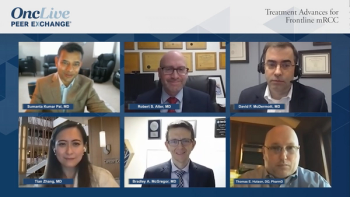
Bradley A. McGregor, MD, of the Dana-Farber Cancer Institute, reacts to the emergence of new treatment gaps associated with novel combination regimens as first-line therapy for patients with metastatic renal cell carcinoma.
Current treatment approaches that can be used to treat favorable-risk metastatic renal cell carcinoma in the first-line setting and implications for individualizing therapy despite guidance provided by the IMDC criteria.
Best approaches to sequencing therapy for patients with favorable-risk metastatic renal cell carcinoma following first-line therapy with novel combinations such as ipilimumab and nivolumab.
Factors that oncologists need to consider when deciding whether to initiate single-agent therapy or a novel combination regimen as frontline treatment for patients with favorable-risk metastatic renal cell carcinoma.
Oncologists discuss how they select an appropriate novel combination strategy as first-line therapy for patients with favorable-risk metastatic renal cell carcinoma.
The rationale for treating favorable-risk metastatic renal cell carcinoma with early, aggressive therapy and considerations for approaching disease progression.
Considerations for evolving from using single-agent therapy to combination approaches to treat intermediate or poor-risk metastatic renal cell carcinoma based on more recent data demonstrated in clinical trials.
Thomas E. Hutson, DO, PharmD, of Texas Oncology, reacts to results demonstrated by the CLEAR study of lenvatinib in combination with pembrolizumab or everolimus for the treatment of metastatic renal cell carcinoma and discusses best practices for educating community oncologists on dosing with lenvatinib.
Drs Bradley A. McGregor and David F. McDermott comment on best approaches for selecting and optimizing treatment with novel combination regimens to manage patients with intermediate- or poor-risk metastatic renal cell carcinoma.
Expert oncologists debate the significance of using quality of life as a metric when assessing patients’ responses to therapy for metastatic renal cell carcinoma.
Advice for appropriately dosing newer novel-based strategies used to treat metastatic renal cell carcinoma and best practices to help community oncologists avoid drug discontinuations.
A panel of oncologists discuss the appropriateness for using PD-1 inhibitors versus PD-L1 inhibitors as frontline treatment for metastatic renal cell carcinoma.
Based on data demonstrated by the recent CLEAR study in metastatic renal cell carcinoma, oncologists comment on decisions for using lenvatinib plus pembrolizumab vs lenvatinib plus everolimus.
Limitations of current data surrounding the appropriate use of immunotherapy plus a tyrosine kinase inhibitor as frontline therapy for patients with metastatic renal cell carcinoma and current recommendations for selecting an appropriate combination regimen.
An overview of novel-based treatment strategies and biomarkers that are currently under investigation to help address current unknowns when treating patients with metastatic renal cell carcinoma.
The significance of studying predictive biomarkers to help oncologists identify mechanisms of resistance to immunotherapy agents in metastatic renal cell carcinoma prior to initiating therapy.
A brief discussion on current second-line treatment options available to patients with metastatic renal cell carcinoma previously treated with a novel-based regimen.
A panel of expert oncologists who manage patients with renal cell carcinoma share enthusiasm over the use of newer novel-based treatment approaches for metastatic disease.