
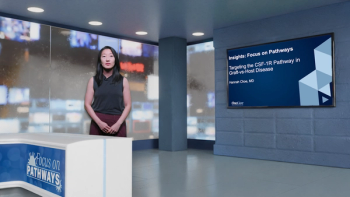
Dr. Hannah Choe reviews data from the AGAVE-201 trial investigating the CSF-1R inhibitor axatilimab, including efficacy, safety, and clinical implications of these data for patients with recurrent or refractory chronic GVHD.
Dr. Hannah Choe reviews data from the AGAVE-201 trial investigating the CSF-1R inhibitor axatilimab, including efficacy, safety, and clinical implications of these data for patients with recurrent or refractory chronic GVHD.
In this video, Dr. Hannah Choe provides an overview of the background of graft-versus-host disease (GVHD), discusses currently approved treatments and their limitations, and the significant unmet treatment needs in GVHD.
David M. O’Malley, MD, and Chandler H. Park, MD, FACP, discuss updates in gynecologic oncology at the 2024 ASCO Annual Meeting.

Linvoseltamab demonstrated durable efficacy with a manageable safety profile in patients with relapsed/refractory multiple myeloma.

Samilia Obeng-Gyasi, MD, MPH, discusses a retrospective study on neighborhood opportunity and all-cause mortality in patients with breast cancer.

Samilia Obeng-Gyasi, MD, MPH, highlights a study on the association between neighborhood opportunity with all-cause mortality in patients with breast cancer.
Laura J Chambers, DO, discusses currently approved PARP inhibitors that are considered for use in ovarian cancer.

Casey M. Cosgrove, MD, discusses the FDA approval of mirvetuximab soravtansine for adult patients with Frα+, platinum-resistant ovarian cancer.
Raj Singh, MD, discusses unmet medical needs in the treatment of patients with lung cancer.

Raj Singh, MD, discusses the use of stereotactic body radiation therapy and stereotactic radiosurgery in the treatment of patients with lung cancer.

Margaret E. Gatti-Mays, MD, MPH, FACP, discusses the current use of neoadjuvant chemoimmunotherapy in early-stage triple-negative breast cancer.

Samilia Obeng-Gyasi, MD, MPH, discusses breast cancer mortality rates in resource-poor neighborhoods.
Raj Singh, MD, discusses treating patients with lung cancer with CNS metastases.

Quad Shot radiation plus a checkpoint inhibitor significantly improved local control vs Quad Shot alone and was well tolerated as a palliative treatment for patients with advanced head and neck cancer.
Samilia Obeng-Gyasi, MD, MPH, discusses the impact of social determinants of health on breast cancer care outcomes.
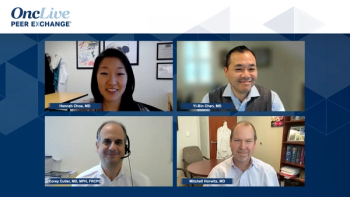
The panel provides advice for community providers treating patients with chronic GVHD, stressing effective communication, staying updated on evolving drugs, and collaborating with specialized multidisciplinary groups for optimal patient care.
The expert doctors discuss the impact of chronic GVHD on long-term survivors' quality of life (QoL). The panel explores the significance of patient-reported outcomes (PROs), challenges in their implementation, and the evolving role of PROs in assessing and improving QoL in chronic GVHD patients.

Dr Mims discusses the utility of emavusertib in acute myeloid leukemia and myelodysplastic syndrome and the rationale for the TakeAim Leukemia trial.
Drs Yi-Bin Chen, Corey Cutler, Hannah Choe, and Mitchell Horwitz share their predictions for the next 3 to 5 years in chronic GVHD management. The panel anticipates advancements in earlier treatment, potential elimination of frontline corticosteroids, and a shift towards preventive strategies and personalized medicine.
The panel reviews axatilimab, an emerging agent for chronic GVHD under clinical studies. The experts explore findings from the Agave-201 study, highlighting potential challenges of intravenous administration and axatilimab’s unique mechanisms.
Drs Yi-Bin Chen, Corey Cutler, Hannah Choe, and Mitchell Horwitz discuss a complex chronic GVHD case post-allogeneic transplant. The panel explores third-line options, including belumosudil, ibrutinib, photopheresis, and clinical trials, emphasizing shared decision-making and the need for well-designed trials in guiding treatment decisions.
Drs Yi-Bin Chen, Corey Cutler, Hannah Choe, and Mitchell Horwitz review a clinical scenario of chronic GVHD post-allogeneic transplant. They explore treatment options and emphasize shared decision-making, considering patient preferences and therapeutic benefits.

Alice Mims, MD, discusses the toxicity profile and initial efficacy of emavusertib in heavily pretreated, FLT3-mutated relapsed/refractory AML.
The expert panel explores belumosudil's role in treating chronic GVHD after multiple systemic therapy lines. They discuss the ROCKstar trial, highlighting its overall response rates and real-world experiences.
Drs Yi-Bin Chen, Corey Cutler, Hannah Choe, and Mitchell Horwitz discuss the approval and real-world experiences of ibrutinib and ruxolitinib for chronic GVHD. The panel discusses the challenges and varying effectiveness observed in real-world usage, contrasting the experiences of the two drugs.
The expert panel explores the approval of ruxolitinib for chronic GVHD based on the REACH3 trial. The panel highlights the trial’s outcomes, long-term follow-up data, and the evolving shift in clinical practices.
The panel examines the transition from systemic steroids to second-line therapies in chronic GVHD, explore standardized clinical trial definitions and real-world challenges in treating chronic GVHD.
Drs Yi-Bin Chen, Corey Cutler, Hannah Choe, and Mitchell Horwitz discuss the complexities of chronic GVHD management, highlighting recent developments and efforts to reduce reliance on steroids.
The GVHD experts discuss recent advancements in chronic GVHD treatment, focusing on agents ruxolitinib, ibrutinib, and belumosudil and their mechanisms of action. The panel emphasizes the need for ongoing research and clinical trials to refine treatment strategies.
Drs Lunning and Maddocks discuss the management of MCL in the up-front setting.