

Opinion|Videos|April 30, 2026
Access to Molecular Testing Across Institutions: Barriers, Resources, and Real-World Solutions
Author(s)Eric K. Singhi, MD, Chinmay Jani, MD
Experts unpack NGS, ctDNA and protein testing to speed actionable biomarker detection and guide targeted therapy choices in advanced lung cancer.
Advertisement
Episodes in this series
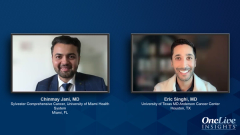
In this segment, Dr. Jani opens by asking how biomarker testing access varies across academic and community settings, including the choice between comprehensive and smaller NGS panels, turnaround time considerations, and how to leverage molecular tumor boards.
Dr. Singhi responds that truly comprehensive, patient-centered biomarker testing is complex and institution-dependent. Key requirements include in-house NGS, rapid testing pipelines, reflex pathology workflows, access to plasma ctDNA, and multidisciplinary interpretation through molecular tumor boards. He identifies several persistent barriers: insufficient tissue, delayed test ordering, lack of reflex workflows, and financial hurdles. He also addresses the clinical pressure to start treatment before results return—from both physicians and patients—and emphasizes that real-world data, albeit retrospective, show that patient outcomes improve when biomarker results are available before initiating therapy. He calls for education of patients, families, and providers to reinforce this message.
Dr. Jani adds a key supporting point: a recent study demonstrated that even if chemoimmunotherapy has already been started, identifying an actionable alteration within one or two cycles and switching to targeted therapy still improves outcomes. He stresses that this finding reinforces the importance of testing at any time if it was not done upfront, and changing treatment as soon as a targetable alteration is found.
In the next episode, "KRAS Mutations in NSCLC: Sequencing Across Lines," the experts discuss how KRAS subtypes inform post-progression and frontline strategies.
Advertisement
Related to this article
A pilot study represents a milestone toward testing a faster, more powerful, and potentially less-toxic form of radiation therapy for cancer treatment.
Oral azacitidine and cedazuridine met the end point of total cycle azacitidine exposure vs subcutaneous azacitidine in MDS or CMML.
UTRxMYCN M1-14 received orphan drug status for soft tissue sarcoma and RPDD for rhabdomyosarcoma.

Interim data showed that the BCMA-directed CAR T-cell therapy NXC-201 generated complete responses in relapsed/refractory AL amyloidosis.
Estelamari Rodriguez, MD, MPH, discusses the rationale, design, and practice implications of the phase 3 RELATIVITY-1093 trial in nonsquamous NSCLC.
Experts spotlight the variety of breast cancer research being presented at the 2026 ESMO Congress.

The third BLA submission for tabelecleucel follows 2 CRLs and includes updated ALLELE data with additional patients and longer follow-up.
A New England Journal of Medicine report describes complete hepatoblastoma regression in a 3-year-old treated with a novel immunotherapy.
Advertisement
Advertisement
Trending on OncLive
1
FDA Grants Fast Track Designation to Plinabulin Plus Docetaxel in Post-ICI Non-Squamous NSCLC
2
Breast Cancer Experts Highlight Abstracts to Watch at ESMO 2026
3
Navigating DLL3-Targeting T-Cell Engagers and the Evolving Small Cell Lung Cancer Treatment Landscape
4
FDA Approves Denosumab Biosimilar for Skeletal-Related Events, GCTB, and Hypercalcemia of Malignancy
5