
Opinion|Videos|June 1, 2026
Second-Line Regimen Selection in EGFR-Mutant NSCLC After First-Line Intensification
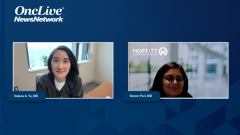
Author(s)Helena A. Yu, MD, Sonam Puri, MD
In this episode, Dr. Puri and Dr. Yu address sequencing after first-line intensification. Whether patients start with osimertinib plus chemotherapy or amivantamab/lazertinib, the second-line landscape includes COMPEL, MARIPOSA-2, MET-directed therapies, and antibody–drug conjugates (ADCs) such as datopotamab deruxtecan.
Advertisement
In this episode, Dr. Puri and Dr. Yu address sequencing after first-line intensification. Whether patients start with osimertinib plus chemotherapy or amivantamab/lazertinib, the second-line landscape includes COMPEL, MARIPOSA-2, MET-directed therapies, and antibody–drug conjugates (ADCs) such as datopotamab deruxtecan. Dr. Yu notes there are no head-to-head sequencing data, but emphasizes that approximately 30% of patients do not receive second-line therapy after first-line, which reinforces using the most active regimens upfront rather than saving anything for later. After amivantamab/lazertinib, she sequences to a chemotherapy-based regimen, potentially with osimertinib per COMPEL. After osimertinib plus chemotherapy, the approach depends on time since carboplatin: if more than six months, she considers retrial of carboplatin/pemetrexed, sometimes adding amivantamab and stopping osimertinib for significant progression; if progression is rapid after platinum exposure, she shifts to amivantamab/lazertinib if it can be obtained. Both strongly support biopsy at progression — at minimum a liquid biopsy, and tissue biopsy when feasible, particularly to identify histologic transformation, which occurs in 10–15% of patients and demands a different chemotherapy approach. Acquired alterations such as MET amplification and EGFR C797S are uncommon but actionable. Dr. Puri emphasizes that tissue biopsy is especially important when progression is faster than expected, and personalizing second-line therapy based on resistance biology remains essential.
In the next episode, “Practical Advice for Community Oncologists,” Dr. Yu and Dr. Puri share guidance for translating these data into community practice.
Advertisement
Related to this article

The phase 3 REZILIENT3 trial met its primary end point at a pre-specified interim analysis, with a median PFS of 14.5 months and a 65.0% ORR.

CHMP has recommended EU approval of senaparib for advanced ovarian cancer based on FLAMES data.

The CHMP recommended perioperative pembrolizumab plus enfortumab vedotin for resectable muscle-invasive bladder cancer.

The FDA approved imlunestrant/abemaciclib for ER-positive, HER2-negative, ESR1-mutated advanced breast cancer after progression on endocrine therapy.

Roswell Park Comprehensive Cancer Center unveiled a new and more compact mobile lung cancer screening unit.

The CHMP recommended approval of adjuvant T-DXd for HER2-positive early breast cancer with residual invasive disease after neoadjuvant therapy.

Udai S. Kammula, MD, FACS, discusses TIL therapy outcomes, the UMIS biomarker, and treatment implications in metastatic uveal melanoma.

CHMP has recommended EU marketing authorization for relacorilant combined with nab-paclitaxel in platinum-resistant ovarian cancer.
Advertisement
Advertisement
Trending on OncLive
1
FDA Approves Imlunestrant Plus Abemaciclib for ER+, HER2–, ESR1-Mutated Metastatic Breast Cancer
2
CHMP Recommends Label Expansion of Melflufen to Third-Line Lenalidomide-Refractory Multiple Myeloma
3
Phase 1 Data Support DAWN-303’s Evaluation of INCB161734 in Frontline KRAS G12D–Mutated PDAC
4
Tumor-Reactive TIL and UMIS Biomarker Predict Response in Metastatic Uveal Melanoma
5