Now Playing
In this episode, Dr. Yu and Dr. Puri share their initial reactions to the phase 3 TOP study, the first prospective trial to specifically test treatment intensification in EGFR-mutant non–small cell lung cancer (NSCLC) patients selected by concurrent TP53 mutation. Dr. Yu reviews the headline data: median progression-free survival (PFS) of 34.0 versus 15.6 months (hazard ratio [HR], 0.44), overall response rate (ORR) of 83% versus 72%, median duration of response (DoR) of 32.7 versus 15.3 months, and an interim overall survival (OS) hazard ratio of 0.57 at roughly 30% maturity. Dr. Puri notes that the positivity of the result was not surprising given prior signals from FLAURA2 and MARIPOSA, but the magnitude of benefit was striking. She underscores that TP53 had previously been examined only post-hoc or as a secondary endpoint, never as the primary selection criterion. Dr. Yu frames the contribution of TOP as confirming that TP53 is not only prognostic but also predictive of benefit from intensification, with TP53-altered patients potentially deriving as much or more benefit than lower-risk groups. Both agree that TOP definitively answers the question of whether the TP53 co-mutated subgroup needs intensification, while acknowledging that OS data remain immature. In the next episode, “Operationalizing First-Line Intensification: TP53 and the Borderline Patient,” Dr. Yu and Dr. Puri discuss how they translate TP53 status into upfront treatment decisions.
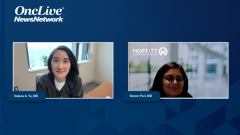
In this episode, Dr. Yu and Dr. Puri share their initial reactions to the phase 3 TOP study, the first prospective trial to specifically test treatment intensification in EGFR-mutant non–small cell lung cancer (NSCLC) patients selected by concurrent TP53 mutation. Dr. Yu reviews the headline data: median progression-free survival (PFS) of 34.0 versus 15.6 months (hazard ratio [HR], 0.44), overall response rate (ORR) of 83% versus 72%, median duration of response (DoR) of 32.7 versus 15.3 months, and an interim overall survival (OS) hazard ratio of 0.57 at roughly 30% maturity. Dr. Puri notes that the positivity of the result was not surprising given prior signals from FLAURA2 and MARIPOSA, but the magnitude of benefit was striking. She underscores that TP53 had previously been examined only post-hoc or as a secondary endpoint, never as the primary selection criterion. Dr. Yu frames the contribution of TOP as confirming that TP53 is not only prognostic but also predictive of benefit from intensification, with TP53-altered patients potentially deriving as much or more benefit than lower-risk groups. Both agree that TOP definitively answers the question of whether the TP53 co-mutated subgroup needs intensification, while acknowledging that OS data remain immature.
In the next episode, “Operationalizing First-Line Intensification: TP53 and the Borderline Patient,” Dr. Yu and Dr. Puri discuss how they translate TP53 status into upfront treatment decisions.