
Opinion|Videos|October 21, 2026
Treatment Sequencing in Multiple Myeloma
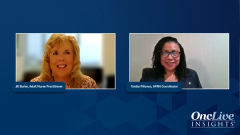
Tanika Pittman, APRN, discusses the evolving role of APPs in helping patients with multiple myeloma navigate increasingly complex treatment sequences across frontline and relapse settings.
Advertisement
Episodes in this series
Tanika Pittman, APRN, discusses the evolving role of APPs in helping patients with multiple myeloma navigate increasingly complex treatment sequences across frontline and relapse settings. She describes APPs as a continuity thread throughout the patient’s treatment journey, coordinating appointments, referrals, medications, and communication among members of the multidisciplinary team while maintaining an understanding of the patient’s individual circumstances and goals. Tanika emphasizes that patients often experience multiple myeloma as one continuous journey rather than as distinct lines of therapy, making it important to explain what has changed when disease progresses and why a new treatment is being recommended. She also highlights the need to prepare patients when transitioning to different treatment settings, such as bispecific antibodies or CAR T-cell therapy, and to explain that treatment modifications or dose reductions do not necessarily indicate treatment failure. The discussion then considers how the APP role may evolve from treatment support toward a “clinical integrator” who understands the disease, therapies, patient goals, and operational requirements for safe treatment delivery. Both faculty underscore the importance of long-term relationships between patients and their multiple myeloma care teams as treatment becomes increasingly complex.
Advertisement
Related to this article
Fadi Haddad, MD, discusses TKI adherence barriers, adverse effect management, and the role of alternative TKI formulations in CML.
Updated ARC-20 data showed casdatifan activity as monotherapy and in combinations across treatment lines in advanced clear cell RCC.

The designation covers QTX3034 plus cetuximab with or without FOLFOX; phase 1 data showed a 25% confirmed ORR with the doublet in CRC and PDAC.
MimiVax and Roswell Park announced phase 2b SURVIVE trial results evaluating the SurVaxM vaccine in newly diagnosed glioblastoma.

Faculty at an OncLive Scientific Interchange and Workshop discussed individualizing frontline immune checkpoint inhibitor selection in metastatic NSCLC.

The FDA granted fast track designation to MC001 for pancreatic cancer.
The NCCN update adds locally advanced CSCC to the category 2A listing cosibelimab received in metastatic disease in 2025.

In TASKIN, the 12-month OS rate was 61.3% with vilamakitug vs 55.7% with placebo plus trifluridine/tipiracil.
Advertisement
Advertisement
Trending on OncLive
1
QTX3034 Plus Cetuximab Receives FDA Fast Track Designation in KRAS G12D–Mutated CRC
2
FDA Grants Fast Track Designation to MC001 in Pancreatic Cancer
3
PD-L1, Histology, and Safety Profile Guide ICI Selection in NSCLC
4
Casdatifan Demonstrates Activity in Advanced Clear Cell RCC
5