Articles by Breelyn Wilky, MD
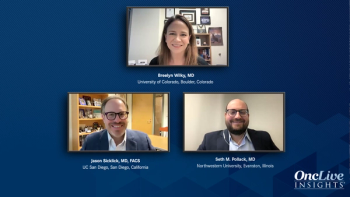
Experts provide practical recommendations for community oncologists managing gastrointestinal stromal tumors (GIST), emphasizing optimized molecular testing and treatment sequencing decisions, and offering guidance on when and how to refer patients to specialized centers.
Experts discuss the preliminary results of the PEAK study on the combination of bezuclastinib and sunitinib in second-line gastrointestinal stromal tumors (GIST), its potential to address heterogeneous resistance mutations, and how mutation-specific, biomarker-driven approaches in ongoing trials like INSIGHT may shift the treatment paradigm compared with traditional line-of-therapy strategies.
Experts discuss how they approach managing adverse events with tyrosine kinase inhibitors (TKIs) like ripretinib, sunitinib, and regorafenib, highlighting notable differences in their safety profiles and how these differences influence treatment decisions.
Experts discuss the key insights from the follow-up exploratory analysis of the INTRIGUE trial investigating circulating DNA (ctDNA) biomarkers and how mutation-specific findings may influence molecular testing before selecting a second-line agent, with practical implications for implementing a more personalized approach in clinical practice.
Experts discuss the key findings from the INTRIGUE trial comparing ripretinib to sunitinib in the second-line setting, focusing on efficacy endpoints like progression-free survival (PFS) and PFS on next line of therapy, and interpret the patient-reported outcome (PRO) and tolerability data reported in the study.
Experts discuss the key efficacy and safety findings from the INVICTUS trial that established ripretinib in the fourth-line setting, and how the inclusion of ripretinib has influenced their approach to managing patients with heavily pretreated gastrointestinal stromal tumors (GIST).
Experts discuss key factors influencing decision-making when patients with advanced gastrointestinal stromal tumors (GIST) progress on imatinib, reviewing standard second-line options, considerations for increasing imatinib dosing vs switching to a different tyrosine kinase inhibitor (TKI), and clinical or radiographic patterns that guide therapy changes or dose escalation at progression.
Experts discuss the tools available to monitor tumor heterogeneity and detect resistance, examining the reliability of current testing methods, differences in molecular testing for newly diagnosed metastatic patients vs those who have progressed, the role of liquid biopsy compared to traditional tissue biopsy, and how these test results inform risk assessment and clinical decision-making.
Experts discuss the biological mechanisms of resistance in gastrointestinal stromal tumors (GIST), differentiating between primary and secondary resistance, and explore how tumor heterogeneity evolves throughout treatment, with implications for long-term management and treatment strategies.
Experts discuss optimizing TKI selection and sequencing strategies for advanced gastrointestinal stromal tumors (GIST) beyond first-line therapy, focusing on the latest clinical data, molecular characterization, and insights from recent trials to guide treatment decisions.
Breelyn Wilky, MD, discusses updated findings from a phase 1 study investigating botensilimab plus balstilimab in refractory metastatic sarcoma.
Breelyn Wilky, MD, an associate professor of Medicine, Sylvester Comprehensive Cancer Care, University of Miami Health System, discusses how to determine which treatment a patient with sarcoma should receive.
Breelyn Wilky, MD, an associate professor of Medicine, Sylvester Comprehensive Cancer Care, University of Miami Health System, discusses the design of a phase II trial investigating concurrent axitinib (Inlyta) and pembrolizumab (Keytruda) in patients with advanced alveolar soft part sarcoma and other soft tissue sarcomas.

Breelyn Wilky, MD, an associate professor of Medicine, Sylvester Comprehensive Cancer Care, University of Miami Health System, discusses the status of a phase II trial investigating concurrent axitinib (Inlyta) and pembrolizumab (Keytruda) in patients with advanced alveolar soft part sarcoma and other soft tissue sarcomas.
Breelyn Wilky, MD, an associate professor of Medicine, Sylvester Comprehensive Cancer Care, University of Miami Health System, discusses a phase II trial exploring concurrent axitinib (Inlyta) and pembrolizumab (Keytruda) in advanced alveolar soft part sarcoma and other soft tissue sarcomas.


