
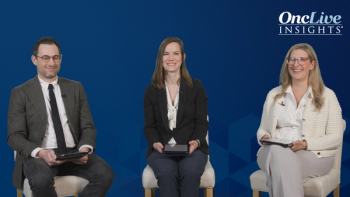
Panelists discuss how they approach prognostic marker testing at relapse, the importance of ruling out Richter's transformation, and timing of treatment initiation based on disease characteristics and progression patterns.

Catherine C. Coombs, MD, is a hematologist-oncologist and associate clinical professor in the Department of Medicine of the Division of Hematology/Oncology at University of California Irvine Health.
Panelists discuss how they approach prognostic marker testing at relapse, the importance of ruling out Richter's transformation, and timing of treatment initiation based on disease characteristics and progression patterns.
Panelists discuss how a patient with CLL with initially low-risk disease and mutated IGHV unexpectedly relapsed early after receiving venetoclax-obinutuzumab treatment with acquisition of high-risk features, presenting unique treatment challenges.
Catherine C. Coombs, MD, discusses the need to establish a standardized definition of high-risk CLL.
Catherine C. Coombs, MD, discusses the challenges in establishing a treatment consensus for relapsed CLL.

The panel concludes by offering final thoughts and insights on recent advancements from EHA 2024.
Key opinion leaders provide concise insights on the potential of bispecific antibodies as emerging novel therapeutic agents for relapsed/refractory chronic lymphocytic leukemia.
Nicole Lamanna, MD, offers expert insights on the emerging data for second-generation BCL2 inhibitors in relapsed/refractory chronic lymphocytic leukemia, highlighting recent advancements in the field.
Key opinion leaders analyze the potential significance of preliminary data on BGB-16673, a BTK inhibitor degrader, in anticipation of its presentation at EHA 2024.
The panel explores potential applications and impact of BTK inhibitor degraders as an emerging class of novel agents for treating relapsed/refractory chronic lymphocytic leukemia.
Key opinion leaders analyze the implications of the FDA's accelerated approval for lisocabtagene maraleucel (liso-cel) in chronic lymphocytic leukemia, based on promising results from the TRANSCEND CLL 004 trial.
A medical expert offers commentary on the recent FDA accelerated approval of pirtobrutinib, discussing the implications of the BRUIN trial findings that supported this decision for chronic lymphocytic leukemia treatment.
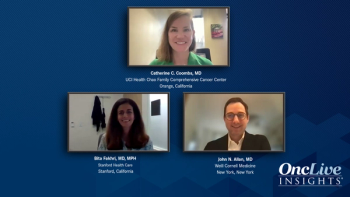
The panel concludes its discussion with a look to the future of CLL treatment, focusing on emerging novel agents and exciting clinical research.
Key opinion leaders examine recent evidence on acquired BTK inhibitor resistance in chronic lymphocytic leukemia and analyze its implications for treatment sequencing decisions in clinical practice.
An oncology specialist outlines their general approach to managing treatment-related atrial fibrillation in patients receiving BTK inhibitor therapy, incorporating insights from recent clinical data to inform their management strategies.
Highlighting recent clinical trial data on pirtobrutinib in patients with chronic lymphocytic leukemia, the panel shares their experience utilizing it in clinical practice.
Bita Fakhri, MD, MPH, shares her general approach to managing common cardiovascular adverse events associated with BTK inhibitors in patients with chronic lymphocytic leukemia.
Medical experts deliberate on strategies for managing newly developed or exacerbated hypertension in patients undergoing treatment with BTK inhibitors for chronic lymphocytic leukemia.
Experts analyze recent real-world evidence on treatment patterns, focusing on the strategies and outcomes of switching and sequencing therapies in chronic lymphocytic leukemia patients.
The panel addresses the intricacies of treating patients with chronic lymphocytic leukemia who experience treatment resistance.
Experts on chronic lymphocytic leukemia discuss treatment practices for patients with relapsed/refractory CLL and provide insights on the role for venetoclax in patients who previously received BTK inhibitors.
Key opinion leaders compare and contrast the most frequently observed causes of BTK inhibitor intolerance in clinical practice among patients treated with ibrutinib, acalabrutinib, or zanubrutinib.
A panel of experts examines and interprets the most recent matching-adjusted indirect comparison (MAIC) data presented at the European Hematology Association 2024 conference, focusing on the comparative analysis of the ASCEND and ALPINE trials in chronic lymphocytic leukemia treatment.
A hematology and oncology specialist presents the case of a 66-year-old man with chronic lymphocytic leukemia.
Catherine C. Coombs, MD, outlines considerations for long-term treatment planning, particularly in younger patients with chronic lymphocytic leukemia.
A clinician outlines their treatment strategy for relapsed/refractory chronic lymphocytic leukemia patients, emphasizing how previous treatment history influences subsequent therapy choices.
An expert in the field provides insights into current clinical trials investigating the efficacy of combined BCL-2 inhibitor and BTK inhibitor therapies.
John N. Allan, MD, provides clinical insights on how appropriate dose ramp-up practices for venetoclax can minimize adverse events and optimize patient outcomes.
Bita Fakhri, MD, MPH, discusses the importance of patient involvement in the shared decision-making process to individualize treatment and improve outcomes.
Experts analyze the potential applications of triplet therapy (venetoclax, BTK inhibitor, and obinutuzumab) in first-line chronic lymphocytic leukemia treatment, focusing on patient subgroups most likely to benefit from this approach.
A chronic lymphocytic leukemia expert examines patient criteria for first-line doublet therapy (venetoclax plus BTK inhibitor) versus triplet therapy, while also addressing findings from the CAPTIVATE trial.