
Experts on chronic lymphocytic leukemia detail how clinical trial data on doublet therapies help inform treatment decisions in the first line.

Catherine C. Coombs, MD, is a hematologist-oncologist and associate clinical professor in the Department of Medicine of the Division of Hematology/Oncology at University of California Irvine Health.
Experts on chronic lymphocytic leukemia detail how clinical trial data on doublet therapies help inform treatment decisions in the first line.
Focusing on the CLL13 and CLL14 studies, Bita Fakhri, MD, MPH, provides insights on the role of venetoclax-based first-line combination strategies and factors that inform treatment selection.

The panelists explore strategies for managing front-line chronic lymphocytic leukemia (CLL) treatment in patients with pre-existing hypertension and atrial fibrillation.
Key opinion leaders examine the use of continuous Bruton's tyrosine kinase inhibitor therapy in front-line treatment, strategies for sequencing therapies, and the potential incorporation of obinutuzumab into treatment regimens.
Catherine C. Coombs, MD, discusses the value of real-world data in informing the treatment of patients with chronic lymphocytic leukemia.
John N. Allan, MD, describes how he selects patients for first-line treatment with continuous BTK inhibitor therapy, referencing data from the RESONATE-2, ELEVATE-TN, and SEQUOIA studies.
Leading chronic lymphocytic leukemia specialists explore strategies for selecting initial treatments, weighing the merits of fixed-duration versus continuous Bruton's tyrosine kinase inhibitor (BTKi) therapy for newly diagnosed patients.
Key opinion leaders are introduced and present a concise overview of the topics to be addressed.
Bita Fakhri, MD, MPH, outlines factors she considers when choosing between fixed-duration and continuous BTK inhibitor therapy and discusses how she approaches treatment discussions with patients.
A panel of experts on chronic lymphocytic leukemia (CLL) review a patient case and describe their initial impressions on treatment decisions.

Catherine C. Coombs, MD, discusses the efficacy of the FLT3 inhibitor quizartinib in acute myeloid leukemia.
Catherine C. Coombs, MD, discusses strategies for disease classification and management for patients with acute myeloid leukemia.
Catherine C. Coombs, MD, discusses the mechanism of action of noncovalent BTK inhibitors in patients with relapsed/refractory mantle cell lymphoma.
A panel of expert oncologists offer closing thoughts on the future treatment landscape and unmet needs in CLL.
Expert oncologists explore emerging therapies being investigated in CLL, including BTKi degraders, CAR-T therapy, and bispecific antibodies, and discussed their potential impact in shaping the future of CLL treatment.
The expert panel discusses recent data regarding the mechanisms of resistance to non-covalent BTK inhibitors in CLL.
Jacqueline Barrientos, MD, MS, discusses the role of non-covalent BTK inhibitors in R/R CLL and provided concise comments on the latest data, including insights from the ongoing BRUIN and Bellwave trials.
Javier Pinilla, MD, PhD explores evidence on molecular mechanisms leading to resistance in second-generation BTK inhibitors for CLL, providing insights from recently presented data at ASH 2023.
A panel of expert oncologists explore the influence of hypertension risk and other cardiovascular AEs in guiding treatment selection with BTKis, sharing insights from ASH 2023.
Faculty provide insights into the selection of BTK inhibitors, emphasizing the role of efficacy, toxicity, and quality of life data in treatment decisions, and exploring the impact of MAIC data.
Panel experts examine considerations for BTKi-based strategies in R/R CLL, highlighting pivotal findings from head-to-head trials, including acalabrutinib vs ibrutinib in ELEVATE-RR and zanubrutinib vs ibrutinib in ALPINE, covering safety, quality of life, and extended follow-up data.
Faculty share insights into the overall strategy for managing relapsed/refractory CLL following first-line therapy with venetoclax-based regimens and BTK inhibitors, discussing strategy variations based on prior first-line treatments.
Experts explore the role of BTKi-based combination therapy in the front-line treatment of CLL, focusing on patient considerations and referencing key data from CAPTIVATE, FLAIR, MAJIC, and SEQUOIA (Arm D).
Javier Pinilla, MD, PhD, provides a brief overview of the changing CLL treatment landscape, discussing the influence of off-target adverse events and the development of treatment resistance on the evolution of BTK inhibitor therapy.
Joanna Rhodes, MD, MSCE, explores the general approach to treatment-naïve CLL patients with high-risk factors such as del17p and TP53 mutations.
Brian Hill, MD, PhD, discusses the use of BTK inhibitor monotherapy in CLL and presented recent long-term data updates from studies such as the 6-year follow-up of ELEVATE-TN and the extended follow-up from SEQUOIA.
Catherine Coombs, MD discusses the present CLL front-line treatment landscape, addressing considerations like choosing fixed-duration or continuous therapy and variations in first-line approaches based on age and ECOG status.
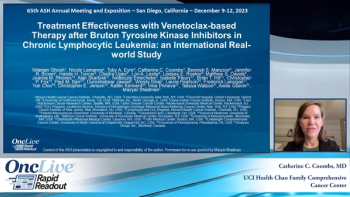
Catherine C. Coombs, MD, presents data investigating venetoclax-based therapy after Bruton tyrosine kinase inhibitors in chronic lymphocytic leukemia.
Catherine C. Coombs, MD, discusses the feasibility of switching from treatment with a covalent BTK inhibitor to a BCL-2 inhibitor vs a different covalent BTK inhibitor in patients with chronic lymphocytic leukemia or small lymphocytic lymphoma treated in a real-world setting.
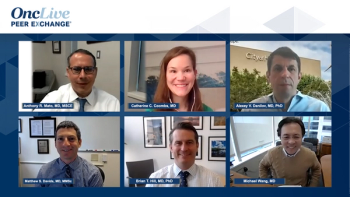
Looking to the future, a panel of experts offers closing remarks on research in CLL and MCL including hopes for further data on bispecific antibodies, BTK degraders, CAR T-cell therapy, and pirtobrutinib.