Robert Emmons, MD, FACP, Joshua Brody, MD, and Javier Pinilla, MD, PhD, sit down with Chandler Park, MD, FACP, to discuss the latest abstracts in chronic lymphocytic leukemia and lymphoma presented during the 2025 ASH Annual Meeting & Exposition.
Robert Emmons, MD, FACP, Joshua Brody, MD, and Javier Pinilla, MD, PhD, sit down with Chandler Park, MD, FACP, to discuss the latest abstracts in chronic lymphocytic leukemia and lymphoma presented during the 2025 ASH Annual Meeting & Exposition.
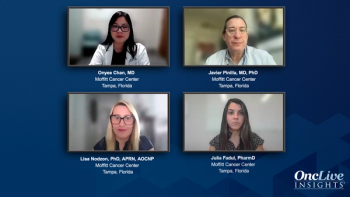
Panelists discuss the declining role of allogeneic transplant in chronic myeloid leukemia (CML) due to advances in tyrosine kinase inhibitors (TKIs) while emphasizing ongoing challenges related to treatment tolerability, management of advanced disease, and financial toxicity that necessitate continued research and supportive care strategies.
Panelists discuss the critical role of mutation testing and individualized ponatinib dosing in managing resistant or relapsed chronic myeloid leukemia (CML), emphasizing frequent molecular monitoring and multidisciplinary care to balance treatment efficacy with toxicity.
Panelists discuss a complex case of chronic myeloid leukemia (CML) progression in a younger patient, highlighting the critical importance of mutation testing, careful tyrosine kinase inhibitor (TKI) selection based on comorbidities, and adaptive treatment strategies to manage resistance and optimize outcomes.
Panelists discuss the importance of monitoring molecular milestones in chronic myeloid leukemia (CML) to guide treatment response and eligibility for treatment-free remission (TFR), emphasizing the multidisciplinary team’s role—including pharmacists and nurses—in supporting adherence, managing adverse effects, and providing individualized patient care.
Panelists discuss the evolving landscape of frontline chronic myeloid leukemia (CML) treatment, highlighting asciminib’s emerging role as a preferred first-line therapy due to its favorable efficacy, tolerability, and potential to simplify treatment selection while supporting long-term goals like deep molecular response and treatment-free remission.
Panelists discuss the critical role of early molecular testing and multidisciplinary collaboration—including pharmacists, nurse practitioners, and physicians—in personalizing chronic myeloid leukemia (CML) treatment, managing adverse effects, and supporting patient adherence to optimize long-term outcomes.
Panelists discuss a multidisciplinary approach to managing chronic myeloid leukemia (CML), using a clinical case to highlight the importance of early diagnosis, timely referral to specialized centers, and coordinated care among oncologists, nurse practitioners, and pharmacists to optimize patient outcomes.
Javier Pinilla, MD, PhD, and Talha Badar, MBBS, MD, highlight key data in CML and ALL presented at the 2024 ASH Annual Meeting.
Javier Pinilla, MD, PhD, and Talha Badar, MBBS, MD, detail factors for selecting a TKI in later lines of therapy in chronic myeloid leukemia.
Javier Pinilla, MD, PhD, and Talha Badar, MBBS, MD, discuss data for ponatinib plus chemotherapy in Ph-positive ALL.
Javier Pinilla, MD, PhD, and Talha Badar, MBBS, MD, discuss dosing strategies for ponatinib in CML and ALL.
Javier Pinilla, MD, PhD, and Talha Badar, MBBS, MD, on the implications of the mutational analysis for ponatinib in the OPTIC trial in CP-CML.
Javier Pinilla, MD, PhD, and Talha Badar, MBBS, MD, discuss 5-year data for ponatinib in pretreated CP-CML.
Javier Pinilla, MD, PhD, and Talha Badar, MBBS, MD, discuss factors that influence later-line treatment choices in chronic myeloid leukemia.
Javier Pinilla, MD, PhD, and Talha Badar, MBBS, MD, on the implications of the FDA approval of asciminib in newly diagnosed CP-CML.
Prithviraj Bose, MD, of The University of Texas MD Anderson Cancer Center, and Javier Pinilla Ibarz, MD, PhD, of Moffitt Cancer Center, sit down with Chandler Park, MD, FACP, to discuss the latest in myeloproliferative neoplasms and chronic lymphocytic leukemia, respectively, from the 2024 ASH Annual Meeting.
A panel of expert oncologists offer closing thoughts on the future treatment landscape and unmet needs in CLL.
Expert oncologists explore emerging therapies being investigated in CLL, including BTKi degraders, CAR-T therapy, and bispecific antibodies, and discussed their potential impact in shaping the future of CLL treatment.
The expert panel discusses recent data regarding the mechanisms of resistance to non-covalent BTK inhibitors in CLL.
Jacqueline Barrientos, MD, MS, discusses the role of non-covalent BTK inhibitors in R/R CLL and provided concise comments on the latest data, including insights from the ongoing BRUIN and Bellwave trials.
Javier Pinilla, MD, PhD explores evidence on molecular mechanisms leading to resistance in second-generation BTK inhibitors for CLL, providing insights from recently presented data at ASH 2023.
A panel of expert oncologists explore the influence of hypertension risk and other cardiovascular AEs in guiding treatment selection with BTKis, sharing insights from ASH 2023.
Faculty provide insights into the selection of BTK inhibitors, emphasizing the role of efficacy, toxicity, and quality of life data in treatment decisions, and exploring the impact of MAIC data.
Panel experts examine considerations for BTKi-based strategies in R/R CLL, highlighting pivotal findings from head-to-head trials, including acalabrutinib vs ibrutinib in ELEVATE-RR and zanubrutinib vs ibrutinib in ALPINE, covering safety, quality of life, and extended follow-up data.
Faculty share insights into the overall strategy for managing relapsed/refractory CLL following first-line therapy with venetoclax-based regimens and BTK inhibitors, discussing strategy variations based on prior first-line treatments.
Experts explore the role of BTKi-based combination therapy in the front-line treatment of CLL, focusing on patient considerations and referencing key data from CAPTIVATE, FLAIR, MAJIC, and SEQUOIA (Arm D).
Javier Pinilla, MD, PhD, provides a brief overview of the changing CLL treatment landscape, discussing the influence of off-target adverse events and the development of treatment resistance on the evolution of BTK inhibitor therapy.
Joanna Rhodes, MD, MSCE, explores the general approach to treatment-naïve CLL patients with high-risk factors such as del17p and TP53 mutations.
Brian Hill, MD, PhD, discusses the use of BTK inhibitor monotherapy in CLL and presented recent long-term data updates from studies such as the 6-year follow-up of ELEVATE-TN and the extended follow-up from SEQUOIA.
December 18th 2024