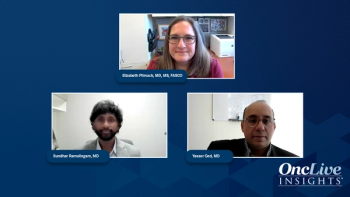
In this final segment, Dr. Elizabeth Plimack and Dr. Yasser Ged discuss the evolving landscape of renal cell carcinoma with a focus on investigational triplet strategies such as those being evaluated in the LITESPARK-012 trial.
In this final segment, Dr. Elizabeth Plimack and Dr. Yasser Ged discuss the evolving landscape of renal cell carcinoma with a focus on investigational triplet strategies such as those being evaluated in the LITESPARK-012 trial.
In this segment, Dr. Elizabeth Plimack and Dr. Yasser Ged discuss the clinical implications of recently presented phase 3 data from the LITESPARK-011 trial in renal cell carcinoma.
In this segment, Dr. Elizabeth Plimack leads a discussion with Dr. Sundhar Ramalingam and Dr. Yasser Ged on how first-line treatment selection influences sequencing strategies in renal cell carcinoma.
In this segment, Dr. Elizabeth Plimack and Dr. Sundhar Ramalingam discuss the practical considerations of dose management for IO plus TKI combinations in renal cell carcinoma.
In this segment, Dr. Elizabeth Plimack and Dr. Yasser Ged discuss how real-world patient factors influence first-line treatment decisions in renal cell carcinoma.
In this segment, Dr. Elizabeth Plimack leads a discussion with Dr. Sundhar Ramalingam and Dr. Yasser Ged on how clinicians approach treatment selection in renal cell carcinoma across different IMDC risk groups.
In this segment, Dr. Elizabeth Plimack and Dr. Sundhar Ramalingam discuss the relationship between clinical trial outcomes and real-world experience in the management of renal cell carcinoma.
In this segment, Dr. Elizabeth Plimack leads a discussion with Dr. Sundhar Ramalingam and Dr. Yasser Ged on the challenges of comparing first-line treatment regimens in renal cell carcinoma across different clinical trials.
In this segment, Dr. Elizabeth Plimack and Dr. Sundhar Ramalingam discuss how the quality of response achieved in the first-line setting influences subsequent treatment strategies in renal cell carcinoma.
In this segment, Dr. Elizabeth Plimack leads a discussion with Dr. Sundhar Ramalingam and Dr. Yasser Ged on the concept of durable responses and the potential long-term survival tail observed with first-line immunotherapy-based regimens in renal cell carcinoma.
Experts share patient-centered strategies for first-line clear cell renal cancer, balancing biology, toxicity, breaks, and emerging trial data.
Kidney cancer treatment shifts toward combo regimens, but missing biomarkers raise overtreatment concerns—experts weigh smarter patient selection.
Oncologists weigh FDA approvals, trial data, and real‑world experience to adopt new renal cancer therapies—nimbly, patient by patient.
Clinicians weigh tolerability against slight tumor growth, using patient-shared scan review and calling for AI volumetric imaging to avoid premature therapy switches.
Clinicians balance cancer control and tolerability by accepting minimal scan “drift,” using qualitative review, and advocating AI volumetric imaging over outdated RECIST.
Experts debate “depth of response” in kidney cancer, warning percentage shrinkage is subjective and variable, while deeper responses generally signal better outcomes.
Learn how clinicians tailor VEGF‑TKI immunotherapy dosing to control cancer fast, curb toxicity, and protect long‑term quality of life.
Why triplet immunotherapy plus VEGF TKI disappoints in kidney cancer—and how symptoms and tumor burden steer first-line TKI–IO choices.
ASCO highlights HIF inhibitors in kidney cancer, showing durable control and strong tolerability as trials test monotherapy vs combination strategies.
Learn how experts tailor kidney cancer first-line therapy—IO-TKI for rapid control, dual immunotherapy for low-burden or sarcomatoid disease.
Why first-line cancer therapy matters: experts weigh proven immunotherapy doublets vs experimental trials, and how tumor biology guides choices.
In this segment, Dr. Elizabeth Plimack and Dr. Yasser Ged examine how clinicians interpret progression-free survival and overall survival when evaluating first-line treatment options in renal cell carcinoma.
In this segment, Dr. Elizabeth Plimack and Dr. Sundhar Ramalingam discuss how clinicians interpret long-term outcomes from first-line clinical trials in renal cell carcinoma, including studies such as CLEAR.
In this segment, Dr. Elizabeth Plimack leads a discussion with Dr. Sundhar Ramalingam and Dr. Yasser Ged on how clinicians balance key efficacy endpoints when selecting first-line therapy for renal cell carcinoma.
In this segment, Dr. Elizabeth Plimack and Dr. Yasser Ged focus on the management of non–clear cell renal cell carcinoma, a group of histologies that has historically been underrepresented in large phase 3 trials.
In this segment, Dr. Elizabeth Plimack invites both Dr. Sundhar Ramalingam and Dr. Yasser Ged to discuss the growing role of combination therapies in the first-line treatment of renal cell carcinoma.
In this segment, Dr. Elizabeth Plimack and Dr. Yasser Ged explore how clinical trials in renal cell carcinoma have evolved, particularly in the first-line setting.
Dr. Elizabeth Plimack and Dr. Sundhar Ramalingam discuss the evolving treatment landscape of renal cell carcinoma, emphasizing that first-line therapy selection is a critical, strategic decision that significantly influences patient outcomes, disease control, and subsequent treatment options.
In this segment, Dr. Brian Rini discusses the heterogeneity of tumor biology in advanced renal cell carcinoma and its implications for clinical decision-making.
In this opening segment, Dr. Thomas Powles sets the stage for a discussion on advanced renal cell carcinoma, emphasizing the critical role of first-line treatment decisions in shaping patient outcomes.
November 3rd 2023