
Experts share patient-centered strategies for first-line clear cell renal cancer, balancing biology, toxicity, breaks, and emerging trial data.

Thomas Powles, MBBS, MRCP, MD, is a professor of genitourinary oncology and the director of the Barts Cancer Centre at St. Bartholomew’s Hospital in London, England.
Experts share patient-centered strategies for first-line clear cell renal cancer, balancing biology, toxicity, breaks, and emerging trial data.
Kidney cancer treatment shifts toward combo regimens, but missing biomarkers raise overtreatment concerns—experts weigh smarter patient selection.
Oncologists weigh FDA approvals, trial data, and real‑world experience to adopt new renal cancer therapies—nimbly, patient by patient.
Clinicians weigh tolerability against slight tumor growth, using patient-shared scan review and calling for AI volumetric imaging to avoid premature therapy switches.
Clinicians balance cancer control and tolerability by accepting minimal scan “drift,” using qualitative review, and advocating AI volumetric imaging over outdated RECIST.
Experts debate “depth of response” in kidney cancer, warning percentage shrinkage is subjective and variable, while deeper responses generally signal better outcomes.
Learn how clinicians tailor VEGF‑TKI immunotherapy dosing to control cancer fast, curb toxicity, and protect long‑term quality of life.
Why triplet immunotherapy plus VEGF TKI disappoints in kidney cancer—and how symptoms and tumor burden steer first-line TKI–IO choices.
ASCO highlights HIF inhibitors in kidney cancer, showing durable control and strong tolerability as trials test monotherapy vs combination strategies.
Learn how experts tailor kidney cancer first-line therapy—IO-TKI for rapid control, dual immunotherapy for low-burden or sarcomatoid disease.
Why first-line cancer therapy matters: experts weigh proven immunotherapy doublets vs experimental trials, and how tumor biology guides choices.
In this segment, Dr. Brian Rini discusses the heterogeneity of tumor biology in advanced renal cell carcinoma and its implications for clinical decision-making.
In this opening segment, Dr. Thomas Powles sets the stage for a discussion on advanced renal cell carcinoma, emphasizing the critical role of first-line treatment decisions in shaping patient outcomes.
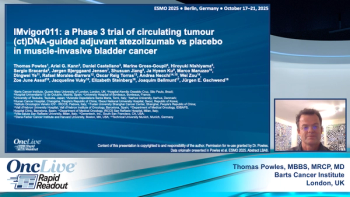
Thomas Powles, MBBS, MRCP, MD discusses IMvigor011: a Phase 3 trial of circulating tumour (ct)DNA-guided adjuvant atezolizumab vs placebo in muscle-invasive bladder cancer.
Thomas Powles, MBBS, MRCP, MD, discusses how future clinical trials could leverage the CREST trial as a basis for BCG-naive NMIBC treatment development.
Thomas Powles, MBBS, MRCP, MD, discusses how according to the ESMO guidelines, enfortumab vedotin plus pembrolizumab (EV+P) has become the new standard of first-line therapy in advanced urothelial carcinoma, and if there are patients who are ineligible for EV+P, alternatives are available such as nivolumab plus cisplatin/gemcitabine or platinum-based chemotherapy followed by maintenance avelumab.
Thomas Powles, MBBS, MRCP, MD, discusses how antibody-drug conjugates have demonstrated improvement over chemotherapy. Data from the EV-301 trial shows that the antibody-drug conjugate enfortumab vedotin decreased the risk of death by 30% versus chemotherapy. Later trial data showed that treatment using enfortumab vedotin plus pembrolizumab (EV+P) reduced the risk of patient death by 53%.
Thomas Powles, MBBS, MRCP, MD, discusses how avelumab maintenance in bladder cancer has been challenging. Specifically in sequenced immune therapy, there was a 25% decrease in patient deaths, but only 50% of the patients survived. Powles also introduces the anatomy of an antibody-drug conjugate (ADC).
Thomas Powles, MBBS, MRCP, MD, discusses how the KEYNOTE-361 trial failed because of the trial’s design. Data show that the maintenance phase of the trial is what was driving the benefit and that the longest survival with this trial was 17 months with both pembrolizumab and chemotherapy treatment rather than just chemotherapy.
Thomas Powles, MBBS, MRCP, MD, discusses how different trials have been used to study urothelial cancer (UC) treatments, including DANUBE, IMvigor130, and KEYNOTE-361, all of which are frontline, randomized, phase 3 studies that were unsuccessful. A trial that had better results involved nivolumab plus gemcitabine/cisplatin, due to patients being in better physical condition to withstand chemotherapy.
Thomas Powles, MBBS, MRCP, MD, discusses how upon examining an elderly patient experiencing hematuria, they were found to have had a transurethral resection of a bladder tumor, which revealed the presence of muscle-invasive bladder cancer. The patient is determined to have metastatic disease and is ineligible for cisplatin chemotherapy in the first line.
Expert perspectives on optimal treatment approaches in patients with newly diagnosed metastatic urothelial carcinoma.
A brief overview of the advanced urothelial carcinoma landscape encompassing disease course and standard of care treatment strategies.

Thomas Powles, MBBS, MRCP, MD, discusses the rationale to evaluate circulating tumor DNA in high-risk muscle-invasive bladder cancer.

Thomas Powles, MBBS, MRCP, MD, discusses the role of circulating tumor DNA positivity in high-risk muscle-invasive urothelial cancer.
Thomas Powles, MBBS, MRCP, MD, director, Barts Cancer Institute, discusses the FDA approval of the combination of pembrolizumab (Keytruda) plus axitinib (Inlyta) for the frontline treatment of patients with advanced renal cell carcinoma (RCC).
Thomas Powles, MBBS, MRCP, MD, director, Barts Cancer Institute, discusses the results of the KEYNOTE-426 trial in metastatic renal cell carcinoma (mRCC).
Thomas Powles, MBBS, MRCP, MD, director, Barts Cancer Institute, discusses the rationale for the KEYNOTE-426 study in patients with metastatic renal cell carcinoma.
Thomas Powles, MBBS, MRCP, MD, director, Barts Cancer Institute, discusses durvalumab in combination with a MET inhibitor in the treatment of patients with papillary renal cancer.

Thomas Powles MBBS, MRCP, MD, professor of Genitourinary Oncology, lead, Solid Tumour Research, Barts Cancer Institute, director, Barts Cancer Centre, discusses the current state of research in bladder cancer.
December 23rd 2021

November 13th 2018
November 30th 2018
March 11th 2019
March 15th 2019