

Brammer reflects on how pivotal phase 3 evidence has historically changed clinical behavior and why emerging duvelisib data may follow a similar path.
Brammer reflects on how pivotal phase 3 evidence has historically changed clinical behavior and why emerging duvelisib data may follow a similar path.
Looking ahead, Zinzani and Brammer consider how peripheral T-cell lymphoma treatment may evolve toward frontline and combination strategies.
Brammer and Zinzani discuss how duvelisib is being used in practice and where it belongs in the treatment sequence for peripheral T-cell lymphoma.
Zinzani introduces the ongoing TERZO phase 3 trial as a logical next step built on the PRIMO results, describing it as a notably focused study.
Zinzani and Brammer turn to the safety profile and mechanism of duvelisib, addressing concerns that have historically accompanied PI3K inhibition. Zinzani notes that contemporary management has improved markedly, with reduced rates of colitis, transaminitis, and pulmonary toxicity, few high-grade events, and a generally manageable profile aided by the induction-then-reduction dosing strategy. Brammer explains the mechanistic basis for duvelisib's distinctive activity, describing it as an inhibitor of both the delta and gamma isoforms of PI3K. He notes that delta inhibition acts on tumor growth and proliferation, while gamma inhibition disrupts the immunosuppressive tumor microenvironment, an effect especially relevant in T-follicular helper disease, where the malignant cells are themselves immune cells prone to autoimmune-type manifestations.
Zinzani details the design and outcomes of the PRIMO study, an international evaluation of duvelisib in relapsed or refractory peripheral T-cell lymphoma that enrolled a substantial cohort weighted toward the most common histologic subtypes.
Brammer and Zinzani examine the rationale for targeting phosphoinositide 3-kinase in T-cell lymphoma and explain why duvelisib has shown activity where other agents in the class have disappointed. Zinzani recalls early single-agent experience reported more than a decade ago, when duvelisib produced notably high response rates in peripheral and cutaneous T-cell lymphoma before development was redirected toward B-cell indications. He highlights duvelisib as distinctive among PI3K inhibitors for its activity in peripheral T-cell disease.
Brammer describes a US treatment landscape that mirrors the European experience, with poor outcomes for patients whose peripheral T-cell lymphoma has relapsed or become refractory. He reviews the modestly effective tools available, including standard chemotherapies, B-cell–derived regimens, and agents such as romidepsin and pralatrexate, each carrying only limited response rates and, in the case of pralatrexate, meaningful toxicity that can be difficult to manage outside academic centers
Zinzani outlines the limited options available to European patients with relapsed or refractory peripheral T-cell lymphoma, emphasizing how few effective therapies exist once frontline treatment fails. He describes a reliance on single-agent chemotherapies such as bendamustine and gemcitabine, sometimes combined as part of regimens used more broadly in lymphoma management. Zinzani stresses that the outcomes with these approaches remain consistently poor regardless of histologic subtype, with overall response rates that rarely exceed roughly 30%, complete metabolic responses in only a small minority of patients, and progression-free survival measured in just a few months. He frames this as a genuinely difficult and longstanding clinical situation, one that leaves clinicians with little to offer patients whose disease has returned. The segment establishes the European baseline against which newer agents such as duvelisib must be judged, underscoring the substantial unmet need that motivates ongoing trial efforts across the continent.
Jonathan Brammer, MD, of The Ohio State University, and Pier Luigi Zinzani, MD, of the University of Bologna, open a discussion devoted to duvelisib in peripheral T-cell lymphoma. Brammer introduces himself as a researcher focused on T-cell malignancies, and Zinzani notes his work as a hematologist with broad experience across lymphoma subtypes and a particular interest in peripheral T-cell lymphoma. Together they frame the conversation around a disease setting that has seen little meaningful progress in recent decades, positioning duvelisib as a development of genuine interest for patients with limited options. Brammer establishes that the discussion will center on the agent's activity in T-cell lymphomas and, in particular, on the recently reported results from the PRIMO study. The introduction sets expectations for a wide-ranging exchange that will move from the current treatment landscape through trial data, mechanism, sequencing, and future directions in this rare and challenging group of diseases.
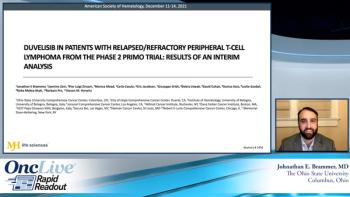
Jonathan E. Brammer, MD, reports data presented at the 2021 American Society of Hematology Annual Meeting regarding interim analysis study results from the phase 2 PRIMO trial evaluating the use of duvelisib monotherapy in patients with relapsed/refractory peripheral T-cell lymphoma.
Jonathan E. Brammer, MD, discusses data that have been reported with inotuzumab ozogamicin (Besponsa) in acute lymphoblastic leukemia (ALL).
Jonathan E. Brammer, MD, discusses the role of stem cell transplant in acute lymphoblastic leukemia.
Jonathan E. Brammer, MD, discusses the progression of transplant in acute lymphoblastic leukemia.

Jonathan E. Brammer, MD, discusses the importance of achieving minimal residual disease negativity in relapsed/refractory acute lymphoblastic leukemia.

Jonathan E. Brammer, MD, assistant professor of hematology, Ohio State University Comprehensive Cancer Center, discusses updates in the treatment landscape of T-cell lymphoma.
Jonathan E. Brammer, MD, assistant professor of hematology, Ohio State University Comprehensive Cancer Center, discusses brentuximab vedotin (Adcetris) for patients with T-cell lymphoma.
October 26th 2017
January 9th 2020
January 23rd 2020
February 6th 2020

