Dr Cortes and Dr Jabbour discuss the orally disintegrating tablet formulation of nilotinib and its June 2026 FDA approval for patients with CML.

Jorge Cortes, MD, is director of the Georgia Cancer Center at Augusta University.
Dr Cortes and Dr Jabbour discuss the orally disintegrating tablet formulation of nilotinib and its June 2026 FDA approval for patients with CML.
Jorge Cortes, MD, discusses the variety of long-term patient goals in chronic myeloid leukemia and how prioritizing them leads to different TKI selections.
Jorge Cortes, MD, discusses the state of the leukemia and lymphoma treatment paradigms in 2025 in recognition of Leukemia and Lymphoma Awareness Month

Drs Raval and Cortes discuss Dr. Cortes’ journey through the hematologic oncology field and highlight ongoing work in the hematologic oncology space.
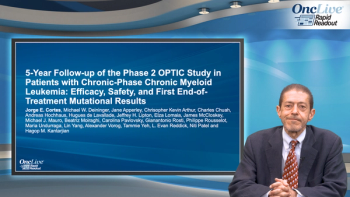
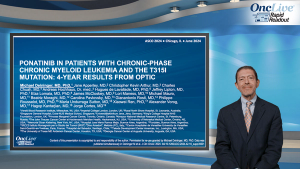
Dr. Jorge E. Cortes provides a comprehensive overview of the 5-year follow-up results from the Phase 2 OPTIC study, showcasing the long-term efficacy, safety, and mutational analysis of ponatinib in patients with chronic-phase chronic myeloid leukemia, including outcomes related to dose modifications and mutation evolution.
Panelists discuss how it is an exciting time for chronic myeloid leukemia (CML) treatment, with many options including 6 different drugs that have been very successful for patients, which give clinicians multiple options to tailor the therapy to their patients and consider whether CML could be curable.
Panelists discuss how a clinician seeks guidance on implementing asciminib in first-line chronic myeloid leukemia treatment following its FDA approval, including understanding its trial data and determining appropriate patient selection compared with existing tyrosine kinase inhibitor options.
Panelists discuss how in selecting first-line therapy for patients with newly diagnosed chronic myeloid leukemia, clinicians must carefully weigh factors including the patient’s risk score, comorbidities, drug interaction potential, monitoring requirements, and cost considerations while recognizing that available tyrosine kinase inhibitor options (imatinib, nilotinib, dasatinib, and bosutinib) have similar efficacy but distinct safety and tolerability profiles.
Panelists discuss how clinicians should implement regular cardiovascular monitoring and dose modifications for ponatinib-associated toxicities while being vigilant for asciminib’s key adverse events, including thrombocytopenia, pancreatic dysfunction, and hypertension, with appropriate dose adjustments and supportive care as needed.
Jorge Cortes, MD, discusses asciminib’s sustained efficacy and improved safety over other TKIs in first-line CML.
Jorge Cortes, MD discusses the FDA approval of luspatercept-aamt has influenced first-line MDS management.
Panelists discuss how when choosing between asciminib and ponatinib for chronic myeloid leukemia treatment, key considerations include the patient’s mutation status, prior tyrosine kinase inhibitor therapy response, cardiovascular risk factors and comorbidities, and the differing safety profiles of the 2 drugs, with ponatinib generally having more cardiovascular concerns but broader mutation coverage vs asciminib’s more favorable tolerability but more specific targeting of BCR::ABL1.
Panelists discuss how for patients with chronic myeloid leukemia who develop the T315I mutation, ponatinib and asciminib have demonstrated efficacy in the PACE and ASCEMBL trials, respectively, with ponatinib showing a major cytogenetic response rate in patients with T315I mutation and asciminib demonstrating superior major molecular response vs bosutinib.
Panelists discuss how mutation analysis should be considered when treatment fails to meet milestones or patients show loss of response to tyrosine kinase inhibitor (TKI) therapy, as this information helps determine whether to continue the current TKI or switch to an alternative agent based on the specific resistance profile.
Panelists discuss how in standard clinical practice, response to first-line tyrosine kinase inhibitor therapy is monitored through regular molecular testing of BCR::ABL1 transcript levels, with key evaluations to assess whether patients achieve target milestone responses that predict long-term outcomes.
Muhamed Baljevic, MD, FACP and Jorge Cortes, MD, discuss upcoming studies and emerging data being presented at the 2024 ASH Annual Meeting.
Jorge E. Cortes, MD, discusses efficacy and safety findings from the phase 4 BYOND study in previously treated patients with Ph+ chronic myeloid leukemia.
Jorge Cortes, MD, discusses 4-year outcomes with ponatinib in patients with chronic myeloid leukemia harboring a T315I mutation.
Following the ASCO 2023 and EHA 2023 Annual Meetings, experts discuss important updates in acute myeloid leukemia.
Shared insight from key opinion leaders on clinical trial data in acute lymphoblastic leukemia from the ASCO 2023 and EHA 2023 Annual Meetings.
Expert perspectives on key data in chronic myeloid leukemia from the ASCO 2023 and EHA 2023 Annual Meetings.

Jorge E. Cortes, MD, discusses the importance of defining fitness in patients with hematologic malignancies prior to treatment selection.
Jorge E. Cortes, MD, discusses important questions in acute lymphoblastic leukemia to address, such as improved understanding of the role of allogenic stem cell transplant and the use of tyrosine kinase inhibitor combinations.

Jorge E. Cortes, MD, discusses emerging therapies in chronic myeloid leukemia.
Jorge E. Cortes, MD, shares advice for navigating among first- and second-generation TKIs in the frontline treatment of patients with chronic myeloid leukemia.
Jorge E. Cortes, MD, discusses the benefits of ruxolitinib (Jakafi) in patients with myeloproliferative neoplasms.
Jorge E. Cortes, MD, professor and deputy chair, Department of Leukemia, The University of Texas MD Anderson Cancer Center, discusses the results of quizartinib in patients with relapsed/refractory acute myeloid leukemia.
February 24th 2023

September 11th 2025
December 16th 2020