Luciano Costa, MD, discusses teclistamab plus daratumumab vs investigator’s choice of DPd/DVd in patients with relapsed or refractory multiple myeloma.
Luciano Costa, MD, discusses teclistamab plus daratumumab vs investigator’s choice of DPd/DVd in patients with relapsed or refractory multiple myeloma.
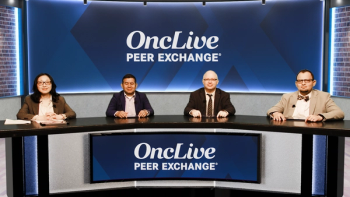
Panelists discuss how evolving therapeutic strategies, including the use of quadruplet regimens and emerging trispecific antibodies, may lead to functional cures in multiple myeloma and shift treatment goals toward finite-duration therapy.
Panelists discuss how dual-targeting bispecific therapies, exemplified by JNJ-78934804 (targeting BCMA and GPRC5D), show early potential to redefine treatment paradigms in heavily pretreated multiple myeloma, with impressive response rates and manageable safety profiles.
Panelists discuss how extended follow-up from the MonumenTAL-1 trial confirms the durable efficacy and favorable infection profile of talquetamab, while ongoing trials like TALISMAN aim to mitigate its unique toxicity profile.
Panelists discuss how the CARTITUDE-4 data support early use of ide-cel in triple class–exposed myeloma patients, emphasizing the importance of avoiding attrition by not delaying highly effective therapies.
Panelists discuss how subgroup analyses of cilta-cel support its efficacy in high-risk cytogenetics and extramedullary disease, though bridging therapy and patient selection remain key for optimal outcomes.
Panelists discuss how sequencing CAR T-cell therapy, bispecifics, and antibody-drug conjugates (ADCs) will become increasingly complex, with treatment decisions depending on patient characteristics, accessibility, and toxicity profiles.
Panelists discuss how updated data from the DREAMM-7 and DREAMM-8 studies validate the early integration of BCMA-targeted therapies like belantamab mafodotin, showing promising efficacy and manageable ocular toxicities.
Panelists discuss how 5-year follow-up data from the CARTITUDE-1 trial demonstrate durable responses and potential functional cures in a subset of relapsed/refractory myeloma patients treated with cilta-cel.
Panelists discuss how the evolving treatment landscape, including CAR T-cell therapy and bispecifics, has made it possible to offer cellular therapies like cilta-cel as early as second-line treatment for eligible patients.
Panelists discuss how novel agents like iberdomide show promising efficacy and manageable toxicity in early-phase studies for transplant-ineligible patients with newly diagnosed multiple myeloma (NDMM).
Panelists discuss how novel agents like iberdomide show promising efficacy and manageable toxicity in early-phase studies for transplant-ineligible patients with newly diagnosed multiple myeloma (NDMM).
Panelists discuss how isatuximab-containing quadruplet regimens offer clinical benefit in patients with 1q gain or amplification, though its advantage appears to reflect a class effect among CD38-targeting agents.
Panelists analyses from the CEPHEUS suggest that quadruplet regimens provide broad benefits in transplant-ineligible patients, though ultra–high-risk subtypes may require novel strategies discuss how subgroup.
Panelists discuss how treating newly diagnosed, transplant-ineligible multiple myeloma patients requires a nuanced approach that accounts for comorbidities, age, and functional status to optimize induction therapy.
Panelists discuss how data from the PERSEUS trial supports the use of daratumumab in quadruplet regimens to improve sustained minimal residual disease negativity and progression-free survival in transplant-eligible myeloma patients.
Panelists discuss how quadruplet-based induction therapy, including anti-CD38 monoclonal antibodies, is becoming the preferred frontline treatment for transplant-eligible patients with multiple myeloma based on risk stratification.
Luciano J. Costa, MD, PhD, discusses clinical implications derived from a final analysis of the phase 2 MASTER trial, which evaluated quadruplet induction therapy in multiple myeloma.
Luciano J. Costa, MD, PhD, discusses the background of the phase 2 MASTER trial in newly diagnosed multiple myeloma.
Luciano J. Costa, MD, PhD, discusses data on the use of minimal residual disease responses to modulate quadruplet induction therapy following autologous stem cell transplant in newly diagnosed multiple myeloma.
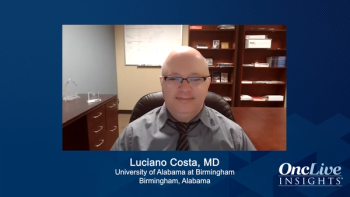
Closing out their discussion on bispecifics in multiple myeloma, expert hematologist-oncologists share practical advice for community physicians alongside their hopes for the future.
Luciano Costa, MD, and Adriana Rossi, MD, consider the possibility of earlier-line bispecific and CAR T-cell therapies in multiple myeloma.
In light of emerging bispecific and CAR T-cell therapies in multiple myeloma, experts consider how they might optimally sequence treatment.
Comprehensive discussion on the MonumenTAL-1 trial of talquetamab, a GPRC5D- and CD3-targeted agent, in the setting of relapsed/refractory multiple myeloma.
Moving on to the second clinical scenario of multiple myeloma, Luciano Costa, MD, details his care of a heavily pretreated patient.
Expert perspectives on the MajesTEC-1 trial, a study of BCMA- and CD3-targeted agent teclistamab in relapsed/refractory multiple myeloma.
Shared insight on factors that help to determine optimal therapy for patients diagnosed with triple-class refractory multiple myeloma.
Expert hematologist-oncologist Adriana Rossi, MD, shares a real-world patient scenario of triple-class refractory multiple myeloma managed with novel bispecific antibody therapy.
Luciano J. Costa, MD, PhD, discusses the rationale to develop later-line therapies for use in the frontline setting in multiple myeloma.
Luciano J. Costa, MD, PhD, discusses the evolving treatment paradigm in newly diagnosed multiple myeloma.
September 14th 2020