
Dr. Gumbleton's primary practice pearl for the management of patients with EGFR-mutated NSCLC in 2026: with very few exceptions, every treatment-naïve patient deserves frontline combination therapy.
Dr. Gumbleton's primary practice pearl for the management of patients with EGFR-mutated NSCLC in 2026: with very few exceptions, every treatment-naïve patient deserves frontline combination therapy.
Dr. Riess presents a 55-year-old male former light smoker with stage IV EGFR L858R adenocarcinoma, ECOG performance status 1, three small asymptomatic brain metastases (largest 8 mm) on baseline brain MRI, no TP53 or other high-risk co-mutation, employed as a remote software engineer with concern about preserving cognitive function and work capacity.
Dr. Riess presents a 52-year-old never-smoking woman with stage IV EGFR exon 19 deletion non-small cell lung cancer, performance status 0, full-time employment as a teacher, no significant comorbidities, and no baseline CNS metastases on brain MRI.
Dr. Riess addresses dose modification frequency in MARIPOSA: dose interruptions in 83% of patients, dose reductions in 59%, and any-agent discontinuation in 35%, with only 10% discontinuing all agents due to treatment-related adverse events.
Dr. Gumbleton discusses how proactive dermatologic management translates into day-to-day clinical practice for patients receiving amivantamab-lazertinib for EGFR-mutated NSCLC.
Dr. Riess presents the COCOON trial data, which evaluated a standardized prophylactic regimen for dermatologic adverse event management with amivantamab-lazertinib in patients with EGFR-mutated NSCLC.
Dr. Gumbleton explains the mechanism of action of amivantamab-lazertinib for clinicians treating patients with EGFR-mutated NSCLC.
Dr. Riess addresses the high rate of CNS metastasis development in EGFR-mutated NSCLC (25%-45%), noting that MARIPOSA's requirement for serial brain MRIs in all participants generated robust intracranial efficacy data.
Dr. Riess highlights TP53 co-mutation as one of the most compelling high-risk subgroups in EGFR-mutated NSCLC, asking Dr. Fidler how TP53 co-mutation status influences frontline treatment selection.
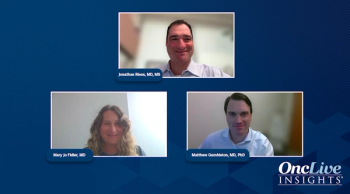
Dr. Jonathan Riess introduces the program on first-line treatment strategies in EGFR-mutated NSCLC, joined by Dr. Mary Jo Fidler and Dr. Matthew Gumbleton.

Mary Jo J. Fidler, MD, discusses the potential utility of circulating tumor DNA to inform treatment escalation in lung cancer.
Mary Jo Fidler, MD, associate professor, medical oncology, hematology, internal medicine, Rush University Medical Center, discusses osimertinib (Tagrisso) in patients with EGFR T790M-positive non–small cell lung cancer.
Mary Jo Fidler, MD, associate professor, medical oncology, hematology, internal medicine, Rush University Medical Center, discusses how early and persistent oligoclonal T cell expansion correlates with durable response to anti-PD1 therapy in non-small cell lung cancer treatment (NSCLC).

September 28th 2017

