
Explore the evolving treatment landscape for Chronic Lymphocytic Leukemia, focusing on BTK and BCL2 inhibitor strategies and biomarker testing insights.

Mazyar Shadman, MD, MPH, is the Innovators Network Endowed Chair and an associate professor, in theClinical Research Division at Fred Hutchinson Cancer. He is also an associate professor in the Medical Oncology Division at University of Washington School of Medicine.
Explore the evolving treatment landscape for Chronic Lymphocytic Leukemia, focusing on BTK and BCL2 inhibitor strategies and biomarker testing insights.
Mazyar Shadman, MD, MPH, details the rationale for investigating the combination of zanubrutinib and venetoclax in treatment-naive CLL/SLL.
Panelists discuss how sequencing therapy after covalent Bruton tyrosine kinase (BTK) inhibitor progression involves choosing between noncovalent BTK inhibitors like pirtobrutinib or venetoclax-based therapy, with the traditional approach favoring venetoclax second-line followed by pirtobrutinib third-line based on available data, while acknowledging that current studies reflect heavily pretreated patients and may not represent the superior outcomes expected in earlier-line settings, and highlight promising early results from zanubrutinib plus venetoclax combinations showing 96% overall response rates and high undetectable minimal residual disease rates in phase 1 studies.
Panelists discuss how Bruton tyrosine kinase (BTK) resistance mutation testing is routinely performed at disease progression, but currently doesn’t change treatment decisions because pirtobrutinib shows comparable efficacy regardless of mutation status. However, high-level mutations (C481S or L528W) might favor venetoclax-based therapy over pirtobrutinib in second-line treatment. The panelists also emphasize the importance of patient education; approximately one-third of progressive patients lack detectable resistance mutations yet still require treatment changes based on clinical progression rather than molecular findings.
Panelists discuss how early data from the REVENGE trial show encouraging results for venetoclax retreatment in patients who relapsed more than 2 years after completing fixed-duration venetoclax-obinutuzumab therapy, with most patients achieving excellent responses, including undetectable minimal residual disease, while acknowledging that treatment approaches after progression on oral acalabrutinib-venetoclax doublets remain a “data-free zone” requiring extrapolation from existing venetoclax retreatment studies and resistance mutation testing to guide therapeutic decisions.
Panelists discuss how biomarker retesting at relapse should include cytogenetics and fluorescence in situ hybridization to detect clonal evolution, Bruton tyrosine kinase (BTK) resistance mutations in patients progressing on BTK inhibitors, and molecular panels to identify new mutations that may predict transformation risk. Real-world registry data demonstrate that venetoclax-based therapy remains highly effective after BTK inhibitor progression, with progression-free survival of 30 to 35 months, providing crucial benchmarks for treatment sequencing decisions in the absence of prospective clinical trial data.
Panelists discuss how managing chronic low-grade BTK inhibitor (BTKi) toxicities like myalgias and palpitations requires individualized decision-making that considers the patient’s response quality, treatment duration, and quality-of-life impact, with options including treatment holidays (given median time to next therapy of over 2 years after stopping), switching to different second-generation BTKi if on ibrutinib, or transitioning to venetoclax-based therapy for patients who cannot tolerate continued BTK inhibition despite achieving good responses.
Panelists discuss how real-world data from retrospective studies show that second-generation Bruton tyrosine kinase inhibitors (BTKi) have lower rates of hypertension compared with ibrutinib, and surprisingly reveal that patients treated with venetoclax-obinutuzumab continue to experience serious infections requiring hospitalization at rates of approximately 10% even 12 to 36 months after completing fixed-duration therapy, which is higher than the 6% rate seen in patients on continuous BTKi therapy and challenges assumptions about infection risk resolution after treatment completion.

Mazyar Shadman, MD, MPH discusses future research avenues based on findings from arm D of the SEQUOIA trial in CLL/SLL.
Panelists discuss how the anticipated FDA approval of acalabrutinib plus venetoclax as an all-oral fixed-duration regimen will expand frontline chronic lymphocytic leukemia (CLL) treatment options and shift practice patterns, with many patients preferring oral therapy over intravenous options, while acknowledging that the MAGIC trial comparing this combination with venetoclax-obinutuzumab may provide definitive efficacy data and that minimal residual disease (MRD)–guided approaches could further personalize treatment duration based on individual response assessment.
Panelists discuss how minimal residual disease (MRD)–directed strategies are evolving in frontline chronic lymphocytic leukemia (CLL) treatment, highlighting the FLARE study’s demonstration of overall survival benefit with fixed-duration ibrutinib-venetoclax compared with continuous ibrutinib, and emphasize that time to next treatment is a clinically meaningful end point because patients often don’t require immediate retreatment upon disease progression, providing valuable counseling information about treatment-free intervals for patients considering fixed-duration approaches.
Panelists discuss how Bruton tyrosine kinase (BTK) inhibitor selection requires careful consideration of patient-specific safety factors including cardiac comorbidities, renal function, infection risk, concurrent medications, and overall comorbidity index scores, emphasizing the importance of tailoring therapy based on individual patient profiles and preferences while recognizing that geriatric patients with chronic lymphocytic leukemia (CLL) often have multiple medical conditions that influence treatment tolerability and logistics.
Panelists discuss how long-term follow-up data from SEQUOIA Arm C demonstrates that zanubrutinib provides excellent outcomes for high-risk patients with TP53-disrupted chronic lymphocytic leukemia (CLL) with 72% progression-free survival at 5 years and increasing complete response rates over time (now around 20%), establishing it as a benchmark for continuous Bruton tyrosine kinase (BTK) inhibitor therapy in this population, while noting that deeper responses than historically expected may lead to future consideration of minimal residual disease–guided treatment discontinuation strategies.
Panelists discuss how treatment selection between continuous Bruton tyrosine kinase (BTK) inhibitor therapy and fixed-duration regimens involves shared decision-making that weighs patient preferences for time investment, with continuous therapy requiring ongoing visits but offering potentially superior efficacy for high-risk patients, while acknowledging that indirect comparisons like the MAIC analysis comparing zanubrutinib-venetoclax with acalabrutinib-venetoclax provide additional evidence despite methodological limitations when head-to-head trials are not feasible.
Panelists discuss how oral fixed-duration Bruton tyrosine kinase (BTK) inhibitor–venetoclax doublets may be considered for patients with high-risk TP53-disrupted chronic lymphocytic leukemia (CLL) based on promising phase 2 data showing high undetectable minimal residual disease (MRD) rates, but express concerns about infection risks with triplet regimens and emphasize the need for longer follow-up data to determine durability of remissions, with some preferring MRD-guided longer duration approaches over standard 14-cycle regimens for these highest-risk patients.
Panelists discuss how determining the optimal duration for fixed-duration chronic lymphocytic leukemia (CLL) therapies requires balancing factors like disease burden, patient age, and IGHV mutation status, with current standard approaches being 12 cycles for venetoclax-obinutuzumab or 14 cycles for oral Bruton tyrosine kinase inhibitor–venetoclax combinations, while recognizing that patients with unmutated IGHV may need longer treatment despite having excellent outcomes even without achieving undetectable minimal residual disease.
Panelists discuss how the SEQUOIA Arm D study demonstrates that zanubrutinib plus venetoclax provides an effective all-oral doublet option for treatment-naive patients with chronic lymphocytic leukemia (CLL) including those with high-risk TP53 abnormalities, achieving 60% undetectable minimal residual disease rates regardless of TP53 status, although high-risk patients may require longer treatment duration than the standard 1-year fixed approach to reach optimal disease clearance.
Panelists discuss how first-line chronic lymphocytic leukemia (CLL) therapy selection balances prognostic testing results with individual patient factors, weighing continuous Bruton tyrosine kinase (BTK) inhibitor therapy vs fixed-duration venetoclax-based regimens based on patient preferences for pill vs infusion treatment, comorbidities like cardiac issues, and the emerging role of oral BTK inhibitor–venetoclax doublets for appropriate candidates.
Panelists discuss how proper baseline testing, including cytogenetics, TP53 mutation status, and IGHV mutation testing, is essential for risk stratification and treatment selection in patients with chronic lymphocytic leukemia (CLL), with TP53 disruption being the most critical prognostic factor that typically directs clinicians toward continuous Bruton tyrosine kinase (BTK) inhibitor therapy.
Mazyar Shadman, MD, MPH, discusses data from arm D of the phase 3 SEQUOIA trial of zanubrutinib plus venetoclax in treatment-naive CLL/SLL.
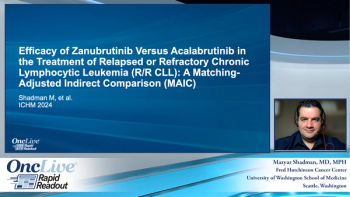
Mazyar Shadman, MD, MPH, presents data from a matching adjusted indirect comparison (MAIC) of the efficacy of zanubrutinib versus acalabrutinib in relapsed or refractory (R/R) chronic lymphocytic leukemia (CLL) based on data from the Phase 3 ALPINE and Phase 3 ASCEND trials.
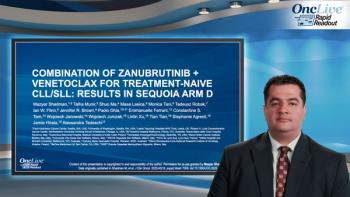
Mazyar Shadman, MD, MPH, of Fred Hutchinson Cancer Center, presents updated SEQUOIA Arm D results demonstrating deep, durable responses and favorable safety with fixed-duration zanubrutinib plus venetoclax in treatment-naive CLL/SLL, including patients with del(17p)/TP53 mutations.
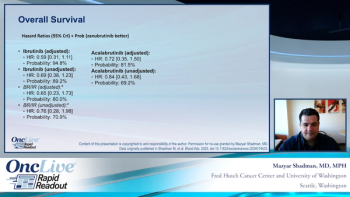
Mazyar Shadman, MD, MPH, presents a network meta-analysis evaluating Bruton tyrosine kinase (BTK) inhibitors in high-risk relapsed/refractory CLL, showing that zanubrutinib demonstrated the greatest efficacy in reducing progression and death compared with other BTK inhibitors and treatments.
Mazyar Shadman, MD, MPH, discusses the rationale and methodological framework of a network meta analysis of BTK inhibitors in relapsed/refractory CLL.
Mazyar Shadman, MD, MPH, discusses the rationale and methodological framework of a network meta-analysis aimed at evaluating the comparative efficacy of BTK inhibitors in R/R CLL.
Mazyar Shadman, MD, MPH, discusses the need for a clinical consensus in selecting optimal treatment strategies in diffuse large B-cell lymphoma.
Dr Shadman discusses key findings and implications from trials that were presented at the 2024 ASH Annual Meeting investigating zanubrutinib in CLL.
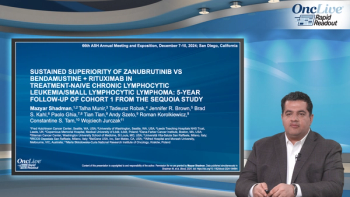
Dr. Mazyar Shadman presents an OncLive Rapid Readout on the SEQUOIA study, highlighting 5-year follow-up data that confirm zanubrutinib’s sustained progression-free survival superiority over bendamustine plus rituximab in treatment-naive chronic lymphocytic leukemia/small lymphocytic lymphoma, with consistent efficacy across risk groups and a favorable long-term safety profile.
Mazyar Shadman, MD, MPH, discusses real-world outcomes following early dose adjustments of first-line ibrutinib in CLL/SLL.
Mazyar Shadman, MD, MPH, discusses the investigation of sonrotoclax in the CELESTIAL-TNCLL trial in treatment-naïve chronic lymphocytic leukemia.