The panel addresses two important areas not fully covered earlier.

Mazyar Shadman, MD, MPH, is the Innovators Network Endowed Chair and an associate professor, in theClinical Research Division at Fred Hutchinson Cancer. He is also an associate professor in the Medical Oncology Division at University of Washington School of Medicine.
The panel addresses two important areas not fully covered earlier.
The panel emphasizes MRD testing is not a current standard of care requirement, advising community oncologists not to feel obligated to order it outside clinical trials or high-risk treatment extension decisions.
Dr. Lipsky outlines different conceptual frameworks for evaluating the 2 CELESTIAL trials.
Dr. Shadman introduces sonrotoclax as a next-generation selective BCL-2 inhibitor approved for mantle cell lymphoma, with emerging CLL data in combination with zanubrutinib.
Dr. Coombs frames sequencing philosophy around patient age and disease trajectory.
Dr. Parikh summarizes the CLL17 trial: a 3-arm comparison of continuous ibrutinib, ibrutinib-venetoclax doublet, and venetoclax-obinutuzumab, all with approximately 3-year median follow-up showing no significant PFS difference between fixed-duration regimens and continuous ibrutinib.
Dr. Hoffmann frames long-term adherence as a practical challenge in continuous BTK inhibitor therapy.
Dr. Lipsky separates high-risk biomarkers conceptually, emphasizing TP53 aberrations and IGHV unmutated status should be considered distinctly rather than aggregated. TP53 aberrations—encompassing del(17p) and/or TP53 mutation—represent the highest-risk adverse predictive biomarkers across all CLL treatment strategies.
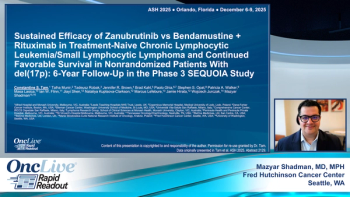
Dr. Shadman reviews SEQUOIA 6-year follow-up data, highlighting that zanubrutinib monotherapy continues demonstrating high efficacy regardless of del(17p) status. Key outcomes include 74% PFS at 6 years for del(17p)-negative patients (Arm A) and 64% for del(17p)-positive patients (Arm C, 111 patients representing the largest prospective BTK inhibitor cohort in this high-risk population).
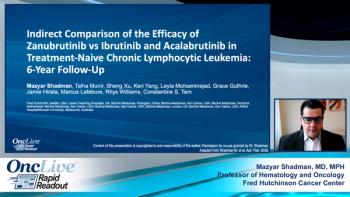
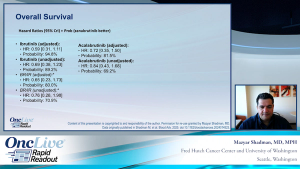
This presentation shows that the next-generation BTK inhibitor zanubrutinib demonstrates increasingly durable long-term survival and progression-free benefits compared with ibrutinib and acalabrutinib in previously untreated chronic lymphocytic leukemia, supporting its use as a preferred frontline therapy when direct comparative trial data are unavailable.
Dr. Parikh highlights the CLL14 9-year follow-up data as among the most important datasets presented at EHA 2026. The study enrolled treatment-naïve patients with significant comorbidities (high CIRS score) randomized to venetoclax-obinutuzumab versus chlorambucil-obinutuzumab. With 9-year follow-up, the median PFS for venetoclax-obinutuzumab reaches approximately 6 years overall, with a remarkably striking finding for IGHV-mutated patients achieving median PFS of approximately 8.5 to 9 years.
Dr. Marc Hoffmann introduces the program on optimizing CLL treatment strategies, noting that CLL remains the most common adult leukemia in the Western world with approximately 20,000 new annual US diagnoses. The panel includes Drs. Catherine Coombs, Andrew Lipsky, Sameer Parikh, and Mazyar Shadman.
Mazyar Shadman, MD, MPH, discusses data from the phase 1/1b BGB-11417-101 trial of sonrotoclax plus zanubrutinib in frontline CLL/SLL.

Dr. Brander asks about synthesizing comparative analyses and important limitations clinicians should understand when interpreting cross-trial comparisons, including balancing insights with other evidence forms.
Dr. Brander introduces the third analysis comparing zanubrutinib from SEQUOIA with acalabrutinib plus venetoclax from AMPLIFY, representing an anchored analysis with similar comparison arms showing zanubrutinib association with prolonged progression-free survival when adjusting for baseline characteristics.
Dr. Shadman transitions to discussing the second analysis comparing zanubrutinib as continuous therapy versus venetoclax-obinutuzumab fixed-duration regimen, the previously preferred approved fixed-duration option in the United States.
Dr. Brander discusses the comparison of zanubrutinib from the SEQUOIA trial with fixed-duration venetoclax plus ibrutinib from GLOW and CAPTIVATE studies, examining patient populations and study design relevance.
Dr. Mazyar Shadman from the University of Washington and Fred Hutchinson Cancer Center and Dr. Danielle Brander from Duke Cancer Institute introduce their discussion on interpreting matching adjusted indirect comparisons (MIACs) to inform first-line chronic lymphocytic leukemia (CLL) treatment decisions. The focus centers on how recent comparative analyses help clinicians choose between continuous BTK inhibitor therapy versus fixed-duration venetoclax-based therapies in clinical practice.
Dr Shadman discusses an indirect comparison evaluating zanubrutinib vs acalabrutinib plus venetoclax in chronic lymphocytic leukemia.

Mazyar Shadman, MD, MPH, discusses a post hoc analysis that compared data BTK inhibitor–based regimens for treatment-naive chronic lymphocytic leukemia.

Experts discuss advancements in CLL treatment, highlighting pirtobrutinib's role and the potential of CAR T-cells and bispecific therapies.
Experts discuss the role of MRD testing in CLL treatment, emphasizing personalized approaches and the importance of continuity in patient care.
Experts discuss the impact of real-world data on CLL treatment sequencing, highlighting survival outcomes and the importance of targeted therapies.
Explore the latest insights on venetoclax retreatment effectiveness and its impact on patient outcomes in chronic lymphocytic leukemia therapy.
Experts discuss the implications of recent studies on pirtobrutinib, comparing its efficacy and safety against other BTK inhibitors for CLL treatment.
Experts discuss strategies for selecting second-line therapies in CLL, emphasizing treatment history, patient response, and genetic factors.
Experts discuss the balance of safety, efficacy, and logistics in treatment choices, highlighting the evolving landscape of BTK inhibitors and patient preferences.
Experts discuss the importance of patient-specific factors and preferences in selecting first-line treatments for CLL.
Experts discuss evolving treatment strategies for CLL, highlighting the balance between time-limited and continuous therapies for optimal patient outcomes.