
Dr. Lunning acknowledges country-specific cost-access realities for novel therapies, noting he prescribes what the evidence supports and then navigates insurance processes including peer-to-peer reviews when needed.
Dr. Lunning acknowledges country-specific cost-access realities for novel therapies, noting he prescribes what the evidence supports and then navigates insurance processes including peer-to-peer reviews when needed.
Dr. Graff addresses the persistent gap between the CAR-T evidence base and real-world utilization.
Dr. Johnson discusses the FDA's April 2026 update to the epcoritamab label permitting outpatient monitoring for the first full 48 mg dose in relapsed/refractory DLBCL.
Dr. Graff reviews the EPCORE DLBCL-1 Phase 3 trial comparing epcoritamab monotherapy against investigator's choice of R-GemOx or bendamustine-rituximab in relapsed/refractory DLBCL.
Dr. Johnson addresses whether using CD19-directed agents in the frontline compromises subsequent relapse options.
Dr. Graff discusses the challenging scenario of a positive interim PET scan mid-treatment.
Dr. Johnson confirms dose-adjusted R-EPOCH as his standard for the vast majority of double-hit patients outside clinical trials, noting POLARIX and frontMIND each included only approximately 6% to 8% double-hit patients, far too few for meaningful subgroup analysis.
Dr. Graff addresses whether the absence of overall survival benefit from either POLARIX or frontMIND should discourage adoption.
Dr. Lunning discusses decision-making when both Pola-R-CHP and Tafa-Len-R-CHOP are options.
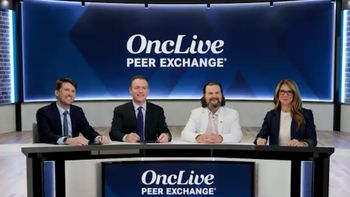
Experts review new Phase 3 DLBCL data, Pola-R-CHP adoption, biomarker testing, and emerging molecular risk groups as bispecific antibodies reshape relapsed care.
Experts review new Phase 3 DLBCL data, Pola-R-CHP adoption, biomarker testing, and emerging molecular risk groups as bispecific antibodies reshape relapsed care.