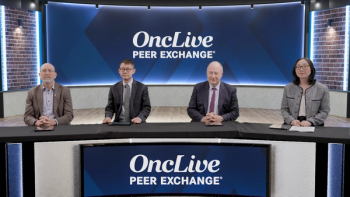
Dr. Hans Lee and Dr. Douglas Sborov discuss how clinicians conceptualize the three major BCMA-directed treatment approaches in relapsed/refractory multiple myeloma: CAR T-cell therapy, bispecific antibodies, and antibody-drug conjugates.

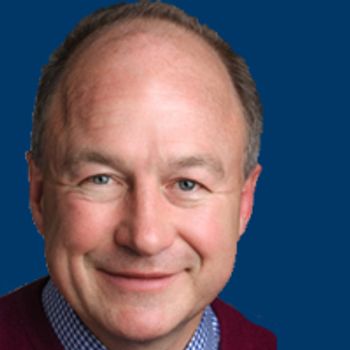
Paul G. Richardson, MD, is the RJ Corman Professor of Medicine at Harvard Medical School and the clinical program leader and director of Clinical Research of the Jerome Lipper Multiple Myeloma Center at Dana-Farber Cancer Institute, both in Boston, Massachusetts.
Dr. Hans Lee and Dr. Douglas Sborov discuss how clinicians conceptualize the three major BCMA-directed treatment approaches in relapsed/refractory multiple myeloma: CAR T-cell therapy, bispecific antibodies, and antibody-drug conjugates.
The discussion opens with an overview of the rapidly evolving treatment landscape in relapsed/refractory multiple myeloma, highlighting the expanding range of BCMA-directed therapeutic approaches.
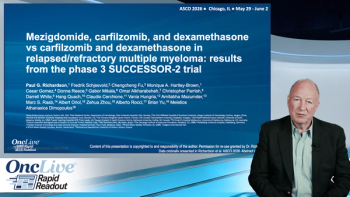
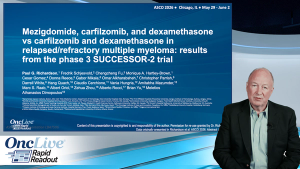
This presentation details results from the phase 3 SUCCESSOR-2 clinical trial evaluating the combination of oral mezigdomide, carfilzomib, and dexamethasone against carfilzomib and dexamethasone alone. The study focused on patients with relapsed or refractory multiple myeloma who had previously been exposed to specific standard therapies. Findings indicate that adding mezigdomide significantly improves progression-free survival across all prespecified patient subgroups while presenting a predictable and manageable safety profile.
Paul G. Richardson, MD, discusses the activity of quadruplet regimens containing daratumumab or isatuximab in patients with 1q-amplified multiple myeloma.
Paul G. Richardson, MD, discusses 2 quadruplet regimens for the treatment of patients with newly diagnosed multiple myeloma and changes in administration.
Paul G. Richardson, MD, discusses the role of triplet regimens as the current standard of care in newly diagnosed multiple myeloma.

Paul G. Richardson, MD, discusses how the continued development of the novel agent mezigdomide could affect the treatment paradigm for patients who progressed on, and developed resistance to, other available BCMA-directed therapies.
Paul G. Richardson, MD, discusses the impact of combining proteasome inhibitors and monoclonal antibodies in multiple myeloma.
Paul G. Richardson, MD, discusses the overall survival benefit displayed by isatuximab plus pomalidomide and dexamethasone in patients with relapsed or refractory multiple myeloma.
Paul G. Richardson, MD, discusses the patient population analyzed in the first-in-human phase 1 trial of the CELMoD CC-92480.
Paul G. Richardson, MD, discusses the mechanism of action of CC-92480 in patients with multiple myeloma.
Paul G. Richardson, MD, discusses phase 1 data (NCT03374085) with CC-92480 in multiple myeloma.
Paul G. Richardson, MD, clinical program leader and director of clinical research, Jerome Lipper Multiple Myeloma Center, and institute physician, Dana-Farber Cancer Institute, and RJ Corman Professor of Medicine at Harvard Medical School, discusses the FDA approval of isatuximab-irfc (Sarclisa) for use in combination with pomalidomide (Pomalyst) and dexamethasone in relapsed/refractory multiple myeloma.
Paul G. Richardson, MD, clinical program leader and director of clinical research, Jerome Lipper Multiple Myeloma Center, and institute physician, Dana-Farber Cancer Institute, and RJ Corman Professor of Medicine at Harvard Medical School, discusses the preliminary data that has been reported with belantamab mafodotin (GSK2857916) in multiple myeloma.
Paul G. Richardson, MD, clinical program leader and director of clinical research, Jerome Lipper Multiple Myeloma Center, and institute physician, Dana-Farber Cancer Institute, discusses interim results of the phase II HORIZON trial in relapsed/refractory multiple myeloma.
Paul G. Richardson, MD, clinical program leader and director of clinical research, Jerome Lipper Multiple Myeloma Center, and institute physician, Dana-Farber Cancer Institute, discusses new directions in multiple myeloma.
While the expansion of therapeutic opportunity in multiple myeloma has been incremental in some ways, it’s been continuous and, when seen in aggregate, the impact is considerable.
Paul G. Richardson, MD, clinical program leader and director of clinical research at the Jerome Lipper Multiple Myeloma Center at Dana-Farber Cancer Institute, discussed the phase III ICARIA-MM trial, which looked at the triplet regimen of isatuximab, pomalidomide (Pomalyst), and dexamethasone in patients with relapsed/refractory multiple myeloma.
Paul G. Richardson, MD, clinical program leader and director of clinical research, Jerome Lipper Multiple Myeloma Center, and institute physician, Dana-Farber Cancer Institute, discusses advances made with immunotherapy in the treatment of patients with relapsed/refractory multiple myeloma.
Paul G. Richardson, MD, clinical program leader, director of clinical research, Jerome Lipper Multiple Myeloma Center, Dana-Farber Cancer Institute, and RJ Corman Professor of Medicine, Harvard Medical School, discusses treatment approaches targeting mutational burden in multiple myeloma.