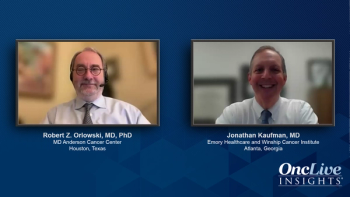
The relapsed/refractory multiple myeloma experts conclude by highlighting current unmet needs in the field and sharing valuable clinical pearls to guide practice and improve patient outcomes.
The relapsed/refractory multiple myeloma experts conclude by highlighting current unmet needs in the field and sharing valuable clinical pearls to guide practice and improve patient outcomes.
The key opinion leaders provide essential insights and recommendations for community oncologists to enhance and optimize treatment strategies for their patients with relapsed/refractory multiple myeloma.
The experts in relapsed/refractory multiple myeloma care outline their treatment sequencing strategies for patients who have already received T-cell engaging therapies.
The panel shares their expert impressions of the case and deliberates on potential treatment strategies for the 53-year-old patient with heavily pre-treated multiple myeloma, considering his prior therapies and current clinical status.
The panel presents and analyzes a case study of a 53-year-old man with heavily pre-treated multiple myeloma, including chemotherapy – based therapy and prior T-cell directed therapy, to illustrate treatment considerations and challenges in advanced disease management.
The panel evaluates selinexor's current role in the treatment landscape for multiple myeloma and explores its potential future applications and evolving significance in therapeutic strategies.
The experts examine the available CAR T-cell therapy options for relapsed/refractory multiple myeloma.
The panelists explore the evolution of treatment approaches for patients with relapsed/refractory multiple myeloma who have undergone 1-3 lines of therapy, with a particular focus on the implications of increased anti-CD38 monoclonal antibody usage in newly diagnosed or early relapse cases.
The key opinion leaders examine selinexor combinations and dosing strategies they currently employ, while also addressing how the frequency of treatment-related adverse events (TRAEs) associated with selinexor varies with lower dosing regimens in the context of managing early relapse multiple myeloma.
A panel of experts in relapsed/refractory multiple myeloma analyzes a patient case, detailing their clinical approach to optimize outcomes for a 68-year-old male presenting with early relapse multiple myeloma.
Key opinion leaders present a clinical patient scenario involving a 68-year-old male patient presenting with early relapse multiple myeloma.
Dr Orlowski discusses key efficacy data from the IMROZ trial of Isa-VRd in newly diagnosed, transplant-ineligible multiple myeloma.
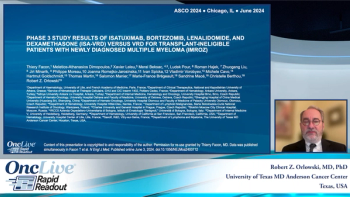
IMROZ (NCT03319667) is the first global Phase 3 study of an anti-CD38 mAb in combination with VRd in patients with transplant-ineligible NDMM.
Robert Z. Orlowski, MD, PhD, Department Chair ad interim, Department of Lymphoma/Myeloma, Division of Cancer Medicine, professor, Florence Maude Thomas Cancer Research Professorship, The University of Texas MD Anderson Cancer Center, discusses the phase III SWOG 0777 study, which examined the addition of bortezomib to lenalidomide and dexamethasone versus lenalidomide and dexamethasone alone in patients with previously untreated multiple myeloma.
September 18th 2024
August 14th 2024
August 14th 2024