
A brief review of prevalent clinical trials in the early-stage HR+ breast cancer paradigm and how they help to inform treatment decision-making.
A brief review of prevalent clinical trials in the early-stage HR+ breast cancer paradigm and how they help to inform treatment decision-making.
Key opinion leaders in breast cancer management discuss Ki67 and the monarchE trial, which analyzed abemaciclib therapy in the HR+ space.

A broad look at the role of Ki67 expression in informing the selection of therapy for patients with early-stage HR+ breast cancer.

Expert panelists share their perspectives on best practices for molecular profiling in patients diagnosed with early-stage breast cancer.
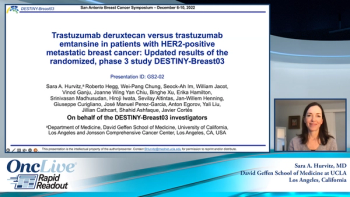
Sara A. Hurvitz, MD, reviews updated data comparing trastuzumab deruxtecan versus trastuzumab emtansine for the treatment of HER2+ metastatic breast cancer.
Sara A. Hurvitz, MD, discusses updated survival data with fam-trastuzumab deruxtecan-nxki in HER2-positive, unresectable/metastatic breast cancer.

Before closing out their conversation on metastatic triple-negative breast cancer, expert oncologists share a few clinical pearls on optimizing TNBC management.
Perspectives on the most prominent unmet needs in metastatic triple-negative breast cancer and how these may be addressed with future clinical trials.
Expert oncologists review novel ADCs in TNBC and consider how their approval may impact sequencing of therapy in this setting.
Comprehensive discussion on the safety and efficacy profile of the antibody-drug conjugate (ADC) sacituzumab govitecan and managing ADC-related adverse events in patients with mTNBC.

Fielding questions from their live audience, Joyce O'Shaughnessy, MD, and Sara Hurvitz, MD, discuss optimal selection of therapy for patients with breast cancer.

Highlights of the results from the DESTINY-Breast03 and HER2CLIMB trials, evaluating T-DXd and tucatinib, respectively, in HER2+ metastatic breast cancer.
Joyce O'Shaughnessy, MD, and Sara Hurvitz, MD, consider how they would approach the treatment of a patient with HER2+ metastatic breast cancer.
Expert perspectives on adjuvant and neoadjuvant use of pembrolizumab in the KEYNOTE-522 study in triple-negative breast cancer.
Following their discussion on the OlympiA and monarchE trials in breast cancer, experts consider when they would use olaparib or abemaciclib in the adjuvant setting.
Shared insight on the monarchE trial, which studied adjuvant abemaciclib in patients with HR+, HER2- high-risk early breast cancer.
Shared insight on specific treatment options in breast cancer made available when patients are found to have actionable targets via molecular testing.
Expert perspectives on platforms for molecular testing in breast cancer, as well as the actionable targets that treating physicians should be looking for.

Patrick Neven MD, PhD; Sara A. Hurvitz, MD; Kevin Kalinsky, MD, MS; and Aditya Bardia, MD, MPH, share insight on updates in key clinical trials and novel therapies in breast cancer presented at SABCS 2021.
Sara A. Hurvitz, MD; Aditya Bardia, MD, MPH; Patrick Neven, MD, PhD; and Kevin Kalinsky MD, MS, discuss SABCS 2021 updates on the use of CDK4/6 inhibitors in HR+/HER2 breast cancer.
Experts in the management of breast cancer review recent data on SERDs (selective estrogen receptor degraders) in ER+/HER2 advanced breast cancer presented at SABCS [San Antonio Breast Cancer Symposium] 2021.

Sara A. Hurvitz, MD, discusses the rationale for the phase 3 DESTINY-Breast03 trial examining in HER2-positive breast cancer.
Various breast oncologists discuss the potential effect of treatment advances in hormone receptor-positive metastatic breast cancer.
An overview of key presentations from ESMO 2021 that continues studying the potential effect of novel-based treatment options for use in hormone receptor-positive metastatic breast cancer.
The relevance of PIK3CA mutations in terms of the pathophysiology of HR-positive metastatic breast cancer, and lessons learned in practice and via clinical studies in terms of sequencing therapy with PI3K inhibitors.
The rationale for conducting a post-hoc analysis of palbociclib plus endocrine therapy on time to chemotherapy across subgroups of patients with hormone receptor-positive metastatic breast cancer as presented at ESMO 2021.
Clinical implications of a pooled analysis of endocrine therapy-naïve participants in MONARCH 2 investigating the use of abemaciclib plus fulvestrant to treat hormone receptor-positive metastatic breast cancer.

Drs Joyce O’Shaughnessy, Sara Tolaney, Sara Hurvitz, and Mark Pegram examine recent trial data from ESMO 2021 on triple-negative breast cancer.
Options available as first-line therapy for HR+ metastatic breast cancer and variables that impact which CDK4/6 inhibitor and endocrine partner is selected for a patient.
Breast oncologists explain results from the phase III MONALEESA-2 trial presented at ESMO 2021, and its clinical implications.