



Breast Cancer
Latest News
Advertisement
Latest Videos





































































Advertisement
More News

The evolving treatment landscape across breast cancer has escalated the need for the accuracy of sentinel lymph node biopsies following treatment with neoadjuvant chemotherapy to correctly inform subsequent treatment decisions for patients.

Joyce O’Shaughnessy, MD, highlights key data from the 2022 San Antonio Breast Cancer Symposium, explains how trastuzumab deruxtecan and CDK4/6 inhibitors are altering the treatment landscape, and discusses novel data on steroid receptor expression in triple-negative breast cancer.

Daniel Rotroff, PhD, discusses the investigation of biomarkers that could help identify patients with breast cancer who are at risk for developing chemotherapy-induced peripheral neuropathy.

Natasha B Hunter, MD, discusses the utility of 18F-Fluoroestradiol PET imaging for patients with estrogen receptor–positive and HER2-positive breast cancer.

Frank A. Vicini, MD, discusses the potential utility of using the DCISionRT test to determine treatment benefit in the phase 3 NRG-NSABP-B43 trial in HER2-positive ductal carcinoma in situ of the breast.

Sasha Stanton, MD, discusses efforts to improve the responses to immunotherapy regimens in early-stage hormone receptor–positive breast cancer.
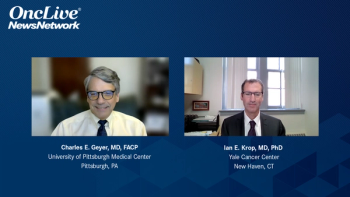
Dr Krop leads a discussion of results from the DESTINY-Breast02 and DESTINY-Breast03 studies concerning the use of trastuzumab deruxtecan in patients with metastatic breast cancer.
Charles E. Geyer, MD and Ian E. Krop, MD, PhD touch on recent advances in the metastatic HR+ breast cancer setting and evaluate PROTAC estrogen receptor (ER) degraders compared with other ER modulators.
Drs Goetz and Choong discuss the potential for adjuvant endocrine therapy omission in patients with estrogen receptor–positive breast cancer who have a pathologic complete response to neoadjuvant chemotherapy.

Andrew McKenzie, PhD, discusses biomarkers to test for in breast and lung cancers, the value of multicancer early detection, and how biomarker testing can better direct targeted treatment across solid tumors.
Detailed clinical insights on the use of adjuvant therapy plus abemaciclib in patients with high-risk, early stage HR+ breast cancer.
Using the monarchE trial as a benchmark, experts in oncology discuss the use of abemaciclib with adjuvant endocrine therapy in patients with high-risk, early stage HR+ breast cancer.

Joyce A. O’Shaughnessy, MD, discusses key data from the phase 3 DESTINY-Breast02 and DESTINY-Breast03 trials in metastatic HER2-positive breast cancer.

A review of the standard of care regimens for the preoperative or neoadjuvant treatment of HER2+ early breast cancer.
Virginia Borges, MD, explains how common HER2+ early breast cancer is and the goals of treatment for patients.

Ajay Dhakal, MBBS, discusses the two key trials supporting the use of pertuzumab as a standard-of-care regimen in HER2-positive breast cancer.
Joyce A. O’Shaughnessy, MD, discusses key results from the phase 3 EMERALD trial of elacestrant, and the potential effects of the agent’s approval on the use of oral selective estrogen receptor degraders for hormone receptor–positive, HER2-negative breast cancer.

Jose Javier Bravo-Cordero, MD, discusses the role of extracellular matrix proteomics and disseminating tumor cells when regulating the tumor microenvironment to induce dormancy in breast cancer.
Conversation centered around the clinical implications of recently presented data from the randomized, multi-dose phase II SERENA-2 trial.
Dr Geyer and Dr Krop explore data from the OlympiA phase III trial of adjuvant olaparib in patients with variants in BRCA1/2.

Virginia F. Borges, MD, MMSc, and colleagues highlight updates across the breast cancer landscape, including key updates from the 2022 SABCS.
Dr Giacchetti discusses the findings from a study of patient-selected timing of the daily oral intake of adjuvant hormone therapy and everolimus in breast cancer and how this study highlights the need for further research combining the fields of chronobiology and oncology.
Expert oncologists offer their initial impressions of a profile of a 56-year-old woman with early stage, HR+ breast cancer.
Sara Tolaney, MD, MPH, and Massimo Cristofanilli, MD, discuss factors that affect risk stratification of patients with HR+, HER2- breast cancer.

Ruth M. O’Regan, MD, discusses the significance of the Breast Cancer Index as a prognostic tool, as well as the investigation of the phase 3 SOFT trial for patients with early-stage, hormone receptor-positive breast cancer.
Advertisement
Advertisement
Trending on OncLive
1
FDA Approves Tucatinib Plus Trastuzumab/Pertuzumab as First-Line Maintenance in Advanced HER2+ Breast Cancer
2
FDA Grants Breakthrough Device Designation to Natera’s Multi-Cancer Early Detection Assay
3
Iberdomide Plus Daratumumab/Dexamethasone Yields Significant PFS Benefit in R/R Myeloma
4
VIR-5500 Receives FDA Fast Track Designation in mCRPC
5