
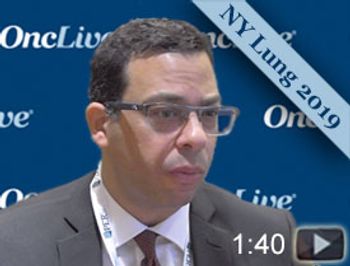
Nasser H. Hanna, MD, discusses challenges in consolation immunotherapy for patients with lung cancer.
Nasser H. Hanna, MD, discusses challenges in consolation immunotherapy for patients with lung cancer.
Neoadjuvant immunotherapy can offer promise to patients with resectable non–small cell lung cancer, but further investigation is required for optimal use, Tina Cascone, MD, PhD, said in a presentation during the 14th Annual New York Lung Cancers Symposium®.

Based on efficacy, tolerability, and practicality, neoadjuvant therapy in lung cancer offers significant advantages over adjuvant treatment, said Jamie E. Chaft, MD, in a presentation during the 14th Annual New York Lung Cancers Symposium®. However, she added, adjuvant treatment predominantly remains the standard of care at many cancer centers, she said.
Benjamin P. Levy, MD, discusses therapeutic strategies for patients with oncogenic-driven and nondriver non–small cell lung cancer.
There is limited data on when and whether oncologists should change systemic therapy for patients with non–small cell lung cancer, but some studies provide useful guidance.
In light of recent advancements, the current paradigm for choosing first-line therapy for patients with metastatic non–small cell lung cancer who do not harbor an actionable driver oncogene depends upon PD-L1 expression level and histology.
Roy S. Herbst, MD, PhD, discusses where future research is headed for immunotherapy in lung cancer.

Nasser Hanna, MD, Tom and Julie Wood Family Foundation Professor of Lung Cancer Clinical Research, at Indiana University Melvin and Bren Simon Cancer Center, discusses the efficacy of consolidation immunotherapy in patients with stage III non–small cell lung cancer.
Roy S. Herbst, MD, PhD, chief of medical oncology, professor of medicine, Yale Cancer Center, Smilow Cancer Hospital, discusses mechanisms of immune resistance for patients with lung cancer.
Although driver mutations have been identified for significant NSCLC subsets, patients with metastatic disease benefit from broad panel next-generation sequencing testing because of the growing clinical relevance of less common alterations and gene signatures.
Roman Perez-Soler, MD, chairman of the Department of Oncology and chief of the Division of Medical Oncology at Montefiore Medical Center, discusses the efficiency of next-generation sequencing in lung cancer.
D. Ross Camidge, MD, PhD, discusses the crowded landscape of oncogene-driven non­–small cell lung cancer.
Hossein Borghaei, DO, chief, Division of Thoracic Medical Oncology, director, Lung Cancer Risk Assessment, associate professor, Department of Hematology/Oncology, Fox Chase Cancer Center, discusses the evolving second line of treatment in small cell lung cancer.
Mark G. Kris, MD, medical oncologist, William and Joy Ruane Chair in Thoracic Oncology, Memorial Sloan Kettering Cancer Center, discusses adjuvant systemic therapy in patients with non–small cell lung cancer.
D. Ross Camidge, MD, PhD, director of thoracic oncology, University of Colorado, discusses optimal treatment regimens for patients with EGFR-positive non–small cell lung cancer.
Balazs Halmos, MD, MS, discusses overcoming acquired resistance and other next steps needed to advance the oncogene-driven non–small cell lung cancer paradigm.
Hossein Borghaei, DO, MS, discusses current and potential therapeutic approaches for patients with non-oncogene driven lung cancer who progress on frontline treatment.
Alexander E. Drilon, MD, discusses developing markers in the non–small cell lung cancer paradigm.
Mark G. Kris, MD, medical oncologist, Memorial Sloan Kettering Cancer Center, discusses challenges associated with sequencing in the treatment of patients with lung cancer.
Immunotherapy continues to revolutionize the field of non–small cell lung cancer, with researchers now focusing on the optimal use of immune agents in the frontline setting.
Hossein Borghaei, DO, discuss what lies ahead for immunotherapy in lung cancer, and what changes may be on the horizon for such agents as pembrolizumab (Keytruda), nivolumab (Opdivo), and ipilimumab (Yervoy) in the frontline setting.
Standard of care for newly diagnosed non-small cell lung cancer is shifting to include PD-L1 expression to determine the appropriate treatment plan, says Matthew D. Hellmann, MD.
Balazs Halmos, MD, director, Thoracic Oncology, director, Clinical Cancer Genomics, Montefiore Medical Center, discusses the prevalence of MET mutations in patients with non–small cell lung cancer (NSCLC).
H. Jack West, MD, a thoracic oncologist of Swedish Cancer Institute at Swedish Medical Center, discusses factors he takes into consideration for EGFR tyrosine kinase inhibitors in patients who have EGFR-positive non–small cell lung cancer (NSCLC).

Individualizing frontline therapy for patients with non–small cell lung cancer based on preferences and clinical experience, as well as efficacy and safety data from pivotal trials, is an appropriate method for selecting EGFR-targeted agents.
The treatment landscape for patients with ALK-rearranged non–small cell lung cancer is changing rapidly, gearing up the potential for more therapeutic options to address the heterogeneity of the mechanism of resistance in this population.
Roman Perez-Soler, MD, chairman of the Department of Oncology and chief of the Division of Medical Oncology at Montefiore Medical Center, Albert Einstein College of Medicine of Yeshiva University, discusses the impact of osimertinib (Tagrisso) on patients with T790M-positive non–small cell lung cancer (NSCLC).
Anne Chiang, MD, PhD, professor and thoracic oncologist at Yale Cancer Center, discusses molecular testing in lung cancer and how it affects treatment decisions.
Lung cancer treatment has undergone a game-changing transformation within the past few years, with a burst of FDA approvals of targeted agents and immunotherapies across a number of indications.
Geoffrey R. Oxnard, MD, Assistant Professor of Medicine, Harvard Medical School, Dana Farber Cancer Institute, discusses how to define resistance to EGFR-inhibitors in lung cancer.